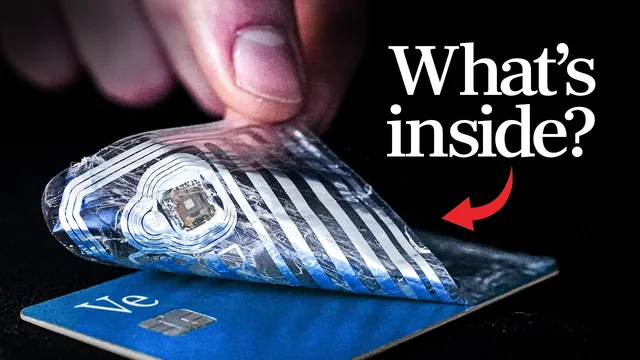
The Secret Spy Tech Inside Every Credit Card
Based on Veritasium's video on YouTube. If you like this content, support the original creators by watching, liking and subscribing to their content.
Passive eavesdropping devices can be nearly invisible to sweeps when they contain no battery or active power source, relying instead on resonance to amplify returned signals.
Briefing
Credit cards hide a chain of radio and magnetic tricks that make payments fast—but each layer also creates a new attack surface. The core finding is that modern “tap to pay” security depends less on secrecy of the card number and more on cryptographic keys and transaction limits; when those assumptions fail (through proximity attacks like ghost tapping or through stolen credentials like CVV), fraud becomes possible in ways that look like magic.
The story begins with Cold War eavesdropping. In the early 1950s, Soviet listening devices were found only after radio signals were traced to a plaque containing a passive “bug” with no battery. The Soviets exploited resonance: radio waves near a tuned frequency induced oscillations in an antenna, and a resonant cavity amplified the returned signal. To carry speech, the bug used amplitude modulation—sound vibrations changed a diaphragm’s capacitance, shifting the resonant behavior and imprinting the conversation onto the radio return. The Americans later reverse-engineered the concept, but found the original approach too sensitive to environmental changes, so they pivoted to powering electronics with radio energy (rectifiers) and modulating a return signal—an idea that foreshadows later RFID systems.
That spy lineage meets consumer finance in the evolution from magnetic stripes to chips and then to contactless. Magnetic stripe cards stored data statically, which made them quick to read but also easy to clone: dust or filings could be used to reproduce the same encoded pattern, enabling skimmers and “grabbers” that harvested thousands of card numbers. As fraud surged, the industry adopted EMV chip technology. Chips act like mini computers that generate a fresh, transaction-specific encrypted response using secret keys shared with the issuing bank. Because the secret key never leaves the chip in usable form, cloning becomes impractical, and each transaction’s unique code blocks replay attacks.
Chip-and-PIN reduced counterfeit fraud dramatically, but it introduced friction: transactions took longer, and the system’s speed became a business concern. That pressure helped drive near-field communication (NFC), which uses magnetic fields rather than long-range radio so cards don’t trigger payments from meters away. NFC cards still rely on the same general cryptographic principle as EMV, and the transcript notes that simply reading card data from an NFC card is far less useful for fraud than cloning or stealing the missing pieces like the CVV.
Yet contactless introduces a different threat model: digital pickpocketing, or “ghost tapping,” where a malicious reader repeatedly charges small amounts while staying within a victim’s pocket range. The transcript highlights that limits per tap vary by country (the UK limit grows over time; the US has no such cap per transaction), meaning repeated taps could add up quickly. Practical defenses include using a Faraday cage wallet, spacing cards to reduce readability, enabling payment notifications, and—where possible—moving cards into mobile wallets that avoid storing real card numbers on the phone.
The segment closes by teeing up a more direct test of contactless security—attempting to steal $10,000 from a locked iPhone using a standard payment terminal—underscoring that the biggest vulnerabilities often come from how real-world systems are used, not just how the cryptography is designed.
Cornell Notes
Credit card security evolved from magnetic stripes to chips and then to contactless NFC, and each step changed what attackers can realistically do. Magnetic stripes were easy to clone because they store data statically, enabling skimmers and “grabbers” to harvest card numbers. EMV chips act like mini computers that generate a unique encrypted response per transaction using secret keys, making cloning and replay far harder. NFC contactless payments use near-field magnetic coupling to keep range short, and the transcript emphasizes that reading card details is less useful than cloning or obtaining the CVV. The main contactless risk discussed is “ghost tapping,” where repeated small charges can accumulate if the attacker stays within pocket range and exploits per-tap limits (or lack of them).
Why was the Soviet “bug” hard to detect, and how did it carry speech without a battery?
What made magnetic stripe cards vulnerable to cloning?
How do EMV chips stop replay and cloning compared with magnetic stripes?
Why did contactless NFC use magnetic fields instead of long-range radio?
What is “ghost tapping,” and why do transaction limits matter?
Review Questions
- How does resonance-based modulation in passive spy bugs relate conceptually to how RFID/NFC systems transfer information without a battery?
- Compare the attacker’s options against magnetic stripes versus EMV chips: what changes about cloning feasibility and what remains possible?
- In a ghost-tapping scenario, which system design choices (range, per-tap limits, notifications) most strongly determine the attacker’s payoff?
Key Points
- 1
Passive eavesdropping devices can be nearly invisible to sweeps when they contain no battery or active power source, relying instead on resonance to amplify returned signals.
- 2
Magnetic stripe fraud scaled because the stripe encodes data statically, making cloning and repeated use straightforward before banks detected anomalies.
- 3
EMV chip transactions generate unique encrypted responses using secret keys, making replay attacks and practical cloning far harder than with magnetic stripes.
- 4
NFC contactless payments deliberately limit range by using near-field magnetic coupling rather than long-range radio, reducing accidental triggers.
- 5
Contactless fraud risk shifts from cloning to proximity-based attacks like ghost tapping, where repeated small charges can accumulate depending on per-tap limits.
- 6
Enabling payment notifications and using mobile wallets can reduce harm by enabling rapid detection and by avoiding storage of real card numbers on the device.
- 7
Physical mitigations like Faraday cage wallets and spacing cards can reduce the chance that an attacker’s reader can successfully capture data from a pocket.