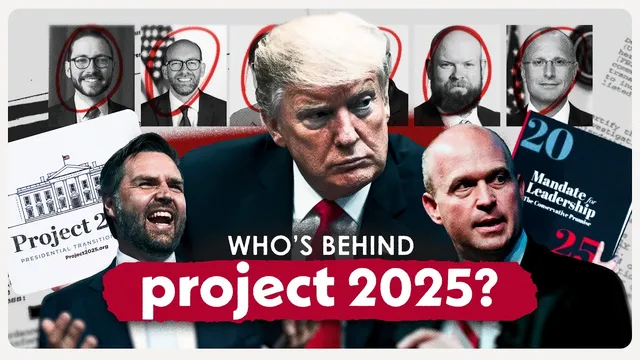
The Shady Group Behind Project 2025
Based on Second Thought's video on YouTube. If you like this content, support the original creators by watching, liking and subscribing to their content.
Project 2025 is described as a 920-page conservative plan aimed at rapid, day-one implementation after a conservative president takes office.
Briefing
Project 2025 is a 920-page conservative blueprint for a future Republican administration, laying out steps to expand presidential power, weaken or “kneecap” regulatory institutions, carry out mass deportations, restrict voting and abortion access, roll back transgender rights, and increase surveillance. It also calls for rapid implementation—effectively having the machinery ready to execute on day one after a conservative president takes office. The central concern raised is not just the policy agenda itself, but the network behind it: the Heritage Foundation, a conservative think tank that has functioned less like a neutral research shop and more like an advocacy engine.
Heritage’s influence is portrayed as long-running and unusually coordinated. The transcript links Heritage to Trump’s orbit through multiple points of overlap: Trump speeches praising Heritage, leaked training materials for Project 2025 featuring many people with Trump ties, and claims that earlier “mandate” documents were substantially adopted during Trump’s first term. The Heritage Foundation is described as a think tank that evolved into a highly strategic organization designed to produce predetermined policy outcomes quickly—then market those outcomes aggressively to policymakers and the public.
To explain how Heritage became so effective, the transcript traces its origins to 1973, when Paul Weyrich and Edwin Feulner founded the organization with seed funding from Joseph Coors. It then places Heritage’s rise in the broader political shift of the late 1960s and 1970s: as the federal government expanded and labor protections and social programs grew, business leaders became anxious about losing influence. In that environment, corporate interests sought conservative policy research that could counter regulation and labor gains.
Heritage’s strategy is described as a departure from traditional think-tank models. Instead of granting researchers independence or focusing on deep, slow analysis, Heritage allegedly kept staff “on a tight leash,” aimed for specific conservative conclusions from the start, and produced short, recommendation-heavy reports designed to be read quickly—summarized through a “briefcase test.” The organization also invested heavily in marketing and mobilization, building a large activist network through Heritage Action, with tens of thousands of people ready to contact representatives and amplify talking points.
The transcript argues that this approach paid off when Ronald Reagan took office. In January 1981, Heritage published “Mandate for Leadership,” a detailed set of department-by-department recommendations. The transcript claims Reagan distributed the document to cabinet members and later implemented a large share of it during his first term. From there, Heritage’s ties to Republican administrations and corporate donors are presented as durable, even as funding has become harder to trace.
A major emphasis is on “dark money” structures. The transcript claims that donor-advised funds—managed by third-party financial institutions—can route money to organizations like Heritage with reduced transparency, and it cites estimates of large assets held in such funds. It also points to past email leaks involving donations tied to defense contracting interests, suggesting that policy outputs can align with corporate profit incentives.
Finally, the transcript frames Project 2025’s long-term goal as incremental power transfer: dismantling progressive coalitions, restoring business influence at the top of the policy agenda, and reducing democratic accountability. It portrays the plan as a methodical process rather than a dramatic political rupture, with Heritage and Project 2025 personnel working on “plans to take control of bureaucracies,” backed by corporate and anonymous funding streams. The takeaway is that Project 2025’s policy proposals are inseparable from the organizational and financial infrastructure designed to make them stick.
Cornell Notes
Project 2025 is presented as a detailed conservative governing plan—about 920 pages—aimed at rapidly expanding presidential authority, weakening regulatory institutions, restricting voting and abortion access, rolling back trans rights, and increasing surveillance. The transcript argues that its real leverage comes from the Heritage Foundation, which has operated less like a neutral think tank and more like a coordinated advocacy and mobilization machine. Heritage’s methods are described as fast, recommendation-driven outputs (“briefcase” reports), tight internal coordination, and heavy marketing plus activist infrastructure through Heritage Action. The transcript also highlights funding opacity, including donor-advised funds that can channel large sums with limited transparency. The significance: policy outcomes are linked to organizational strategy and financial pathways, not just election-day promises.
What does Project 2025 propose doing once a conservative president takes office?
Why does the transcript treat the Heritage Foundation as central to Project 2025’s influence?
How does Heritage’s operating style differ from a traditional think tank model?
What historical and political pressures does the transcript cite as the reason Heritage emerged and grew?
What role do donor-advised funds and “dark money” play in the transcript’s account of Heritage’s influence?
How does the transcript connect Heritage’s strategy to real-world policy implementation under Reagan?
Review Questions
- How does the transcript distinguish Heritage Foundation from other think tanks in terms of goals, speed, and public influence?
- Which specific policy areas does Project 2025 target, and how are those connected to the transcript’s description of expanded presidential and surveillance power?
- What mechanisms does the transcript cite to explain how funding influence can become harder to trace (and why that matters)?
Key Points
- 1
Project 2025 is described as a 920-page conservative plan aimed at rapid, day-one implementation after a conservative president takes office.
- 2
The plan’s recommendations include expanding presidential power, weakening regulatory institutions, restricting voting and abortion access, rolling back trans rights, and increasing surveillance.
- 3
The Heritage Foundation is portrayed as the organizational engine behind Project 2025’s influence, with personnel overlap and long-term ties to Republican administrations.
- 4
Heritage’s approach is characterized as fast, recommendation-driven, and tightly coordinated—using short reports designed for quick consumption by policymakers.
- 5
The transcript claims Heritage invests heavily in marketing and mobilization through Heritage Action, building an activist network that can pressure representatives and amplify messaging.
- 6
Funding opacity is highlighted through donor-advised funds, which can route large donations with reduced transparency.
- 7
The transcript frames the broader strategy as incremental power transfer—dismantling progressive coalitions and shifting policy control toward business interests and conservative governance.