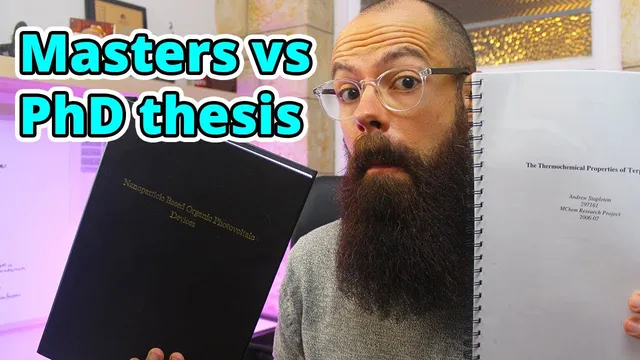
The Simplest Breakdown: Masters and PhD Theses
Based on Andy Stapleton's video on YouTube. If you like this content, support the original creators by watching, liking and subscribing to their content.
PhD theses are expected to answer an original research question and generate knowledge that can be published in peer-reviewed journals.
Briefing
A PhD thesis and a master’s thesis can look similar on paper, but they diverge sharply in what counts as “new,” who evaluates the work, and how the finished document is treated—both academically and personally. The biggest functional difference is originality: PhD research is expected to answer an original research question and generate knowledge that can be published in peer-reviewed journals. Master’s theses often build on existing results, extending known techniques, materials, or methods—where the novelty may come from combining two established ideas in a new way rather than creating entirely new knowledge.
That distinction shows up in evaluation. Master’s theses are typically assessed internally, with university staff checking whether the candidate has met the required criteria. In the example described, the master’s thesis stayed within the university and was reviewed by the people who needed to sign off; once it was deemed “big enough and boring enough” for the workload level, the process effectively ended there.
PhD theses, by contrast, are examined more rigorously and externally. The described PhD was sent to multiple external examiners—three in total, including one in Germany and one in the United States—after which the candidate received a decision that the thesis deserved the PhD. The external reviewers, positioned as field experts, assessed whether the work produced novel, interesting research knowledge that advanced the area of study. One examiner even recommended publication, signaling that the thesis results were not just adequate for a degree but meaningful enough for the wider research community.
Revisions also separate the two paths. Minor revisions—typos, small errors, and low-level academic “jousting”—can be required before submission, and the thesis may not need to return to the same external reviewers if changes satisfy internal checks. Major changes, however, can trigger a second round of scrutiny, and in extreme cases a PhD can be downgraded to a master’s if the reviewers conclude the candidate did not generate sufficiently novel contributions.
Length matters, but depth matters more. The PhD described runs to 229 pages, while the master’s is around 50–60 pages; thickness signals effort, yet the more important difference is how deeply the work is analyzed and how thoroughly the candidate engages with the field. A master’s may function as an extension project—using known techniques on new molecules or materials—while a PhD requires a deeper “deep dive” into the ins and outs, including what went wrong, what went right, and what can be extracted from each figure. The thesis becomes a record of sustained reasoning across years, not just a report of results.
Finally, the emotional weight differs. The master’s thesis is characterized as a procedural milestone—challenging, but ultimately a box to tick. The PhD thesis is portrayed as a life-defining achievement: something the candidate revisits through acknowledgements, memories of lab setbacks and breakthroughs, and a sense that the document represents a substantial portion of their identity and growth. In the account given, that personal pride is the “no contest” difference once the degrees are completed.
Cornell Notes
PhD theses are expected to create genuinely new knowledge by answering an original research question, often with results publishable in peer-reviewed journals. Master’s theses more commonly extend existing work: the techniques and materials may already be known, and the novelty can come from combining known elements in a new overlap. Evaluation also differs—master’s work is usually assessed internally, while PhD work is typically reviewed by external experts who judge whether the contribution is novel enough to advance the field. The PhD process can involve multiple rounds of revisions, and insufficient novelty can even lead to a downgrade. Beyond logistics, the PhD thesis is described as emotionally heavier because it represents years of lab life and personal investment.
What makes a PhD thesis different from a master’s thesis in terms of “new knowledge”?
How does the evaluation process typically differ between master’s and PhD theses?
What role do revisions play, and when do theses return to external reviewers?
Why does thesis length not fully determine academic value?
How does the emotional experience of completing a master’s thesis compare with completing a PhD thesis?
What can happen if a PhD thesis doesn’t convince reviewers about novelty?
Review Questions
- How do originality and publishability expectations differ between PhD and master’s theses?
- What evaluation differences (internal vs external) influence how novelty is judged?
- Why is depth of analysis considered more important than page count when comparing thesis quality?
Key Points
- 1
PhD theses are expected to answer an original research question and generate knowledge that can be published in peer-reviewed journals.
- 2
Master’s theses often extend existing work, with novelty arising from new applications or overlaps of known techniques and materials.
- 3
Master’s theses are typically assessed internally, while PhD theses are commonly reviewed by external experts in the field.
- 4
Minor revisions may be handled without returning to external reviewers, but major revisions can trigger re-review when concerns remain.
- 5
Page count is a weak proxy for quality; depth of analysis and engagement with results and limitations matters more.
- 6
Insufficient evidence of novelty can lead to serious consequences, including potential downgrades from PhD to master’s.
- 7
The personal meaning of a PhD thesis is often described as more identity-defining because it represents years of lab life and sustained effort.