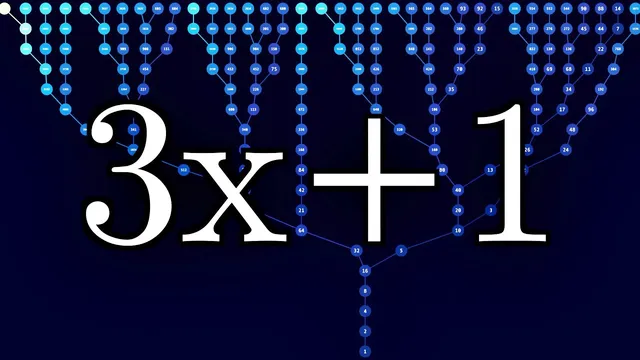
The Simplest Math Problem No One Can Solve - Collatz Conjecture
Based on Veritasium's video on YouTube. If you like this content, support the original creators by watching, liking and subscribing to their content.
Collatz (3x+1) applies n → 3n+1 when n is odd and n → n/2 when n is even, and the conjecture claims every positive starting value eventually reaches the loop 4 → 2 → 1.
Briefing
The Collatz conjecture—also known as 3x+1, the Syracuse problem, and several other names—asks whether repeatedly applying two simple rules to any positive integer always eventually lands in the loop 4 → 2 → 1. Despite the problem’s elementary setup, no one has proved the claim for all starting values, and mathematicians treat it as a rare example of a question that is easy to state but stubbornly hard to resolve. Its importance is partly cultural—Erdős reportedly warned that mathematics wasn’t “ripe” enough for questions like this—and partly technical, because progress has required blending number theory with probabilistic reasoning, computation, and dynamical systems.
The rules are straightforward: if the current number is odd, replace it with 3n + 1; if it’s even, divide by 2. Starting from 7, the sequence eventually falls into the 4-2-1 loop after a long chain of ups and downs. The behavior varies wildly: 27 rockets up to 9,232 before descending, taking 111 steps to reach the loop. These “hailstone numbers” are named for their bounce-like trajectories. Even adjacent starting values can diverge dramatically, which makes pattern-hunting difficult.
Why does the conjecture seem plausible at all? One reason is that the process has a built-in bias toward shrinking. Although odd numbers get multiplied by 3, they are immediately followed by an even number and then a division by 2. More carefully, the path from one odd number to the next odd number behaves like multiplying by about 3/2, but with frequent extra halvings: sometimes the next odd appears after dividing by 2 once (a factor near 3/4 overall), sometimes after dividing by 4 (near 3/8), and so on. Using a geometric-mean argument, the average multiplicative effect from one odd to the next is less than 1, suggesting that typical trajectories should drift downward.
Another line of evidence comes from computation. Every starting value up to 2^68 has been checked, roughly 295 quintillion cases, and none escapes the 4-2-1 loop. If a different loop existed, calculations indicate it would have to be enormous—at least 186 billion numbers long. Yet brute force can’t settle the conjecture, because a counterexample could be astronomically large and effectively impossible to “guess” without a guiding principle.
Mathematicians have also proved weaker “almost all” results. Riho Terras showed in 1976 that almost all sequences dip below their starting value; later work tightened the bound, and in 2019 Terry Tao proved that almost every starting number eventually reaches values below any slowly growing function f(x) that still tends to infinity. Tao described this as close to the conjecture without actually solving it. The gap remains crucial: “almost all” can be true even when infinitely many exceptional cases exist.
The transcript also highlights why proof is so elusive. A single divergent trajectory to infinity or a closed loop disconnected from 4-2-1 would refute the conjecture, but no such structure has been found. The problem’s complexity is underscored by the fact that negative integers behave differently, producing three independent loops rather than just one. Finally, there’s a philosophical edge: generalizations like John Conway’s FRACTRAN are Turing-complete and tied to the halting problem, raising the possibility that Collatz might be undecidable with current methods. In the meantime, the conjecture remains a benchmark for how far mathematics can go with a rule set that fits on a chalkboard.
Cornell Notes
Collatz (3x+1) starts with any positive integer and repeatedly applies: if odd, map n → 3n+1; if even, map n → n/2. The conjecture claims every starting value eventually reaches the unique loop 4 → 2 → 1. Evidence includes a strong “downward drift” argument: odd numbers lead to even numbers that are then halved, and the average effect from one odd to the next is less than 1. Computation has verified all starting values up to 2^68 (about 295 quintillion) without finding a counterexample. Partial results by Riho Terras and especially Terry Tao show that “almost all” sequences eventually fall below arbitrarily slowly growing thresholds, but that still doesn’t prove the claim for every single starting value.
What exactly is the Collatz conjecture, and what does it mean for a sequence to “end up” in the 4-2-1 loop?
Why does the process look like it should grow, and what mechanism actually biases it toward shrinking?
How much has brute-force computation verified, and what does that verification not guarantee?
What do “almost all” results mean in this context, and why don’t they settle the conjecture?
How does the behavior differ for negative integers, and why is that surprising?
What role does the idea of undecidability or Turing completeness play in the discussion?
Review Questions
- What is the average-effect argument that makes 3x+1 seem more likely to shrink than grow, and how does it use the behavior between odd terms?
- Why does verifying all starting values up to 2^68 still leave the conjecture unresolved?
- What does Terry Tao’s “almost all” theorem guarantee, and what specific gap remains compared with proving the conjecture for every starting value?
Key Points
- 1
Collatz (3x+1) applies n → 3n+1 when n is odd and n → n/2 when n is even, and the conjecture claims every positive starting value eventually reaches the loop 4 → 2 → 1.
- 2
Despite occasional large climbs (like 27 reaching 9,232), the process shows a statistical downward drift because odd steps force an even number followed by at least one halving.
- 3
A geometric-mean argument tracks how often sequences divide by 2, 4, 8, and so on before reaching the next odd term, yielding an average factor less than 1 from odd to odd.
- 4
Brute-force verification has confirmed the conjecture for all starting values up to 2^68 (about 295 quintillion), but that cannot rule out counterexamples beyond that range.
- 5
Riho Terras and later results proved that “almost all” sequences eventually fall below their starting value or below arbitrarily slowly growing thresholds, but “almost all” still allows exceptional cases.
- 6
Negative integers behave differently: the same rules produce three independent loops (including ones starting at -17 and -5), unlike the single known positive loop.
- 7
The discussion raises the possibility that Collatz-like systems could be undecidable in principle, drawing an analogy to Turing-complete generalizations such as Conway’s FRACTRAN.