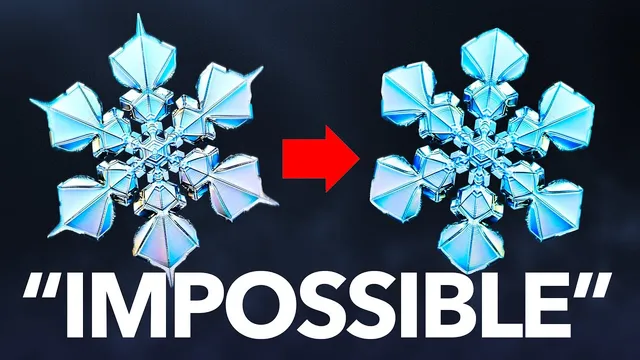
The Snowflake Myth
Based on Veritasium's video on YouTube. If you like this content, support the original creators by watching, liking and subscribing to their content.
Snowflake shapes emerge from controlled growth conditions that steer which facets (basal vs prism) can add new layers fastest.
Briefing
Snowflakes aren’t “designed” by a hidden blueprint—they’re shaped by a chain of molecular rules that turns tiny differences in temperature and humidity into radically different ice architectures. The central claim tying the lab demonstrations to decades of snow-crystal research is that the same hexagonal ice starting point can grow into plates or columns depending on which crystal facets can more easily add new layers, and that subtle facet geometry can even explain why the pattern flips back and forth across temperature ranges.
The discussion begins with hands-on control of growth conditions. In a lab setup, Ken Libbrecht grows ice crystals on a sapphire substrate while adjusting temperature and humidity (super-saturation). Small changes—like shifting from -13 Celsius to -15 Celsius or raising and lowering humidity—steer growth toward branches, then toward faceting, then toward side branches again. The process hinges on how droplets form and recede: moisture encourages branching, while drying pushes the crystal toward sharper, faceted edges. Libbrecht also emphasizes that his crystals can be “designed” by hand without full computer automation, producing repeatable outcomes that are still distinct.
That control matters because snowflakes look like they should be governed by symmetry and individuality at once. The transcript contrasts the iconic, highly symmetric snowflakes popularized by Wilson A. Bentley—who photographed thousands of crystals and selected the most pristine examples—with the broader reality: snowflakes can be hollow columns, needles, cups, bullets, and capped columns. The variety isn’t an exception; it’s the norm. Yet the six-fold radial symmetry persists because both sides of a single crystal experience the same growth conditions. The “no two are alike” idea is framed as a consequence of complexity: once growth follows a unique path through changing atmospheric conditions, the resulting crystal becomes effectively one-of-a-kind.
At the molecular level, the mechanism starts with water vapor becoming super-saturated, condensing onto dust particles, and then freezing when a droplet nucleates. The frozen structure forms a hexagonal lattice because of hydrogen bonding in water’s polar molecules. From that lattice to visible geometry comes down to facet growth rates: smooth facet surfaces tend to repel incoming molecules, while rough surfaces with dangling bonds capture them more readily. This statistical sticking difference yields faceted shapes—basal facets and prism facets of a hexagonal prism.
The key switch between plates and columns is which facets grow faster. If prism facets outpace basal facets, the result trends toward flat plates; if basal facets grow faster, columns emerge. This is where the Nakaya Diagram enters: temperature and super-saturation map out which forms dominate, with plates around about -2 Celsius, columns and needles around -5 Celsius, and plates again near -15 Celsius before columns and plates reappear at colder temperatures.
Libbrecht’s proposed resolution for the “flip-flop” pattern invokes nucleation barriers—energy hurdles for adding new molecular layers. Those barriers depend on temperature and also on facet size. Large facets follow one barrier profile, but narrow facets can have dips in their nucleation barriers at specific temperatures (around -4 Celsius for narrow basal facets and around -15 Celsius for narrow prism facets). That geometry-dependent barrier shift explains why plates can reappear after columns, and why the same underlying physics can generate the full spectrum of snow-crystal forms. After roughly 85 years since Nakaya’s diagram, the work suggests molecular ice physics may finally be coherent enough to account for the diversity seen in nature—and reproduced in the lab.
Cornell Notes
Snowflakes form from super-saturated water vapor that condenses into droplets, then freezes into hexagonal ice. The visible shapes—plates, columns, needles, and more—come from how different crystal facets (basal vs prism) grow at different rates. A key control knob is temperature and humidity, which changes super-saturation and the growth conditions each facet experiences. The transcript links the classic Nakaya Diagram to a molecular explanation: nucleation barriers determine how easily new layers form, and those barriers depend not only on temperature but also on facet geometry (narrow vs large facets). This helps explain why snow-crystal forms can switch from plates to columns and back again across specific temperature ranges.
Why do snowflakes keep a six-fold symmetry even though they vary wildly in shape?
How do temperature and super-saturation determine whether a snowflake becomes a plate or a column?
What role do nucleation barriers play in explaining the “flip-flop” between plates and columns?
How does facet roughness versus smoothness translate into macroscopic snowflake shapes?
Why can lab-grown “twin” snowflakes be more similar than expected, even though no two natural snowflakes are identical?
What did Wilson A. Bentley contribute, and why do his photos sometimes mislead people about snowflake diversity?
Review Questions
- What physical mechanism turns a hexagonal molecular lattice into a faceted ice prism with basal and prism facets?
- How does the transcript connect nucleation barriers to the temperature-dependent dominance of plates versus columns in the Nakaya Diagram?
- Why does controlling temperature and humidity in a lab increase the chance of producing similar snowflakes, yet still not guarantee identical twins?
Key Points
- 1
Snowflake shapes emerge from controlled growth conditions that steer which facets (basal vs prism) can add new layers fastest.
- 2
Hexagonal ice forms because water molecules are polar and hydrogen-bond into a hexagonal lattice, which then grows into a hexagonal prism.
- 3
Smooth facet surfaces repel incoming vapor molecules more than rough surfaces, creating faceted growth patterns.
- 4
The Nakaya Diagram links temperature and super-saturation to dominant snow-crystal forms, including plates near -2 Celsius and columns/needles near -5 Celsius.
- 5
A molecular explanation for the plate–column “flip-flop” uses temperature-dependent nucleation barriers that also depend on facet geometry (narrow vs large facets).
- 6
Symmetry comes from all six branches experiencing the same instantaneous conditions, while individuality comes from each snowflake’s unique time history of changing conditions.
- 7
Lab experiments can produce unusually similar “twin” snowflakes by controlling the environment, though moisture competition can still limit perfect matching.