The Stickiest *Non-Sticky* Substance
Based on Veritasium's video on YouTube. If you like this content, support the original creators by watching, liking and subscribing to their content.
Gecko-inspired adhesion is directional: it grips when pulled in shear (parallel to the surface) and releases easily when pulled the wrong way.
Briefing
A gecko-inspired adhesive can grip without feeling sticky—holding weight only when pulled in the right direction. That directional “stickiness” matters because it lets small robots climb, pick up fragile objects, and even operate in microgravity without the constant drag and residue associated with conventional tacky materials.
The effect starts with a material that looks nothing like tape. It won’t even hold regular tape, yet it can support a tomato when draped over it. Flip it and it drops, showing the adhesion is highly dependent on how force is applied. The same behavior appears on other smooth surfaces like water bottles and chip bags, as long as the contact area is sufficiently smooth.
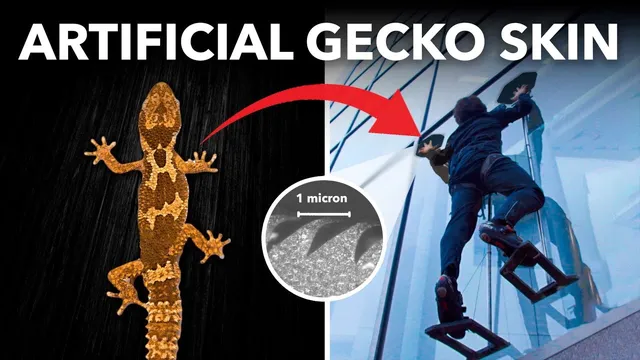
The underlying model comes from gecko feet. Geckos stick far more strongly than suction cups, using no hairs or spikes. Instead, their toes contain lamellae that branch into seta, which further split into extremely fine spatula structures—each spatula is less than one micrometer across. The adhesion mechanism is not chemical bonding like ionic or hydrogen bonds. It relies on Van der Waals forces: momentary charge imbalances in neutral atoms induce complementary fluctuations in nearby atoms, creating a weak attraction between the gecko and a surface such as glass.
In everyday life, Van der Waals forces are hard to notice because skin is bumpy, limiting close contact. Gecko feet overcome that by multiplying contact points through their branching microstructures. The artificial version takes a different route: it uses sharp wedge-shaped tips (about one to two micrometers wide) made from a silicone polymer—Sylgard 170—cast from a wax mold. When first pressed onto a surface, only the wedge tips touch, leaving contact too limited to feel sticky. But when shear force loads the material—pulling parallel to the surface—the wedges bend and spread, creating a much larger, nearly continuous contact area. Adhesion then turns on; pull in the wrong direction and it won’t grip, which also makes removal easy.
Researchers built devices to exploit this directional behavior. A tiny robot called MicroTug weighs 17 grams yet can pull a 20 kilogram load. Its gecko adhesive sits on the underside so that pulling creates shear contact; as the load changes, the shear decreases and the robot can detach and move. The team also quantified contact area using a light-through-acrylic method that reveals where contact frustrates an LED beam. Roughly one square inch of contact supports about 4.5 kilograms (10 pounds).
The adhesive has been tested in space on Astrobee, a fan-driven robot inside the International Space Station. With no gravity, the goal was gentle grabbing and easy release, and the same shear-based adhesion worked for about a year and a half. Beyond anchoring and climbing, the material is aimed at robotic grippers—“smart gecko palms”—to lift delicate produce with minimal squeezing. In a dramatic demonstration, multiple adhesive pads anchored a winch setup that could move a car, and a PhD project by Elliot Hawks tackled the challenge of maintaining enough adhesive contact to support a climber’s full weight on glass.
Cornell Notes
Gecko-inspired adhesives can hold loads without being tacky because they rely on Van der Waals forces activated by shear. Gecko feet use microscopic branching (lamellae → seta → spatula) to create large intimate contact areas, but the artificial version uses simpler wedge tips made from Sylgard 170. When pressed, only the tips touch, so the material feels non-sticky; when pulled parallel to the surface, the wedges bend and expand contact, turning adhesion on. This directionality makes release easy and reduces the effort needed for climbing or gripping. The approach has powered small robots like MicroTug, worked on Astrobee aboard the International Space Station, and supports grippers designed for delicate items.
Why does the adhesive feel non-sticky yet still support weight?
What physical force actually produces gecko adhesion?
How does the artificial design approximate gecko feet if it can’t replicate the full branching structure?
Why must the adhesive be pulled in a specific direction to stick?
What evidence shows the technology works beyond lab demos?
How does this adhesive help robotic grippers and delicate handling?
Review Questions
- How do wedge tips and shear force work together to switch adhesion from weak to strong?
- Explain Van der Waals forces in terms of momentary charge fluctuations and why close contact area is crucial.
- Compare the roles of gecko microstructures and the artificial wedge design in achieving strong grip without chemical bonding.
Key Points
- 1
Gecko-inspired adhesion is directional: it grips when pulled in shear (parallel to the surface) and releases easily when pulled the wrong way.
- 2
The adhesion mechanism is Van der Waals attraction between neutral atoms, not ionic or hydrogen bonding.
- 3
Gecko feet achieve strong adhesion by creating massive intimate contact through microscopic branching structures (lamellae, seta, spatula).
- 4
The artificial version uses simpler wedge-shaped tips made from Sylgard 170; pressing alone touches only the tips, while shear loading bends them into broader contact.
- 5
Adhesion strength scales with contact area; a measurement method uses LED light through acrylic to map where contact occurs.
- 6
Robots including MicroTug and space-tested Astrobee use shear-based gecko adhesives for tasks like pulling loads, sticking to walls, and gentle microgravity handling.
- 7
Climbing applications require maintaining enough adhesive contact with glass to support full body weight, a challenge tackled in a PhD project by Elliot Hawks.