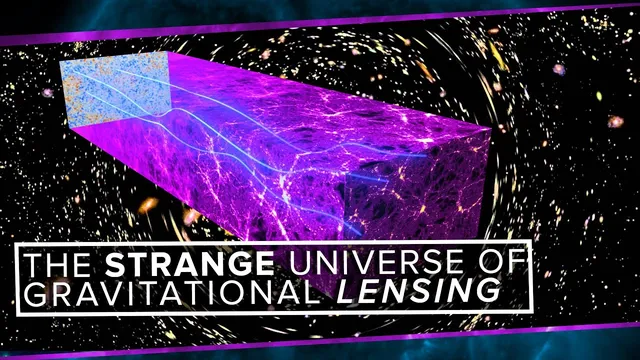
The Strange Universe of Gravitational Lensing
Based on PBS Space Time's video on YouTube. If you like this content, support the original creators by watching, liking and subscribing to their content.
General relativity predicts that mass curves spacetime and that light follows that curvature, producing gravitational deflection.
Briefing
Gravitational lensing turns the universe into a cosmic funhouse mirror: curved spacetime bends light, so distant objects appear magnified, shifted, stretched into arcs, or even split into multiple images. That distortion isn’t just a visual oddity—it has become a central method for mapping mass in the cosmos, testing Einstein’s general relativity, and measuring key cosmological distances.
Einstein’s general theory of relativity describes spacetime as flexible and dynamic rather than a fixed Euclidean grid. Mass and energy curve that spacetime, and light follows the resulting geometry—so gravity deflects light rays. One of the earliest direct confirmations came in 1919, when Sir Arthur Eddington organized expeditions to observe a solar eclipse from Principe and Brazil. By measuring how nearby stars shifted position as their light passed near the Sun, the team found a deflection angle matching Einstein’s prediction, helping cement general relativity’s credibility.
Today, lensing is observed everywhere, not only in rare, dramatic cases. When alignment between a lensing mass and a background source is strong, light forms highly distorted images—bright arcs and rings around galaxies or galaxy clusters. These “strong lensing” patterns can be inverted to reconstruct the lens’s gravitational field and mass distribution. Such analyses have been used to weigh galaxies and clusters and to support the conclusion that most matter in the universe is dark matter.
Lensing can also produce multiple images of the same source. The “Einstein Cross” illustrates this: a luminous distant quasar appears as four spots because its light takes four different paths through a nearby spiral galaxy’s warped spacetime. Achieving this requires near-perfect alignment, which is why only a small fraction of known quasars show such clear splitting. The quasar’s own variability adds another layer of information. By measuring time delays between flickers in the multiple images, astronomers infer differences in path length—one of the hardest quantities to measure in astronomy—and use lensing distances to estimate the Hubble Constant, independently checking the universe’s expansion rate.
Even when distortions are subtle, lensing still leaves fingerprints. “Weak gravitational lensing” slightly warps the shapes of essentially all galaxies. By statistically analyzing the alignments of hundreds or thousands of galaxies, researchers detect correlations that trace the cosmic web—dark matter strands and junctions that structure the universe. Within the Milky Way, “microlensing” occurs when compact objects like black holes, neutron stars, or brown dwarves pass in front of background stars, briefly boosting brightness. These flashes enable counts of otherwise hard-to-detect stellar remnants.
At the extreme end of the lensing spectrum sits the black hole. Light that falls past the event horizon is lost, but just outside it, the photon sphere forces photons into highly curved trajectories. Simulations suggest a bright ring formed by severely lensed light from the surrounding hot plasma, while the most extreme lensing near the photon sphere remains a frontier for direct observation. Across all scales—from galaxy clusters to compact objects—lensing has become a powerful toolkit for decoding the universe that Euclidean intuition would otherwise misplace.
Cornell Notes
Gravitational lensing arises because mass curves spacetime and light follows that curvature, producing magnified, shifted, and sometimes multiple images of distant sources. Strong lensing (arcs, rings, and systems like the Einstein Cross) lets astronomers reconstruct the lens’s mass distribution and has supported the dominance of dark matter. Lensing also enables distance measurements: time delays between multiple quasar images can be used to estimate the Hubble Constant. When distortions are too small to see directly, weak lensing uses statistical shape alignments of many galaxies to map the cosmic web, while microlensing reveals compact objects by their brief brightening effects. Together, these methods turn lensing into a core observational tool for cosmology and astrophysics.
Why does gravitational lensing make distant galaxies look like arcs, rings, or stretched shapes?
How did the 1919 eclipse experiment connect lensing to Einstein’s general relativity?
What information can be extracted from multiple images of a lensed quasar, such as the Einstein Cross?
How does weak gravitational lensing map dark matter when individual distortions are too small to see?
What does microlensing reveal about compact objects in the Milky Way?
What is the photon sphere, and why does it matter for black hole lensing?
Review Questions
- How do strong, weak, and microlensing differ in what they distort and what they help measure?
- Explain how time delays between multiple quasar images can be used to infer cosmological distances.
- Why does gravitational lensing provide evidence for dark matter even when the lensing objects are not directly visible?
Key Points
- 1
General relativity predicts that mass curves spacetime and that light follows that curvature, producing gravitational deflection.
- 2
The 1919 eclipse measurements of star position shifts near the Sun matched Einstein’s predicted light-bending angle.
- 3
Strong lensing (arcs and rings) can be inverted to reconstruct a lens’s mass distribution, supporting dark matter as the dominant mass component.
- 4
Multiple-image lensing systems like the Einstein Cross enable distance estimates through measured time delays, including constraints on the Hubble Constant.
- 5
Weak gravitational lensing uses statistical alignment of many galaxies’ shapes to map the cosmic web’s dark matter structure.
- 6
Microlensing detects otherwise hard-to-see compact objects by their brief magnification of background stars.
- 7
Near black holes, the photon sphere produces extreme lensing signatures such as a predicted bright ring from severely lensed light.