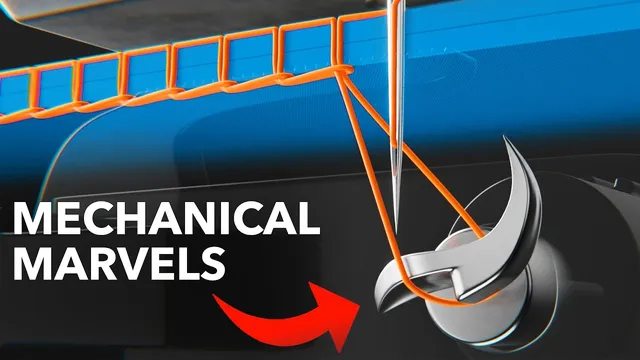
The Surprising Genius of Sewing Machines
Based on Veritasium's video on YouTube. If you like this content, support the original creators by watching, liking and subscribing to their content.
Sewing machines required a new stitching method because they can’t replicate hand sewing’s release-and-regrab motion each time the needle passes through fabric.
Briefing
Sewing machines didn’t succeed by simply speeding up hand sewing—they required a fundamentally new method of locking thread and moving fabric in tiny, repeatable steps. The core breakthrough was figuring out how to form secure stitches without the hand-sewing motion of passing a needle through fabric, releasing it, and grabbing it again on the other side. Once that problem was solved, the rest became a chain of mechanical refinements that made reliable mass production possible.
Human sewing predates modern humans by tens of thousands of years. A 50,000-year-old bone needle found in a Siberian cave belonged to Denisovans, showing that stitching was already part of human life long before Homo sapiens. For millennia, needles stayed remarkably consistent—sharp tips and an eye for thread—across artifacts from Europe and Asia. The major turning point came in 1755 with German inventor Charles Frederick Wiesenthal, who patented a needle sharp on both sides. That change eliminated the need to flip the needle each stitch and, crucially, positioned the eye near the tip so the thread could be drawn through and managed more effectively.
From there, sewing machines had to solve the “tangle” problem: pulling a thread through fabric doesn’t automatically keep it from slipping back out. Two main strategies emerged. One is the chain stitch, where a loop of thread remains under the fabric and the next needle pass links into it. Early chain-stitch machines included designs by Thomas Saint (patent drawings in 1790), Joseph Madersperger (patented in 1814, built but not commercialized), and Barthélemy Thimonnier (built a factory in the 1830s; his machines were destroyed by a mob of tailors). In 1857, James Gibbs and Charles Raymond both patented more reliable chain mechanisms. Raymond’s used a hook that catches a buckled bulge of thread to form loops; Gibbs used a rotating hook, requiring dozens of prototypes to get the looper shape right. Chain stitches can be vulnerable if a thread comes loose, so later variants used more thread for robustness.
The other strategy is the lock stitch, which interlocks top and bottom threads using two spools: the needle carries the top thread through the fabric while a bobbin thread forms the counterpart. Elias Howe patented a lock-stitch approach in 1846 and demonstrated it against seamstresses, though his early design was limited. Allen B. Wilson later improved the mechanism with patents in 1850 and 1851, first using a vibrating shuttle and then—more importantly—using a rotating hook with an internal bobbin. In both cases, tension must match so the stitch meets in the middle of the two fabric layers; mismatched tension weakens the seam. To reduce wear from repeated pulling, modern needles often include a groove on one side to cut friction and fraying.
Finally, machines needed a way to advance fabric at a precise rate after each stitch. Wilson’s feed-dog concept—grooved metal that grips and moves the fabric forward when the needle lifts—became standard. That combination of thread-locking, tension control, low-friction needle design, and automated feeding turned sewing into a high-speed industrial process.
Isaac Singer later accelerated adoption by buying and assembling key patents, optimizing manufacturing, and cutting prices from about $100 to around $10, making machines affordable for families. The result was dramatic: a shirt that once took over 12 hours could be sewn in under 30 minutes, reshaping clothing production and consumption worldwide. The lasting takeaway is that sewing machines are “tiny mechanical miracles” built from multiple breakthroughs—especially the invention of a new way to sew, not just faster needles.
Cornell Notes
Sewing machines work because they replace hand sewing’s up-and-down needle motion with mechanisms that lock thread and advance fabric automatically. Early needles changed little for tens of thousands of years, but Charles Frederick Wiesenthal’s two-sided needle (1755) made continuous stitching practical by keeping the eye near the tip. Stitch security came from two competing designs: chain stitches that link loops under the fabric, and lock stitches that interlock a top thread with a bobbin thread. Allen B. Wilson’s rotating-hook lock stitch (1851) and the feed-dog fabric advance mechanism made reliable, repeatable seams. These engineering choices enabled mass production and helped drive major shifts in how quickly and cheaply clothing could be made.
Why did inventing a sewing machine require more than a faster needle?
What problem does the chain stitch solve, and what makes it different from hand sewing?
How does a lock stitch interlock two threads?
What changed when sewing machines moved from shuttle mechanisms to rotating hooks?
Why do many sewing machine needles have a groove?
How does the machine advance fabric between stitches without human repositioning?
Review Questions
- What specific “tangle” problem must a sewing machine solve so stitches don’t pull out after the needle withdraws?
- Compare chain stitch and lock stitch in terms of how loops are formed and how stitches remain secure.
- Which mechanical components are responsible for (1) locking thread and (2) advancing fabric, and how do they interact during each stitch?
Key Points
- 1
Sewing machines required a new stitching method because they can’t replicate hand sewing’s release-and-regrab motion each time the needle passes through fabric.
- 2
Charles Frederick Wiesenthal’s two-sided needle (1755) enabled continuous back-and-forth stitching by keeping the eye near the sharp tip.
- 3
Chain stitches lock by linking successive loops under the fabric, but they can unravel if one thread segment comes loose.
- 4
Lock stitches interlock a top needle thread with a bobbin thread, and stitch strength depends on matching top and bottom tension so the seam forms in the fabric’s middle.
- 5
Allen B. Wilson’s rotating-hook lock stitch (1851) became the foundation for most modern sewing machines.
- 6
Feed dogs (with a presser foot) advance fabric by a precise amount between stitches, making spacing consistent at high speed.
- 7
Isaac Singer accelerated adoption by consolidating patents, optimizing manufacturing, and dropping prices—turning sewing from a slow task into a widely accessible industrial process.