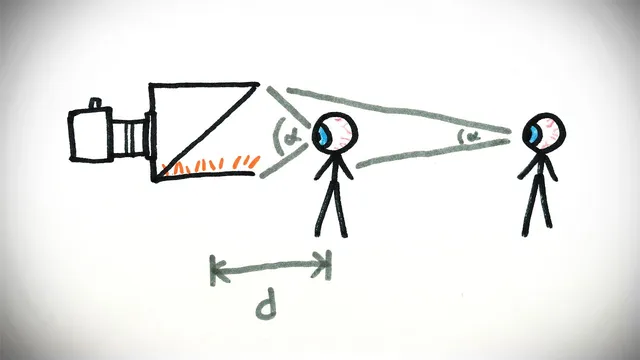
The Teleprompter Paradox
Based on minutephysics's video on YouTube. If you like this content, support the original creators by watching, liking and subscribing to their content.
Teleprompter eye motion detectability is governed by geometry plus human visual resolution, not just performance habits.
Briefing
Teleprompters can look “less authentic” because viewers can often detect unnatural eye motion—yet making that motion small enough to hide comes with a brutal constraint: the teleprompter may need to be so far away that the text becomes unreadable. The core insight is that eye movement isn’t just a performance issue; it’s a geometry-and-vision problem governed by how far the teleprompter is, how wide the text is, and how the camera framing maps the host’s eye rotations into the viewer’s field of view.
The discussion starts with why close teleprompters are obvious. When a partially transmissive mirror sits near the host, the eyes visibly sweep back and forth between the script and the camera lens. Moving the teleprompter farther away reduces how much the eyes have to rotate to read the sides of the text, making the motion smaller from the viewer’s perspective. But there’s a trade: farther away also makes the text harder to read, especially for small displays.
Six factors determine the “teleprompter paradox,” combining eyeball geometry with viewing conditions: the radius of the eyeball (which sets how far the iris moves for a given eye rotation), the host-to-teleprompter distance, the width of the text (narrower text requires less side-to-side eye travel), the camera field of view relative to eye motion (wider framing makes the eyes move less across the screen proportionally), the size of the screen the viewer watches on (bigger screens make eye motion appear larger), and the viewer’s distance from their screen (farther viewers make the host appear smaller and eye motion harder to notice).
Using basic trigonometry, the analysis yields a practical constraint: viewers likely won’t notice eye motion if the angle of that motion stays below about a 60th of a degree. Human visual resolution—limited by diffraction through the pupil and typical acuity—sets this scale. Rearranging the resulting “teleprompter equation” gives a rule of thumb for distance: the host-to-screen distance should be at least 30 times the teleprompter text width divided by the camera’s field-of-view width (in meters). In feet, it’s about 100 times the text width divided by the field of view.
Examples make the paradox concrete. With 30 cm wide teleprompter text and a ~2 m field of view, the camera should be at least ~4.5 m away. If the frame is tighter—say only 1 m wide—distance jumps to ~9 m. A phone-sized teleprompter can allow a closer setup for the same 1 m frame (around 3.6 m), but readability collapses because the text is too small at that distance.
The “solutions” follow the same logic. To keep eye motion undetectable, either zoom out so the presenter occupies less of the frame, narrow the text, or accept that sharp-eyed viewers may notice. Another workaround is an ear prompter that reads the script aloud into an earpiece, eliminating the need to visually scan text. The final warning is symmetrical: don’t move the teleprompter farther away while also making it larger—doing both cancels the benefit and reintroduces detectable eye motion.
Cornell Notes
Teleprompter eye motion becomes detectable when the host’s eyes must rotate enough to read the sides of the script. A geometry model links that rotation to six variables: eyeball size, host-to-teleprompter distance, text width, camera field of view, viewer screen size, and viewer distance. By comparing the resulting eye-motion angle to human visual resolution limits (on the order of a 60th of a degree), the analysis produces a distance rule: the camera/host distance should be at least ~30×(teleprompter text width)/(camera field-of-view width) in meters (or ~100× in feet). The catch is the “paradox”: making the motion small enough often forces the teleprompter so far away that the text becomes unreadable—especially for small displays.
Why do close teleprompters make eye motion obvious to viewers?
What are the six factors that determine how detectable teleprompter eye motion is?
How does the analysis connect eye motion to human vision limits?
What practical distance rule comes out of the “teleprompter equation”?
Why does the “teleprompter paradox” happen even when the math says to move the camera farther away?
What are the main ways to reduce detectability without sacrificing readability?
Review Questions
- If the camera field of view is tightened from 2 m to 1 m while keeping teleprompter text width the same, how does the minimum distance change according to the rule of thumb?
- Which factor most directly reduces the required eye rotation: increasing host-to-teleprompter distance, narrowing the text, or changing viewer distance—and why?
- Why can’t a setup simply “go farther away” to hide eye motion when using a phone-sized teleprompter?
Key Points
- 1
Teleprompter eye motion detectability is governed by geometry plus human visual resolution, not just performance habits.
- 2
A close teleprompter forces larger eye rotations to read the script, producing noticeable side-to-side motion on-screen.
- 3
Six variables drive the effect: eyeball radius, host-to-teleprompter distance, text width, camera field of view, viewer screen size, and viewer distance.
- 4
Keeping eye motion below roughly a 60th of a degree (viewer-perceived angle) makes detection unlikely.
- 5
A practical rule of thumb sets minimum distance: at least ~30×(text width)/(camera field-of-view width) in meters (or ~100× in feet).
- 6
The paradox: the distance needed to hide eye motion can make the text unreadable, especially for small screens.
- 7
Best mitigations include zooming out, narrowing the text, or using an ear prompter to eliminate visual scanning.