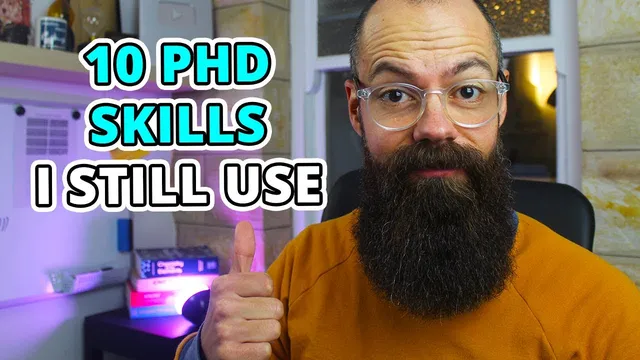
The Top 10 PhD Skills You Never Knew You Needed After Graduation
Based on Andy Stapleton's video on YouTube. If you like this content, support the original creators by watching, liking and subscribing to their content.
Comfort with ambiguity trains people to act without guaranteed outcomes, treating uncertainty as a normal part of progress.
Briefing
A PhD’s most durable payoff isn’t just research competence—it’s a toolkit for handling uncertainty, setbacks, and people. The through-line across the “top 10” skills is learning to keep moving when outcomes are unclear, experiments fail, and workplace dynamics get complicated. That combination matters because most post-PhD careers—academia, industry, government, or entrepreneurship—reward adaptability and persistence as much as technical knowledge.
The first skill is comfort with ambiguity: being willing to try things without knowing what will happen, and finding energy in the non-linear returns of not having a guaranteed path. Unlike undergraduate work, where lectures and exams are laid out in advance, a PhD often demands experimentation on the fly—“try some things and see what happens.” That tolerance for uncertainty becomes a practical advantage later, including in roles where progress depends on iteration rather than certainty.
Next comes “managing upwards,” meaning the ability to work effectively with supervisors by understanding what they need to hear, when they need it, and how to communicate at the right level. The value isn’t only professional; it also shapes day-to-day working life. The same skill helps a postdoc in university settings and later in industry by navigating hierarchical structures and “complicated hierarchical egos” so work stays productive rather than political.
Several skills then reinforce the research mindset as a transferable career strategy. Appreciation for serendipity is about treating unexpected opportunities as signals rather than distractions—like starting multiple YouTube channels at once, expecting most to fail while one or two might “burst off.” Iterative thinking follows: try, fail or partially succeed, reassess, and adjust until outcomes improve. The transcript frames this as the core logic of research, and notes that without years of repeated iteration, people may interpret failure as a dead end instead of information.
That leads into embracing failure as a skill. A PhD normalizes repeated failure—fail, fail, fail, then occasional wins—so setbacks stop feeling like personal verdicts. Success comes from discovering what doesn’t work, and the PhD environment trains people to treat failure as temporary and actionable.
Other skills focus on how to operate in real organizations. Challenging norms is presented as confidence to question established ways of doing things—useful in many workplaces, though not always welcomed in systems like government once processes become rigid. Intrinsic motivation is described as the ability to keep going by understanding what drives you internally, rather than relying solely on external rewards like money or prestige.
Finally, endurance and persistence are treated as the practical engine behind all of it: doing small amounts of writing, analysis, or experimental design every day, even when progress feels slow, because momentum accumulates over the long duration of a PhD. Learning how to learn is also emphasized—without course structure, PhD students must choose what to read, how to read it, and which resources to use—fueling lifelong learning.
The capstone skill is public speaking. The transcript argues it’s both enjoyable and broadly useful: persuading groups ranging from conference rooms to a thousand-person stage at National Science Week. Practice through departmental talks, symposia, and oral presentations helps make speaking feel less scary—because the speaker controls the flow of the session.
Taken together, the “top 10” skills portray a PhD as training for uncertainty, communication, and resilience—capabilities that keep paying off long after the thesis is finished.
Cornell Notes
The transcript frames a PhD as training for real-world performance, not just academic research. The most important thread is learning to operate under uncertainty—comfort with ambiguity, iterative experimentation, and embracing failure as information rather than a personal verdict. It also highlights career-relevant people skills: managing upwards by communicating with supervisors effectively and public speaking to persuade and report research confidently. Other transferable abilities include challenging norms when appropriate, building intrinsic motivation, and sustaining endurance through daily progress. Finally, learning how to learn supports lifelong curiosity, turning the PhD’s freedom in study choices into a lasting skill set.
Why does comfort with ambiguity matter after graduation, and how is it different from undergraduate training?
What does “managing upwards” practically involve, and why is it portrayed as both professional and personal?
How do serendipity and iterative thinking connect to the research process?
Why is embracing failure treated as a distinct skill rather than a mindset slogan?
What makes public speaking a “capstone” PhD skill in this account?
How does “learning how you learn” become a lifelong advantage?
Review Questions
- Which PhD-trained abilities in the transcript most directly help someone handle uncertainty in a new job, and why?
- How does the transcript distinguish iterative thinking from simply “trying hard,” and what role does reassessment play?
- In what situations would challenging norms be beneficial versus risky, based on the examples given?
Key Points
- 1
Comfort with ambiguity trains people to act without guaranteed outcomes, treating uncertainty as a normal part of progress.
- 2
Managing upwards means tailoring communication to supervisors’ needs and timing, which improves both relationships and day-to-day work.
- 3
Appreciation for serendipity encourages taking advantage of unexpected opportunities instead of dismissing them as distractions.
- 4
Iterative thinking—try, reassess, adjust—turns research failure into actionable information and improves outcomes over time.
- 5
Embracing failure is framed as a skill built through repeated cycles, preventing setbacks from becoming personal verdicts.
- 6
Intrinsic motivation helps people push through hard periods without relying only on external rewards like money or prestige.
- 7
Public speaking is portrayed as a practical, widely transferable persuasion skill that becomes easier through repeated practice in academic settings.