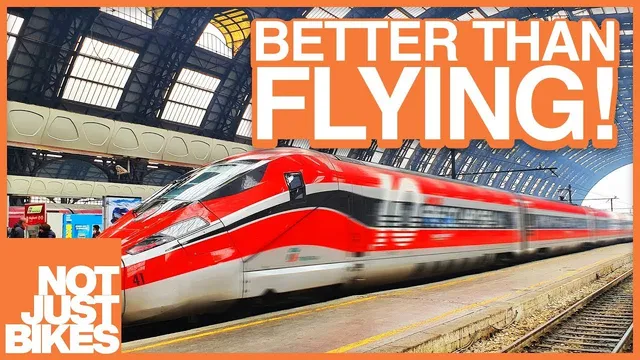
The Trains that Killed an Airline - Italian HSR
Based on Not Just Bikes's video on YouTube. If you like this content, support the original creators by watching, liking and subscribing to their content.
Alitalia’s bankruptcy is linked partly to competition from Italy’s expanding high-speed rail network, especially because domestic flights formed a large share of its routes.
Briefing
Alitalia’s bankruptcy has been linked in part to competition from Italy’s growing high-speed rail network—an example of how rail can siphon off short-haul and domestic air demand when train service becomes fast, frequent, and city-centered. The argument isn’t that flights were the only problem for Alitalia, but domestic routes made up a unusually large share of its flying, and Italy’s high-speed network expanded rapidly over the past decade. That timing matters: as rail improved, short trips that once required airport time increasingly became practical by train.
The broader policy backdrop is Europe-wide. Several countries have floated or proposed rules that restrict short-haul flights when train alternatives exist, and one report cited that roughly one-third of Europe’s top short-haul flights have train options under six hours—options that could improve further with more EU investment in high-speed rail and night trains. The implication is straightforward: when a credible rail alternative exists, travelers often choose it, reducing the market for short flights.
To test that claim on the ground, the trip described runs through Italy’s high-speed spine and then into local rail. From Verona to Padova, the journey uses a Frecciarossa 1000, then continues on a Frecciarossa ETR 500 direct to Napoli. The experience is framed as both comfortable and competitively priced. Business-class pricing is presented as relatively close to economy—99 euros for business versus 75 euros for economy on the trip—plus an intermediate premium category (executive class) that offers a more “boardroom” style seating layout. Onboard amenities include a dining car with a limited food menu, extensive coffee options, bar-style service, and washrooms described as small but not worse than airplane facilities.
Speed and time savings are central to the pitch. The 700-kilometer run from Padova to Napoli takes about five hours, with stretches cruising near 300 kilometers per hour. The route also offers countryside views, though tunnels interrupt the scenery frequently. Still, the narrative highlights a practical advantage over flying: mobile data remains usable for much of the trip, and—most importantly—train stations are close to city centers, avoiding airport transfers and the “hurry up and wait” rhythm of air travel.
After Napoli, the trip shifts to the Circumvesuvia narrow-gauge network, a single-track commuter line that also serves tourist access such as Pompeii. Here the contrast is stark: the trains are described as run-down, and the single-track layout forces waiting at stations for trains to pass—an inconvenience that makes the local service feel far less competitive.
Taken together, the trip supports a key takeaway: high-speed rail can be an easy decision for distances roughly between 150 and 800 kilometers, offering a better travel experience than flying while also improving environmental outcomes. The closing message is that other countries could learn from Italy’s approach to building future rail projects—if service quality matches what travelers get on the Frecciarossa routes, rail’s case becomes hard to ignore.
Cornell Notes
Italy’s high-speed rail growth is presented as a meaningful factor behind Alitalia’s bankruptcy, because improved train options increasingly replace domestic short-haul flights. The trip described uses Frecciarossa services—Frecciarossa 1000 from Verona to Padova and Frecciarossa ETR 500 from Padova to Napoli—highlighting speed (up to ~300 km/h), comfort, and city-center station access. Pricing is framed as less polarizing than airlines, with business class only modestly more expensive than economy on the cited fare. The journey also avoids airport time costs and offers usable onboard connectivity for much of the route. A switch to the Circumvesuvia commuter line shows the downside when service quality and infrastructure (single track) lag behind high-speed standards.
Why does high-speed rail threaten short-haul airlines in Italy specifically?
What makes the Frecciarossa experience competitive with flying on the cited route?
How does pricing compare between economy and business class on the described train trip?
What does the Napoli-to-sorrento segment reveal about where rail still struggles?
Why do European flight-restriction proposals focus on train alternatives under six hours?
Review Questions
- What combination of speed, pricing, and station location makes high-speed rail a practical substitute for short-haul flights in the described account?
- How does single-track infrastructure on the Circumvesuvia line change the passenger experience compared with high-speed services?
- Why does the share of domestic flights matter when assessing the impact of rail competition on an airline’s financial health?
Key Points
- 1
Alitalia’s bankruptcy is linked partly to competition from Italy’s expanding high-speed rail network, especially because domestic flights formed a large share of its routes.
- 2
European policymakers are increasingly considering limits on short-haul flights when train alternatives exist, with one cited estimate placing many options under six hours.
- 3
Italy’s high-speed services (Frecciarossa/Aero) reach speeds around 300 km/h and compete directly with airplanes on time and convenience.
- 4
On the described Frecciarossa journey, business class pricing (99 euros) was only moderately higher than economy (75 euros), making upgrades easier to justify.
- 5
City-center station access and reduced airport friction are presented as major advantages over flying, alongside onboard connectivity for much of the trip.
- 6
Rail’s competitiveness depends on service quality: the Circumvesuvia narrow-gauge network’s single-track constraints and aging rolling stock make it far less attractive than high-speed routes.
- 7
High-speed rail is framed as the ideal option for trips roughly between 150 and 800 kilometers, combining better travel experience with environmental benefits.