The Trains that Subsidize Suburbia - GO Transit Commuter Rail
Based on Not Just Bikes's video on YouTube. If you like this content, support the original creators by watching, liking and subscribing to their content.
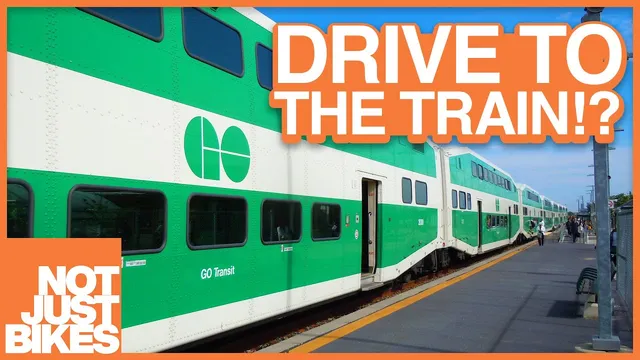
GO Transit offers a relatively rider-friendly commuter experience, including clean stations, two-level trains, and Presto contactless payment.
Briefing
GO Transit’s commuter-rail model is delivering strong rush-hour relief for Toronto-bound suburban workers while simultaneously locking the region into “car-dependent transit”—a system that works mainly for people who already drive, and that wastes the land-and-wealth-building potential of rail.
Riders get a comparatively pleasant experience: clean, well-maintained stations; two-level trains with ample space; and contactless payment via the Presto card. The service also scores on accessibility, with level boarding areas for wheelchair users and elevator connections at most stations. Yet the design choices still frustrate some users—especially cyclists—where a bar in the middle of certain train-door openings can block bicycle boarding even though other doors lack the obstruction.
The broader case for GO Transit traces back to post–World War II planning in both the U.S. and Canada, when cities subsidized car infrastructure and treated passenger rail as obsolete. By the 1960s, highway capacity limits pushed planners toward commuter rail. GO Train lines were built for one core job: reduce the number of suburban commuters driving into downtown during peak hours.
By that metric, GO Transit performs well. Among suburban residents who work in downtown Toronto, 67% take the GO Train, while only 20% commute by car. But the same system struggles outside the narrow commuting pattern it was designed for. When jobs are located anywhere other than downtown, car use dominates—nearly 90%—while GO Train ridership drops to about 1%. The timetable reinforces the limitation: service is heavily structured around a morning outbound and afternoon return, with few options for trips outside those windows or between suburban locations.
That mismatch leads to a land-use critique. Commuter rail stations are typically surrounded by large parking lots, turning rail into an extended “park and ride” for drivers rather than a catalyst for walkable neighborhoods. GO Transit is described as Ontario’s largest parking provider, with roughly 70,000 spaces—mostly free—subsidized by taxpayers. The result is a financial incentive to drive to the station, with little price advantage for walking or cycling. Even where bicycle parking exists at every station, the surrounding station design often leaves cyclists and pedestrians navigating car-oriented access roads and parking-lot environments.
The most pointed example is Bloomington GO, a newly opened station positioned in the Greater Toronto Area’s Greenbelt. The station is characterized as massive and car-first: large surface parking, a “kiss and ride” drop-off zone, and highway-adjacent access that effectively requires driving. Despite meeting LEED Gold-style sustainability requirements (solar panels, LED lighting, low-flow plumbing), more than 90% of the site is still devoted to free parking for over a thousand vehicles. The critique is that sustainability checklists can’t compensate for a development model that prioritizes vehicle storage over transit-oriented growth.
Still, there’s a forward-looking counterweight. Metrolinx has expanded all-day service on some lines, such as Lakeshore West with 30-minute headways since 2013. The planned GO Expansion Project—electrifying lines, increasing frequency to every 15 minutes or better on several routes, and boosting weekly trips from about 1,500 to over 6,000—could broaden GO Transit beyond peak commuting. But the argument remains that without station-area redevelopment that brings people closer to rail, electrification and frequency alone won’t fix the system’s core problem: rail designed primarily to move drivers, not to build the places they want to live.
Cornell Notes
GO Transit is praised for delivering a comfortable, accessible commuter experience—clean stations, two-level trains, Presto contactless payment, and level boarding/elevator access. It also performs strongly for its intended purpose: moving suburban workers into downtown Toronto during rush hour, where 67% ride GO versus 20% by car. Outside that pattern, ridership collapses: when jobs aren’t in downtown, nearly 90% drive and only about 1% use GO, with timetables largely limited to morning outbound and afternoon return. The central critique is land use: stations function as “park and ride” facilities surrounded by mostly free parking, subsidizing driving and limiting walkable development. Planned electrification and more frequent all-day service could help, but station-area design will determine whether GO becomes a broader mobility and wealth-creation tool or stays car-dependent.
What makes GO Transit feel “usable” for everyday riders, and where does the experience fall short?
Why does GO Transit succeed for some trips but fail for others?
How does station design turn commuter rail into “car-dependent transit”?
What’s the argument behind the Bloomington GO example?
What improvements are planned, and why might they not be enough on their own?
Review Questions
- How do the transcript’s ridership statistics (downtown vs. non-downtown jobs) demonstrate the limits of commuter rail’s design assumptions?
- What specific station features (parking policy, access roads, timetable structure) contribute to the “car-dependent transit” label?
- Why does the transcript treat electrification and higher frequency as necessary but not sufficient for transforming GO Transit’s role in the region?
Key Points
- 1
GO Transit offers a relatively rider-friendly commuter experience, including clean stations, two-level trains, and Presto contactless payment.
- 2
Accessibility is strong across the network, with level boarding areas for wheelchair users and elevator connections at most stations.
- 3
GO Train ridership is highly concentrated in the downtown Toronto commute pattern; outside that pattern, car use dominates and GO usage drops sharply.
- 4
Station-area design—especially large amounts of mostly free parking—turns rail into a “park and ride” system that subsidizes driving.
- 5
Timetables built around peak commuting (morning outbound, afternoon return) limit GO Transit’s usefulness for off-peak and cross-suburb trips.
- 6
Metrolinx’s planned electrification and frequency increases could broaden service, but station-area redevelopment is portrayed as the deciding factor for whether GO becomes transit-oriented rather than car-dependent.
- 7
Bloomington GO is used as a cautionary case where sustainability features can’t offset a car-first site plan in a protected Greenbelt area.