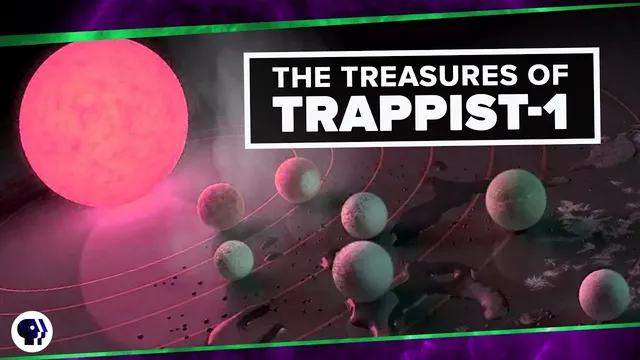
The Treasures of Trappist-1 | Space Time
Based on PBS Space Time's video on YouTube. If you like this content, support the original creators by watching, liking and subscribing to their content.
TRAPPIST-1a hosts seven Earth-sized planets discovered through transit observations, with TRAPPIST identifying three in 2015 and Spitzer adding four later.
Briefing
A nearby ultra-cool red dwarf, TRAPPIST-1a, has been found to host seven Earth-sized planets—an unusually large haul of potentially habitable worlds around a single star. The system sits about 39.5 light-years away in Aquarius, and the planets were detected with the transit method, which tracks the star’s slight dimming as planets pass in front of it. Initial observations with TRAPPIST at La Silla Observatory in Chile identified three planets in 2015, and follow-up with the Spitzer Space Telescope added four more, bringing the total to seven.
TRAPPIST-1a is tiny and cool—roughly 10% the Sun’s diameter and under 10% its mass, with a surface temperature near 2,500 Kelvin. That matters because the planets orbit extremely close: all seven lie within about one fifth of Mercury’s orbital distance from the star. As a result, their orbital periods range from about 1.5 days for the innermost planet (TRAPPIST-1b) to roughly three weeks for the outermost (TRAPPIST-1h). Their tight spacing also means their mutual gravity slightly alters their orbits, letting astronomers estimate masses (about 0.4 to 1.4 times Earth’s) and, from transit depths, infer sizes and densities. Those density estimates point toward rocky or “rocky/watery” compositions rather than gas giants.
The planets’ arrangement offers clues about how the system formed. Stable orbital resonances suggest the worlds may have formed farther out and migrated inward, since there likely wasn’t enough raw material to build so many planets so close to the star. Formation distance also shapes chemistry: different materials condense at different temperatures, so where each planet formed can influence its mix of volatiles like water. That possibility becomes especially important for habitability because the star’s habitable zone is compressed into a narrow band. In TRAPPIST-1’s case, three planets fall within that band where surface temperatures could allow liquid water.
Climate modeling adds nuance—and caution. The innermost planets may be more “Venus-like,” potentially pushed into runaway greenhouse conditions. The outermost planet, beyond the system’s “snow line,” is expected to be icy, but tidal heating from gravitational interactions could warm it enough for liquid water. Even so, liquid water alone doesn’t guarantee life. Stellar activity from young M dwarfs, atmospheric erosion, and tidal locking (likely causing permanent day and night sides) could all reshape climates and strip atmospheres. Hubble observations indicate at least some planets (a, b, and h) lack hydrogen-helium envelopes, meaning they’re not thick gas worlds like Jupiter.
Future spectroscopy with the James Webb Space Telescope is expected to probe atmospheric chemistry and search for signatures that could hint at biology. The system also raises a broader point: Earth-sized planets may be common around M dwarf stars, and a nearby potentially habitable world has already been found around Proxima Centauri. With M dwarfs making up the galaxy’s most numerous stars, TRAPPIST-1 strengthens the case that “possible homes for life” could be far more plentiful than once thought—provided these worlds can survive their star’s turbulent youth and maintain atmospheres capable of supporting stable, life-friendly conditions.
Cornell Notes
TRAPPIST-1a, an ultra-cool red dwarf about 39.5 light-years away, is now known to host seven Earth-sized planets discovered via the transit method. TRAPPIST identified three planets in 2015, and Spitzer added four more, enabling mass estimates from orbital interactions and size estimates from transit depths. The planets are tightly packed with orbital periods from ~1.5 days (TRAPPIST-1b) to ~3 weeks (TRAPPIST-1h), and their densities suggest rocky or rocky/watery worlds. Three planets fall within the star’s compressed habitable zone, but climate modeling suggests the inner ones could be Venus-like due to runaway greenhouse effects. Habitability also depends on stellar activity, atmospheric loss, tidal locking, and tidal heating—factors that James Webb spectroscopy will help evaluate.
How were the seven TRAPPIST-1 planets detected, and why did adding Spitzer matter?
What do the planets’ close orbits imply about their year length and physical properties?
Why do orbital resonances hint at a migration history rather than in-place formation?
How is the habitable zone different around TRAPPIST-1a than around the Sun?
What are the biggest threats to habitability beyond “being in the habitable zone”?
Review Questions
- What measurements allow scientists to estimate both the masses and sizes of the TRAPPIST-1 planets, and how do those estimates lead to conclusions about composition?
- Why might three TRAPPIST-1 planets fall in the habitable zone while the innermost planets still risk becoming Venus-like?
- How do tidal locking and stellar activity interact to affect atmospheric survival and climate stability on planets orbiting close to an M dwarf?
Key Points
- 1
TRAPPIST-1a hosts seven Earth-sized planets discovered through transit observations, with TRAPPIST identifying three in 2015 and Spitzer adding four later.
- 2
The planets orbit extremely close to TRAPPIST-1a, producing short orbital periods from ~1.5 days (TRAPPIST-1b) to ~3 weeks (TRAPPIST-1h).
- 3
Mutual gravitational interactions allow mass estimates (about 0.4–1.4 Earth masses), and transit depths provide sizes; together these imply rocky or rocky/watery compositions.
- 4
Stable orbital resonances suggest the planets likely formed farther out and migrated inward, rather than forming in place near the star.
- 5
The habitable zone around TRAPPIST-1a is compressed into a narrow band; three planets lie within it, but climate modeling suggests the inner planets may be overheated by runaway greenhouse effects.
- 6
Habitability depends on more than temperature: stellar activity, atmospheric loss, tidal locking, and tidal heating can all push planets toward or away from stable, life-friendly conditions.
- 7
Hubble observations indicate at least TRAPPIST-1a, b, and h lack hydrogen-helium atmospheres, and James Webb spectroscopy is expected to refine atmospheric composition and potential biosignature indicators.