The Trebuchet Challenge | Space Time
Based on PBS Space Time's video on YouTube. If you like this content, support the original creators by watching, liking and subscribing to their content.
Energy in physics is a precisely defined property that can be conserved, not a vague influence.
Briefing
Energy’s conservation turns a messy trebuchet mechanics problem into a clean calculation: once the counterweight and projectile start and end at known heights, their masses and the energy bookkeeping determine the projectile’s impact speed—without needing arm lengths, release geometry, or detailed force vectors. The core move is treating the trebuchet as an ideal conservative system where energy lost by the counterweight becomes kinetic energy (and potential energy) gained by the projectile.
The episode begins by grounding “energy” in physics: it’s not a vague influence but a precisely defined property that can be conserved. For conservative forces, the change in speed between two points depends only on the start and end positions, not on the path taken. That idea scales up: for any system of interacting particles under conservative forces, the sum of kinetic energy and potential energy stays constant. This conservation law is then positioned as a shortcut—replacing complicated Newton’s-law dynamics with energy accounting.
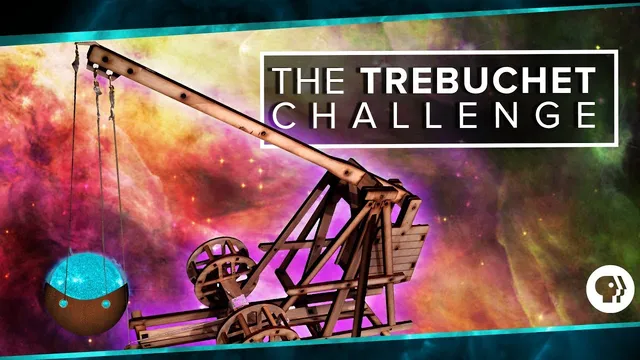
From there, the trebuchet serves as the practical test case. A counterweight drops, pulling down a short arm that pivots a longer arm upward. The projectile rides in a sling attached near the long arm’s tip; as the arm and sling rotate, the projectile is released at high speed. In real life, friction, structural flexing, and air resistance sap energy, but the challenge assumes an “ideal trebuchet” where those losses are ignored (or, in principle, could be added later).
Two questions frame the “Trebuchet Challenge.” First, a conceptual comparison: fire one shot so the projectile hits a fixed point on a tall wall after rising and falling. Then repeat with the counterweight raised to the same height, but release the projectile earlier so it follows a more vertical trajectory and still lands on the exact same spot. The key observation is that the counterweight continues swinging after release in both cases, and in both cases that post-release swing reaches the same maximum height. With damage assumed to depend only on impact speed, the task is to decide which shot delivers more damage.
Second, an extra-credit numerical problem supplies specific masses and heights. A five-ton counterweight is dropped from 8 meters above the ground. It swings down and then up again, reaching a lowest point 1 meter above the ground and later rising to 2 meters before returning. A 90-kilogram stone is launched from ground level and travels 300 meters to strike a wall 15 meters high. The surprising claim is that the impact speed can be found using only the start and end locations (and masses) of the counterweight and projectile—no arm lengths and no release-point details.
The episode ends by inviting viewers to submit solutions to either question via email with the subject line “Trebuchet Challenge,” with selected correct entries receiving Space Time T-shirts.
Cornell Notes
The trebuchet challenge uses conservation of energy to predict projectile impact speed without detailed geometry. By assuming an ideal, conservative system (no friction losses in the structure and no air resistance), the total energy of the counterweight–projectile system is conserved. The first question asks which of two shots causes more damage when the projectile lands on the same wall spot and the counterweight’s post-release swing reaches the same height. The extra-credit question gives masses and heights and claims the stone’s impact speed depends only on the counterweight and projectile start/end positions and masses, not on arm lengths or the exact release point. The point is that energy bookkeeping can replace complicated Newton’s-law dynamics.
Why does the projectile’s impact speed depend only on start/end conditions in these problems?
In the first (conceptual) challenge, what information is crucial to deciding which shot does more damage?
What assumptions make it possible to ignore arm lengths, release points, and sling details?
How does the numerical extra-credit problem let you compute the stone’s impact speed without geometry?
Why is the “post-release swing height” of the counterweight so important in the first question?
Review Questions
- In an ideal conservative system, what does conservation of energy say about outcomes when two different paths connect the same initial and final states?
- Which quantities in the trebuchet challenge are treated as sufficient to determine impact speed, and which are explicitly treated as unnecessary (arm lengths, release point, etc.)?
- How do the assumptions about friction, air resistance, and lever-arm mass change what can be computed from energy alone?
Key Points
- 1
Energy in physics is a precisely defined property that can be conserved, not a vague influence.
- 2
For conservative forces, changes in motion depend only on start and end positions, not on the path taken.
- 3
The trebuchet challenge treats the counterweight–projectile system as ideal: no frictional energy transfer to the structure and no air resistance.
- 4
With lever-arm mass neglected, the energy analysis focuses on gravitational potential energy changes of the counterweight and projectile.
- 5
In the first challenge, matching the counterweight’s post-release maximum height and the projectile’s impact location forces the impact speeds to match if damage depends only on speed.
- 6
In the numerical challenge, the stone’s impact speed can be found from the given masses and heights alone, without arm lengths or release-point geometry.
- 7
Real-world losses (friction, air drag) would require adding non-conservative terms, but the challenge starts with the conservative ideal.