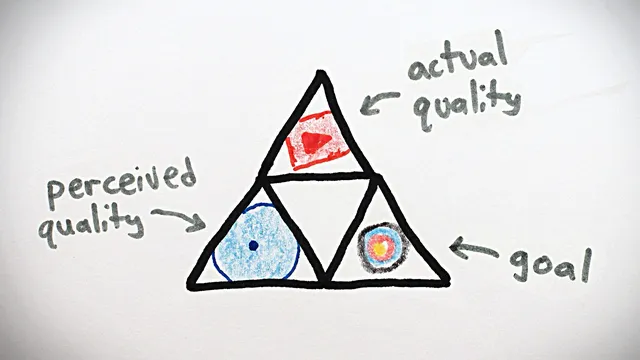
The Trinity of Quality
Based on minutephysics's video on YouTube. If you like this content, support the original creators by watching, liking and subscribing to their content.
Actual quality is multi-axis: some aspects are relatively objective (e.g., color accuracy, audio levels), while others are more subjective (e.g., tone, composition, emotional fit).
Briefing
“Good enough” in creative work depends on three separate things: the work’s actual quality, the target quality you personally want, and how accurately you can judge where you are on the quality scale. Confusion among those three drives most disagreements about whether something is finished—and it also blocks consistent improvement.
Actual quality is the measurable state of the creation across multiple axes. Some axes are relatively objective, like color accuracy, audio levels that land within human hearing, or how faithfully a technical idea is portrayed. Others are more subjective, such as whether a composition feels pleasing, whether a narrator’s tone is too snarky, or whether the piece delivers the emotional payoff someone needed. A single project can score high on some axes and low on others: a film may nail lighting, resolution, sound design, and visual effects while still having a weak story; an internet clip might have poor production values but strong editing, personality, and narrative content. Overall “quality” therefore depends on how heavily someone weighs different axes—yet the framework treats each axis as its own quality dimension.
Taste (preference) sets the target on those axes. Quality describes where the work really lands; taste describes where it should land for a given creator. Some people want maximum quality everywhere, down to scientific accuracy and clarity, while tolerating rough drawings or missing sound effects. Others prioritize speed and volume, accepting lower polish. Taste is personal, but it also has some shared roots in human perception—how eyes and ears process images and sound—and in culturally learned expectations shaped by what media people grew up with.
The missing piece is discernment: the skill of accurately perceiving quality. Even if two people are judging the same work, differences in discernment can make them disagree about progress. One person might rate a stick-figure drawing as a “perfect four out of four,” while another calls it “an eight out of ten”—both judgments can be internally consistent, yet they imply different levels of uncertainty about where the work sits relative to a target. Discernment matters because creators need to know when they’ve truly reached their goal; otherwise they risk either shipping too early or chasing improvements forever.
Taste and discernment are linked—learning to distinguish hot chocolates can change preferences—but they’re not the same. A person can be discerning about a rule (like grammar conventions) while still choosing to violate it for stylistic reasons. Over time, better discernment can improve consistency by making it easier to reproduce what “good” feels like.
When teams disagree, three failure modes show up: one person may be more discerning than the other (leading to different beliefs about whether the target is met), two people may have the same discernment but different tastes (different targets), or both discernment and targets may differ (e.g., someone cares intensely about lighting and also expects it to be perfect). The practical takeaway is to separate “how good it is,” “how good you want it,” and “how well you can tell,” because collapsing those categories is what turns ordinary creative iteration into endless conflict.
Cornell Notes
Creative “good enough” judgments break down into three parts: actual quality, personal taste, and discernment. Quality is how well the work performs across different axes (some measurable like color accuracy and audio levels, others subjective like composition or tone). Taste sets the target—how high each axis needs to be for a creator’s goals. Discernment is the ability to reliably estimate where the work sits on the quality scale, which determines whether someone thinks they’ve reached the target. Most creative disagreements come from mixing these up: different discernment levels, different tastes, or both.
What counts as “quality” in this framework, and why isn’t it one single score?
How does taste differ from quality, and how does that affect what “finished” means?
Why can two people disagree even when they’re both “right” about the work?
What are the three common sources of creative conflict described here?
How does improving discernment help creators make more consistent work?
Review Questions
- In what ways can two creators disagree about whether a project is “finished” without actually disagreeing about the work’s quality?
- Give an example of how an axis of quality might be relatively objective versus relatively subjective, and explain how that would affect judging.
- Which part of the “trinity” would you improve first if your main problem is inconsistent decisions about when to stop revising? Why?
Key Points
- 1
Actual quality is multi-axis: some aspects are relatively objective (e.g., color accuracy, audio levels), while others are more subjective (e.g., tone, composition, emotional fit).
- 2
Taste sets the target quality for each axis; “good enough” changes when the target changes, even if actual quality stays the same.
- 3
Discernment is the ability to accurately estimate where the work sits on the quality scale; without it, creators can’t reliably tell when they’ve reached their goal.
- 4
Creative disagreements usually come from one of three mismatches: different discernment, different taste, or both.
- 5
Improving discernment supports consistency by making it easier to reproduce what “good” feels like and to avoid both premature shipping and endless revision.
- 6
Treating quality, taste, and discernment as separate categories prevents nitpicking from turning into unproductive conflict in teams.