The True Science of Parallel Universes
Based on minutephysics's video on YouTube. If you like this content, support the original creators by watching, liking and subscribing to their content.
Physics typically uses “multiverse” to refer to specific theoretical models rather than casual alternate-life speculation.
Briefing
Parallel universes are popular as a daydream—alternate lives, different outcomes, and “what if” timelines—but physics uses the term “multiverse” in a much narrower, technical way. In scientific discussions, “universe” often gets used loosely to mean the observable universe, the portion of the whole cosmos we can actually detect. Once that distinction is made, it becomes reasonable to talk about multiple observable regions without claiming the entire cosmos splits into copies. The real scientific question is whether any of the proposed multiverse models describe physical reality.
In physics, “Multiverse” typically refers to one of three largely separate theoretical frameworks, none of which has been confirmed by experiment. Type 1 is the bubble (or “baby black hole”) multiverse. The idea is that other regions of space may be so distant—or hidden behind black holes—that they can never be observed from here. Each region could have different physical laws, and the model tries to account for why our universe supports stars, galaxies, and life: observers can only exist in a region whose laws permit their existence. The logic is anthropic—selection by the conditions needed for observers—but it remains untested.
Type 2 is the membranes-and-extra-dimensions picture, inspired by string theory’s difficulty in pinning down the correct number of dimensions. Here, the universe we experience is a three-dimensional “surface” embedded in a larger space with more spatial dimensions (the transcript mentions 9 spatial dimensions). Just as pages are two-dimensional surfaces embedded in a three-dimensional world, multiple three-dimensional “branes” could exist within a higher-dimensional “super-universe,” each behaving like its own universe. Again, the framework is mathematically motivated but lacks experimental evidence.
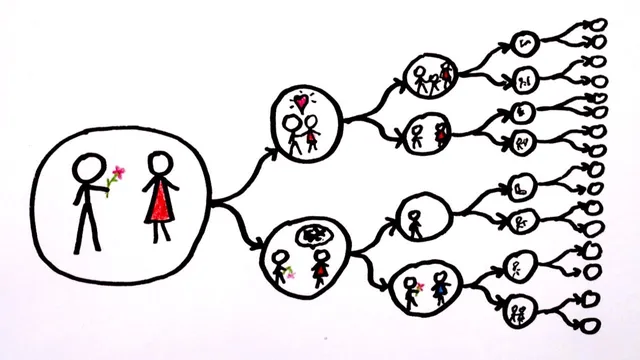
Type 3 is the many-worlds interpretation of quantum mechanics, which targets a different problem: what exactly causes the wavefunction to “collapse.” Many-worlds proposes that every possible outcome of quantum events is realized, with the universe branching into an ever-growing set of alternative histories. The result is a “universal choose-your-own-adventure,” where any timeline that can occur does occur—though any observer only experiences one branch.
Even without direct confirmation, these ideas suggest possible tests. If bubble universes or branes are real and could collide, such an event might leave detectable signatures in the observable sky. Many-worlds, meanwhile, may become testable as experiments gain control over larger quantum systems, pushing closer to the boundary between quantum behavior and everyday reality. The throughline is strict: physics requires claims that can, in principle, be tested and then tested—turning multiverse speculation into something that could eventually face data rather than remain pure philosophy.
Cornell Notes
“Multiverse” in physics usually means one of three theoretical models, not the casual “alternate life” fantasy. The models are: (1) bubble universes (or baby black hole universes) with possibly different laws of physics in disconnected regions; (2) branes in extra dimensions, where our 3D world is a surface embedded in a higher-dimensional space; and (3) many-worlds, where quantum outcomes all occur via branching histories instead of wavefunction collapse. None has experimental confirmation so far. The key reason the ideas matter is that each offers a route to potential evidence—bubble/brane collisions could affect what we observe, while many-worlds might be probed as quantum experiments manipulate increasingly large systems.
Why does the discussion distinguish “universe” from “observable universe” when talking about multiple universes?
What is the core idea behind the bubble (baby black hole) multiverse, and what does it try to explain?
How do branes and extra dimensions generate multiple “universes” in the Type 2 model?
What problem does the many-worlds interpretation address, and what does it claim happens to quantum outcomes?
What kinds of tests are suggested for bubble/brane models versus many-worlds?
Review Questions
- Which meaning of “universe” is most important for avoiding confusion when discussing multiple universes, and why?
- Compare the selection logic in the bubble multiverse with the branching logic in many-worlds—what does each assume about why we observe our particular universe?
- What observational or experimental signatures would be most relevant to testing bubble/brane collisions versus many-worlds?
Key Points
- 1
Physics typically uses “multiverse” to refer to specific theoretical models rather than casual alternate-life speculation.
- 2
“Observable universe” is the practical region of the cosmos we can detect; multiple observable regions can exist without implying the entire universe is duplicated.
- 3
Bubble multiverse models propose disconnected regions (possibly inside black holes) with potentially different physical laws, using an anthropic selection argument.
- 4
Brane multiverse models treat our 3D world as a surface embedded in a higher-dimensional space (the transcript mentions 9 spatial dimensions), allowing other branes to behave like separate universes.
- 5
Many-worlds replaces wavefunction collapse with branching: every possible quantum outcome occurs in a growing set of real histories.
- 6
None of the three multiverse models has experimental confirmation so far, but each suggests possible routes to testing.
- 7
Potential tests include signatures from bubble/brane collisions in the sky and laboratory control of increasingly large quantum systems for many-worlds-related predictions.