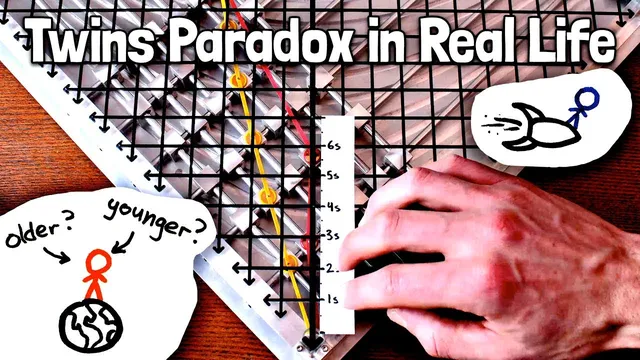
The Twins Paradox Hands-On Explanation | Special Relativity Ch. 8
Based on minutephysics's video on YouTube. If you like this content, support the original creators by watching, liking and subscribing to their content.
Treat the traveling twin’s trip as two inertial legs separated by a turnaround, not as one continuous inertial motion.
Briefing
The twins paradox resolves cleanly once the journey is treated as two different spacetime perspectives: the traveling twin’s worldline switches frames when they turn around, while the stay-at-home twin’s perspective never changes. In the setup used here, one twin remains on Earth for 12 seconds, while the other travels outward at one-third the speed of light for 6 seconds (as measured in Earth’s frame), turns around, and returns at the same speed for another 6 seconds. The paradox wording—“each person views the other’s time as passing more slowly”—sounds like it should imply both twins age the same amount, but the turnaround forces a break in the symmetry.
A spacetime diagram makes that break visible. The outward leg is analyzed by transforming the diagram into the traveling twin’s frame so their worldline becomes vertical (meaning they are at rest in that perspective). In that transformed view, the outward trip lasts about 5 and 2/3 seconds for the traveling twin. The return leg requires a second transformation, because the traveling twin is moving in the opposite direction relative to Earth; making the return segment vertical in the diagram again yields about 5 and 2/3 seconds for that leg. Adding the two proper-time segments gives roughly 11.3 seconds total for the traveling twin, while the stay-at-home twin experiences 12 seconds. The result: the Earth twin is older when they reunite.
The core reason is not that “time dilation” is wrong, but that the phrase “each person views the other’s time as passing more slowly” applies only within a single inertial frame. During the turnaround, the traveling twin cannot maintain one continuous inertial perspective; their journey is stitched together from two inertial segments with different Lorentz transformations. That’s why the traveling twin accumulates two different proper-time intervals, while the Earth twin accumulates one.
The explanation also connects the diagram method to proper time (spacetime intervals). For each leg, the traveling twin covers a distance equal to what light would travel in 2 seconds (“2 light-seconds”) while the Earth-frame time for that leg is 6 seconds. Using the proper-time relation (square root of the difference of the squared interval components) yields 5.66 seconds per leg—matching the spacetime-globe measurement. The hands-on approach is presented as a way to turn the algebraic resolution into an intuitive “gut-level” understanding, emphasizing that the paradox is linguistically confusing rather than physically inconsistent.
Cornell Notes
The twins paradox hinges on the fact that the traveling twin’s trip consists of two inertial legs with different frames, because the turnaround changes their direction. In the example given, Earth measures 12 seconds total (6 seconds out and 6 seconds back) at one-third the speed of light. When the spacetime diagram is transformed into the traveling twin’s frame for each leg, each segment lasts about 5.66 seconds for the traveler, so the total is about 11.3 seconds. The Earth twin therefore ages more. Proper time (spacetime intervals) reproduces the same result without relying on Lorentz transformations, because it directly computes the time accumulated along each leg’s interval.
Why doesn’t the “each twin sees the other’s clock running slow” idea force the twins to age equally?
How does the spacetime-diagram method show the traveling twin’s time is shorter?
What are the specific numbers in the example, and how do they lead to the final comparison?
How does proper time reproduce the same result without Lorentz transformations?
What is the key physical reason the turnaround matters?
Review Questions
- In the given setup, why must the spacetime diagram be transformed twice for the traveling twin?
- Using the example’s numbers (one-third the speed of light, 6 seconds out and 6 seconds back in Earth’s frame), what proper-time value is obtained for each leg and how does it compare to 12 seconds?
- How does the concept of proper time (spacetime intervals) clarify what “time dilation” means in each inertial frame?
Key Points
- 1
Treat the traveling twin’s trip as two inertial legs separated by a turnaround, not as one continuous inertial motion.
- 2
A spacetime diagram resolves the paradox by transforming frames so the traveling twin’s worldline is vertical for each leg.
- 3
In the example, Earth measures 12 seconds total (6 seconds out + 6 seconds back), while the traveling twin accumulates about 11.3 seconds total.
- 4
The traveling twin’s total aging is the sum of two proper-time intervals, each computed in the appropriate frame for that leg.
- 5
The turnaround breaks the symmetry behind the phrase “each person views the other’s time as passing more slowly.”
- 6
Proper time (spacetime intervals) can compute the same durations directly, reproducing about 5.66 seconds per leg without relying on Lorentz transformations.