The Txt File That Almost Destroyed Valve's TF2 Economy | Prime Reacts
Based on The PrimeTime's video on YouTube. If you like this content, support the original creators by watching, liking and subscribing to their content.
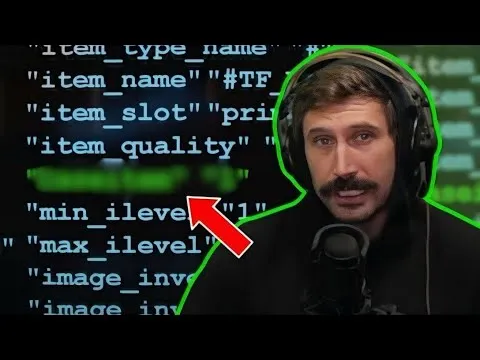
TF2’s crates-and-keys economy relied on a client-side “items game txt” file that defined item attributes and tool behavior.
Briefing
Team Fortress 2’s hat-and-key economy didn’t just grow into a $50 million machine—it also became vulnerable because Valve relied on a single client-side “items game txt” file to define how weapons, hats, crates, keys, and other monetized items behave. As the economy expanded after 2008, players found ways to manipulate that file, effectively turning a local configuration into a lever for economic fraud—sometimes without even needing to “hack” the server.
In the early TF2 years, the game had limited maps, basic loadouts, and no hats. That changed in 2009 with the item drop system, where more play time meant a higher chance of random items. Then the real shift arrived with the Mann vs. Machine and, more importantly, the full economy update: crates and keys. Crates functioned like loot boxes—free to obtain through play, but requiring a key to open, with keys sold through Valve’s Mann Co. Store and then made tradeable on the community market. The result was a self-regulating trading ecosystem designed to keep free-to-play players engaged while monetizing “unusual” items that were mostly cosmetic but wildly valuable.
The core problem was technical: “items game txt” acted as an item schema and attribute database, listing every item and its properties. While the inventory itself lived on Valve’s servers, the file still controlled critical client-side logic—meaning players could edit attributes locally and test outcomes. A key exploit credited to a player named “Game Master 1379” involved copying attributes from one item type to another. By renaming or re-assigning attributes using in-game tools like name tags, players could create “fake” items that appeared legitimate to the client. Valve initially responded by patching the specific misuse and then escalating to a blunt countermeasure: forcing the game to redownload the 7MB items game txt on every launch so local edits would be overwritten.
That redownload approach didn’t end the story. Other researchers found ways to interfere with the redownload process (for example, by blocking access via the host file), then trick the game into treating items as owned or base-item-like. In some cases, items could become “real” when the client presented them in a way the server accepted—until the server-side copy overrode the client. Later, Valve introduced additional restrictions, including enforcing that only rename operations could apply to items actually owned by the player.
The exploit chain kept evolving as Valve added new monetization tools. Giftapult (introduced later) and the Strangifier (a tool meant to convert specific items into “strange” variants) both became targets because their behavior was still regulated through the same items game txt attribute system. Players discovered that certain tool attributes could be repurposed to affect crates and keys, enabling cheap “giftable” or key-like outcomes. Valve eventually added a signature check in October 2014 to make editing the file impossible without breaking the game.
The takeaway is less about one bug and more about design debt: a single text-based item schema became the control center for a massive, real-money trading ecosystem. Each patch reduced one avenue, but the repeated pattern—edit a local schema, find a new attribute mismatch, then patch again—shows how difficult it is to secure an economy when core rules are distributed to the client.
Cornell Notes
TF2’s economy hinged on crates, keys, and tradeable items, but it also depended on a single client-side “items game txt” file that defined item attributes and how tools like name tags, gift items, and strange conversion behaved. Players learned that editing or blocking this file could let them create or repurpose item attributes locally, sometimes leading to economic abuse. A major early breakthrough (credited to “Game Master 1379”) showed that the game lacked client-side checks for item-type compatibility, and Valve responded by forcing a redownload of the file every launch. Later exploits targeted the same workflow—especially when new monetization tools (like Giftapult and the Strangifier) still relied on the same attribute system. Valve ultimately added a signature check in October 2014 to prevent tampering by making the game fail to boot if the file was modified.
Why did TF2’s “items game txt” become a security risk once the economy expanded?
How did crates and keys turn TF2 into a trading economy worth real money?
What was the significance of the “Game Master 1379” exploit?
Why didn’t Valve’s “redownload the file every launch” fix fully stop tampering?
How did later monetization tools keep getting pulled into the same exploit pattern?
What finally made editing the file impractical?
Review Questions
- What role did “items game txt” play in TF2’s economy beyond just listing items?
- Describe one way players used attribute mismatches (renaming or copying attributes) to create economic advantage.
- Why did signature checks matter more than repeated redownloads in the long run?
Key Points
- 1
TF2’s crates-and-keys economy relied on a client-side “items game txt” file that defined item attributes and tool behavior.
- 2
Players exploited attribute mismatches by copying or repurposing attributes across item types, often using in-game renaming tools to trigger the changes.
- 3
Valve’s early mitigation forced a redownload of the 7MB items game txt on every game launch, overwriting local edits.
- 4
Blocking the redownload process (e.g., via the host file) enabled further tampering, including attempts to exploit “base item” logic.
- 5
New monetization tools like Giftapult and the Strangifier still depended on the same attribute system, so they became targets for similar repurposing attacks.
- 6
Valve ultimately added a signature check in October 2014, making modified items game txt break the game and preventing the core tampering workflow.