The unexpectedly hard windmill question (2011 IMO, Q2)
Based on 3Blue1Brown's video on YouTube. If you like this content, support the original creators by watching, liking and subscribing to their content.
Pick a starting line that begins in a perfectly balanced “middle” position by equalizing the number of points on the left and right sides (with a pivot-counting adjustment when |S| is even).
Briefing
A single, carefully chosen starting line can drive a “windmill” rotation that repeatedly uses every point of a finite planar set as the pivot—infinitely often. The key is to pick the line so that it begins in a perfectly balanced position (a “middle” line), then track a quantity that refuses to change as the pivot hops from point to point. That invariant balance forces the windmill to cycle through all points rather than getting trapped among only some of them.
The setup starts with a finite set S of at least two points in the plane, with the condition that no three points are collinear to avoid ambiguity about which pivot should take over. A windmill process begins with a line L passing through a chosen point P. The line rotates clockwise around P until it first hits another point Q of S; then Q becomes the new pivot, and the line continues rotating clockwise until it hits the next point, and so on forever. The challenge is to show that there exists some choice of P and L such that every point in S becomes a pivot infinitely many times.
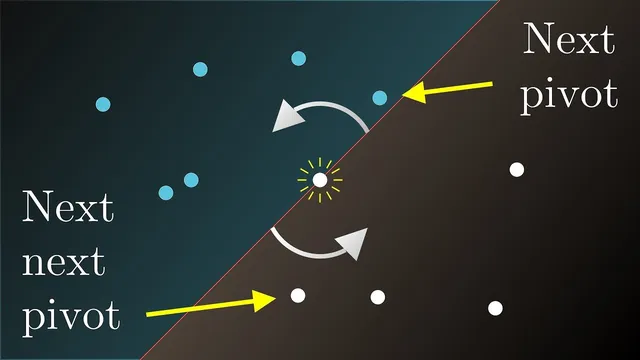
The solution begins by experimenting with small cases: with two points the line alternates; with three points it cycles among them. The first genuinely tricky behavior appears with four points, where a naive starting line can seem to “miss” interior points. The fix is to choose a starting line that runs through a point in the middle of the configuration. To make “middle” precise, the line is given an orientation, splitting the plane into a left side and a right side. For an odd number of points, the starting pivot is chosen so that the number of points strictly on the left equals the number strictly on the right; the pivot itself is treated as neutral. The crucial invariant is then the left–right count: as the rotating line moves from one pivot to the next, points that leave one side are replaced by points that enter the same side, so the number of points on each side stays constant.
Once that invariant is secured, the cycle becomes inevitable. After the line rotates by 180 degrees, it becomes parallel to its starting position. Because the left–right counts must still match the invariant, the only way to maintain the balance is for the line to pass through the same starting pivot again. Meanwhile, a half-turn swaps which points lie on the left versus the right, so the line must have hit every other point during the process. Repeating the motion forever means each point is used as a pivot infinitely many times.
For even |S|, the argument is adjusted slightly by counting the pivot as belonging to one side so that the “equal halves” condition still holds. The same invariant logic forces a return to a corresponding starting configuration after a full 360-degree cycle, again ensuring that all points are visited endlessly.
Beyond the mechanics, the problem’s difficulty is framed as a lesson in mathematical thinking: the hard part isn’t the final invariant-based proof, but the leap to identify a quantity that stays constant amid a chaotic process. That theme—finding invariants—echoes across mathematics and physics, from counting holes in topology to conserving energy and momentum in physics. The windmill puzzle becomes a compact Aesop: when motion is complicated, look for what cannot change.
Cornell Notes
A windmill process rotates a line through a finite set of points, switching the pivot to the next point the line hits. The goal is to choose a starting point P and line L so that every point becomes a pivot infinitely many times. The solution picks L so it starts in a “middle” position: the number of points on the left side equals the number on the right side (with a small modification when the total number of points is even). As the line pivots from point to point, this left–right count stays invariant. After a 180° (odd case) or 360° (even case) rotation, the line must return to a starting pivot configuration, forcing the process to cycle through all points repeatedly.
What exactly is the windmill process, and why does the “no three collinear” condition matter?
How does the solution make the vague idea of a “middle” line precise?
What invariant stays constant during the windmill’s motion, and why doesn’t it change?
Why does a 180° rotation force the line to return to the starting pivot in the odd-point case?
How does the even-point case differ, and why does it require a 360° cycle?
Review Questions
- In the odd-|S| case, what left–right equality condition determines the starting pivot, and how is the pivot treated in the count?
- What is the invariant quantity during the windmill’s rotation, and what local geometric event ensures it stays constant?
- Why does the line’s parallel position after a half-turn (or full turn) constrain which pivot it can pass through next?
Key Points
- 1
Pick a starting line that begins in a perfectly balanced “middle” position by equalizing the number of points on the left and right sides (with a pivot-counting adjustment when |S| is even).
- 2
Track the left–right point count relative to the oriented line; this count is invariant under the pivot-switching dynamics.
- 3
When the line hits a point on one side, the old pivot necessarily ends up on the same side after the pivot changes, preventing the invariant from changing.
- 4
In the odd-point case, a 180° rotation forces the line to return to the original pivot, and the half-turn’s left/right swap implies every point is hit during the cycle.
- 5
In the even-point case, the same invariant logic yields a cycle that returns to the original pivot only after 360°, still guaranteeing infinite repetition across all points.
- 6
The proof’s core move is identifying a quantity that stays constant amid a seemingly chaotic process, turning motion into a forced cycle.