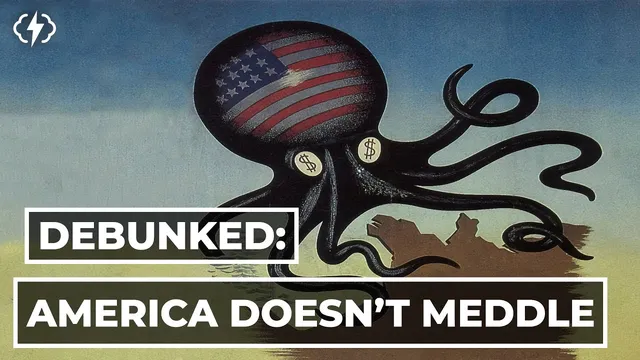
"The US Doesn't Meddle In Foreign Affairs"
Based on Second Thought's video on YouTube. If you like this content, support the original creators by watching, liking and subscribing to their content.
The transcript claims the U.S. has interfered in foreign elections repeatedly, citing a figure of more than 80 elections affected between 1946 and 2000.
Briefing
The central claim is blunt: the United States routinely meddles in foreign affairs—especially other countries’ elections—and does so not to defend democracy but to protect U.S. interests, including resource access, military leverage, and the suppression of left-wing political alternatives. That message matters because it directly challenges a common U.S. justification for intervention, including the familiar “we’re defending democracy” line used in response to allegations like Russia’s alleged interference in U.S. elections.
The argument begins by contrasting U.S. rhetoric with historical record. While U.S. leaders frame election meddling by rivals as uniquely dangerous, the transcript points to a broader pattern of espionage and covert action as normal tools of statecraft across major powers. It then pivots to election interference specifically, citing a figure that the United States interfered in more than 80 foreign elections between 1946 and 2000. The list of named targets includes Italy, Iran, Japan, Brazil, Costa Rica, Chile, Uruguay, El Salvador, Panama, Nicaragua, Ukraine, Russia, Mongolia, and Palestine, among others—alongside the claim that coups and invasions also followed World War II.
To reinforce the point, the transcript uses a direct admission attributed to former CIA director James Woolsey, who reportedly acknowledged efforts to undermine democratic processes for U.S. interests, while claiming such actions were “for the good of the system” and to prevent communists from taking over. The transcript challenges the logic of that defense by arguing that “defending democracy” cannot mean covertly manipulating election outcomes through foreign intelligence channels.
From there, the explanation shifts from “what happened” to “why it happened.” The transcript argues that U.S. interventions—nearly always, with few exceptions—aim to expand imperial reach, secure resources, establish military footholds, overthrow governments that resist U.S. demands, and install more compliant regimes. It further claims that the most targeted governments are those moving toward left-wing economic policies, because worker-centered reforms could offer a real alternative to capitalism and inspire similar movements elsewhere.
The transcript then illustrates the claim with two Latin American case studies. In Chile, it describes the 1973 coup that ousted democratically elected socialist president Salvador Allende, portraying the U.S. as having plotted to overthrow him and support the military takeover led by Augusto Pinochet. It links the aftermath to mass repression—torture, executions, disappearances—and cites the helicopter “disappearances” as a hallmark of the regime. In Nicaragua, after the Sandinistas overthrew the Somoza dictatorship in 1979, it describes U.S. covert action authorized by Ronald Reagan in 1981, including funding, arming, and training the Contras. The transcript alleges the CIA provided materials for “psychological operations in guerrilla warfare,” encouraging assassinations and tactics intended to sow chaos and build support for the Contra cause, resulting in a death toll exceeding 50,000.
Finally, the transcript argues the pattern is ongoing, pointing to alleged U.S.-linked right-wing opposition movements and claiming U.S. intelligence involvement in undermining socialist electoral candidates. It broadens the frame beyond Latin America to coups and interventions in the Middle East and Asia, and it ties the overall strategy to large-scale propaganda operations and a network of military bases surrounding China. The conclusion urges audiences to distrust official claims that the U.S. does not meddle abroad and to seek non-Western sources and firsthand accounts to “deconstruct” imperialist narratives.
Cornell Notes
The transcript argues that the United States has repeatedly interfered in foreign elections and broader political outcomes, contradicting claims that it “doesn’t meddle in foreign affairs.” It cites a historical tally of more than 80 foreign elections affected by the U.S. between 1946 and 2000 and lists multiple countries where election outcomes were targeted. It also uses an attributed admission from former CIA director James Woolsey to claim that covert action is undertaken for U.S. interests, not to protect democracy. The transcript then links intervention to a consistent motive: blocking left-wing, worker-centered economic projects that could challenge capitalism and inspire alternatives. Case studies in Chile (1973) and Nicaragua (1981 onward) are used to illustrate coups, covert funding, and violent repression as part of that strategy.
What evidence is offered that the U.S. interferes in foreign elections, not just in response to rivals’ actions?
How does the transcript use James Woolsey’s comments to challenge U.S. justifications?
What motive does the transcript claim lies behind most U.S. interventions?
How is Chile (1973) presented as an example of election-related or democratic rollback meddling?
What does the transcript claim happened in Nicaragua after the Sandinistas took power?
How does the transcript argue the pattern continues beyond historical cases?
Review Questions
- Which countries are named as targets of U.S. election interference in the transcript, and what time window is given for the overall tally?
- What motive does the transcript assign to U.S. interventions, and how does it connect that motive to opposition to left-wing economic policies?
- How do the Chile and Nicaragua case studies differ in the mechanisms described (coup support vs. covert funding and training), and what outcomes are claimed in each?
Key Points
- 1
The transcript claims the U.S. has interfered in foreign elections repeatedly, citing a figure of more than 80 elections affected between 1946 and 2000.
- 2
It argues U.S. leaders’ “defending democracy” framing collapses when covert intelligence actions are used to influence election outcomes.
- 3
It attributes a consistent motive to U.S. interventions: securing resources, expanding influence, gaining military leverage, and installing compliant regimes.
- 4
The transcript says left-wing, worker-centered economic reforms are a key target because they could offer an alternative to capitalism.
- 5
Chile (1973) is presented as a case where a democratically elected socialist president, Salvador Allende, was overthrown with CIA support, followed by Pinochet’s repression.
- 6
Nicaragua is presented as a case where U.S. covert operations funded and armed the Contras after the Sandinistas took power, with alleged guidance for violent “psychological operations.”
- 7
The transcript concludes that meddling continues, pointing to alleged recent opposition movements linked to U.S. intelligence activity.