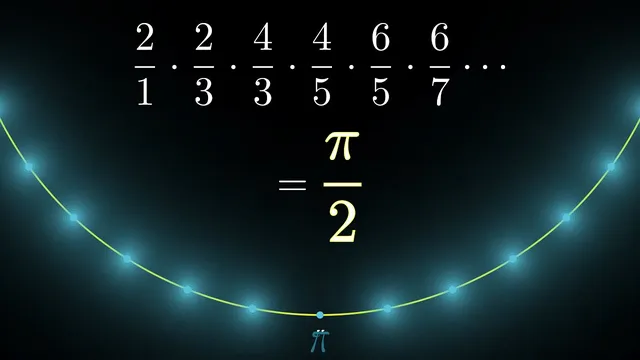
The Wallis product for pi, proved geometrically
Based on 3Blue1Brown's video on YouTube. If you like this content, support the original creators by watching, liking and subscribing to their content.
The Wallace product is an interleaved infinite product (2/1)(2/3)(4/3)(4/5)(6/5)(6/7)… that converges to π/2.
Briefing
A carefully chosen infinite product of simple fractions— (2/1)·(2/3)·(4/3)·(4/5)·(6/5)·(6/7)·…—converges to π/2. The result, known as the Wallace product, matters because it turns a seemingly arithmetic expression into a geometric quantity tied to circles, and it does so with a proof that leans on complex numbers and the algebra of evenly spaced points.
The construction starts by looking at products built from even and odd integers. If all even numbers sit in the numerator and all odd numbers in the denominator, the partial products grow without bound. If the roles are reversed by shifting indices slightly, the partial products shrink toward 0. The Wallace product sits between these extremes: it interleaves factors so the partial products rise and fall in smaller and smaller steps, settling to a finite limit.
To connect this interleaved product to π, the argument switches to geometry. Imagine n “lighthouses” equally spaced on the unit circle in the complex plane, with one extra “observer” point. Instead of adding distances (as in the Basel-problem lighthouse story), the proof multiplies distances from the observer to each lighthouse, defining a “distance product.” Two key lemmas about this distance product drive everything:
1) If the observer is exactly halfway between two adjacent lighthouses, the distance product equals 2, regardless of n. 2) If the observer sits on top of one lighthouse, the full distance product is 0, but removing that lighthouse’s contribution leaves a distance product equal to n.
Complex numbers make these lemmas tractable. The n lighthouses are the n-th roots of unity, the solutions to x^n − 1 = 0. Plugging an observer’s complex coordinate into the polynomial factorization turns the product of distances into the magnitude of a simple expression involving z^n − 1. When the observer lies at a fraction f of the way around the circle between two lighthouses, the distance product becomes the chord length “cord of f,” and the special case f = 1/2 gives the constant value 2.
With the lemmas in place, two observers are introduced: a “keeper” placed on a lighthouse and a “sailor” placed halfway between that lighthouse and the next. Comparing the keeper’s distance product (with the zeroed lighthouse removed) to the sailor’s distance product yields a ratio that equals n times the distance between the observers divided by 2. The same ratio can also be computed lighthouse-by-lighthouse: as n grows, each lighthouse’s contribution approaches a rational factor like 2/1, 2/3, 4/3, 4/5, 6/5, 6/7, and so on. Meanwhile, the distance between adjacent points on the unit circle is about π/n, so the ratio tends to π/2. That limit is exactly the Wallace product.
The proof also flags a subtlety: exchanging limits and infinite products is not automatically valid. Here, dominated convergence supplies the needed justification for the specific one-for-one interleaving of factors. Finally, the same framework generalizes: moving the sailor to a fraction f between lighthouses produces an infinite product formula for sin(πf), linking the Wallace-style circle geometry back to Euler’s product for sine and, indirectly, to the Basel problem’s heritage.
Cornell Notes
The Wallace product is an interleaved infinite product of fractions built from even and odd integers: (2/1)(2/3)(4/3)(4/5)(6/5)(6/7)… . By placing n equally spaced points (the n-th roots of unity) on the unit circle and defining a “distance product” as the product of distances from an observer to all points, two facts emerge: halfway between adjacent points the distance product is always 2, and when the observer sits on a point, removing that point’s zero contribution leaves distance product n. Comparing a keeper (on a point) to a sailor (halfway between points) gives a ratio that also factors into the rational terms of the Wallace product. As n→∞, the ratio approaches π/2, so the product converges to π/2. A dominated-convergence argument justifies the limit/product interchange for this specific interleaving.
Why do the “all-even over all-odd” and “shifted” products behave so differently, and what does the Wallace product change?
What are the two lemmas about the distance product, and how do they stay true for any number of lighthouses n?
How do roots of unity and the polynomial x^n − 1 connect to multiplying distances?
Why does the ratio “keeper distance product / sailor distance product” produce the specific rational factors 2/1, 2/3, 4/3, 4/5, …?
What role does π enter, and why does the limit become π/2?
What subtle issue arises when turning infinitely many factors into a limit, and how is it handled?
Review Questions
- How do the two lemmas about the distance product (value 2 at the midpoint and value n after removing a coincident lighthouse) combine to produce a computable ratio?
- Where exactly do the rational factors in the Wallace product come from in the lighthouse-by-lighthouse ratio, and what approximation becomes accurate as n→∞?
- What goes wrong in general when exchanging limits and infinite products, and why does dominated convergence matter for this argument?
Key Points
- 1
The Wallace product is an interleaved infinite product (2/1)(2/3)(4/3)(4/5)(6/5)(6/7)… that converges to π/2.
- 2
A geometric “distance product” over n equally spaced points on the unit circle can be evaluated using complex numbers and the roots of unity of x^n − 1.
- 3
Placing the observer halfway between adjacent points forces the distance product to equal 2 for every n.
- 4
Placing the observer on a lighthouse makes the full product 0, but removing that point’s factor leaves distance product n.
- 5
Comparing a keeper (on a lighthouse) to a sailor (halfway between lighthouses) yields a ratio that both equals the Wallace product and tends to π/2 as n grows.
- 6
The proof requires careful justification for exchanging limits with infinite products; dominated convergence supports the specific interleaving used.
- 7
The same method generalizes from the midpoint case to a fraction f between lighthouses, producing an infinite product formula for sin(πf).