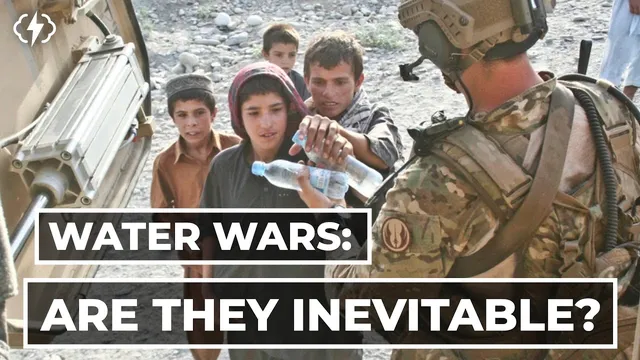
The Water Wars Are Coming
Based on Second Thought's video on YouTube. If you like this content, support the original creators by watching, liking and subscribing to their content.
Only about 1% of Earth’s water is readily available fresh water for human consumption, making shortages highly sensitive to climate and demand changes.
Briefing
Water scarcity is tightening fast enough to turn a basic survival need into a driver of instability—starting with food systems and cascading into local violence, cross-border disputes, and potentially militarized “resource security.” Fresh water is only a small slice of Earth’s total supply: about 70% of the planet is covered by water, but most is salty, and only roughly 3% is fresh. Of that, around two-thirds is locked in ice caps and glaciers, leaving about 1% as readily available water for human use. Climate change and rising demand are shrinking that already-thin margin, and the consequences are showing up in real places rather than remaining theoretical.
Civilizations cluster near fresh water—about 90% of human populations live within 10 kilometers of it—and when cities mismanage supplies, the fallout can be severe. Mexico City’s water crisis traces back to the Spanish draining a lake to expand the city; today it faces acute shortages while serving more than 20 million people. Cape Town offered a stark preview of what “day zero” looks like: a severe shortage in 2017 led to a countdown to complete shutdown, but rationing and public response delayed and ultimately stopped the countdown. The warning is that emergency fixes can only buy time; more cities are now heading toward similar shortages, and the burden falls hardest on poorer communities already living with limited buffers.
The scale of the projected disruption is large. A UN assessment cited here says two-thirds of the world will live in water-scarce regions by 2025, potentially displacing up to 700 million people. By 2040, much of the world may not have enough water to meet demand year-round. When water runs short, the effects don’t stay in water pipes. Crop failures and irrigation limits trigger food insecurity; then critical systems begin to fail, raising the risk of violence—first internal (within affected populations) and then external (as governments and groups compete for contested sources). Armed conflict over water has been relatively rare so far—fewer than 30 instances are cited—but the expectation is that this number will rise.
Several forces feed the crisis. Climate change is central: higher global temperatures can make regional weather more erratic, bringing more droughts, wildfires, hotter temperatures, and less precipitation—often in already dry areas. Food demand also matters because water use is embedded in agriculture. Beef is singled out as especially water-intensive: each kilogram of beef is linked to roughly 15,400 liters of water per cow, far beyond what an average consumer might intuit. Beyond production choices, the distribution problem is about allocation of major freshwater systems. The transcript highlights key river basins—Ganges, Nile, Tigris and Euphrates, Indus, and Colorado—where downstream users increasingly receive less water.
The Colorado River example is used to show how fast “new normal” can arrive: it supplies seven states, major cities like Los Angeles and Las Vegas, and millions of acres of farmland; it has been in its 20th year of drought, with Lake Mead at about 39% capacity and Lake Powell at about 36%. Tensions between urban water providers and farmers are described as constant, with states preparing for their own “day zero” scenarios.
Finally, the transcript argues that disputes over water ownership often stem from overuse, poor planning, and dams or diversions that leave downstream populations short—especially along the Nile, where upstream actions can reduce Egypt’s supply. It also claims that powerful countries may respond to water conflict in familiar ways: by seeking control of strategic resources, monetizing scarcity, and using military or political leverage. The overall takeaway is blunt: water wars may not be labeled as such, but the conditions for them—scarcity, inequality, and shared basins—are already forming.
Cornell Notes
Fresh water is scarce in absolute terms and getting scarcer due to climate change and rising demand, pushing more regions toward “day zero” style shortages. Water stress can trigger a domino effect: irrigation failures lead to food insecurity, system breakdown, and increased risk of both internal and cross-border conflict. The transcript highlights major river basins and shows how downstream users often lose out when upstream overuse, dams, and diversions reduce flows. Agriculture choices—especially water-intensive diets like beef—compound the pressure on limited supplies. Inequality and commodification of water are presented as accelerants, making shortages more politically explosive.
Why is fresh water described as such a narrow resource, and what does that imply for future shortages?
What does “day zero” mean, and what lesson does Cape Town provide?
How does water scarcity connect to conflict risk?
Which factors are blamed for worsening water availability, and how do they interact?
What does the Colorado River example illustrate about speed and scale of the crisis?
How do upstream-downstream dynamics create flashpoints in shared basins like the Nile?
Review Questions
- What percentage of Earth’s water is fresh, and how much of that fresh water is actually available for human use?
- Describe the domino effect from water scarcity to food insecurity and then to conflict risk.
- Why does the transcript treat shared river basins as particularly dangerous compared with regions that rely on independent water sources?
Key Points
- 1
Only about 1% of Earth’s water is readily available fresh water for human consumption, making shortages highly sensitive to climate and demand changes.
- 2
Water crises can cascade into food insecurity and system failures, raising the likelihood of both internal unrest and external disputes.
- 3
Climate change is linked to more droughts, wildfires, hotter temperatures, and less precipitation—often in already water-stressed regions.
- 4
Agricultural demand, especially water-intensive foods like beef, can significantly amplify pressure on limited water supplies.
- 5
Conflicts often emerge from allocation fights over major river basins, where upstream overuse and infrastructure can reduce downstream access.
- 6
The Colorado River example shows how prolonged drought and low reservoir levels can force rapid planning for “day zero” conditions.
- 7
Shared basins with politically tense neighbors increase the odds that water disputes become flashpoints for broader conflict.