The Wave-function of the Universe Might Finally Be Calculable
Based on Sabine Hossenfelder's video on YouTube. If you like this content, support the original creators by watching, liking and subscribing to their content.
The Cosmohedron proposes a geometric way to compute the universe’s wave function using polygons rather than summing infinitely many Feynman diagrams.
Briefing
A new theoretical framework called the Cosmohedron aims to make the “wave function of the universe” calculable by replacing the usual, unwieldy Feynman-diagram approach with a polygon-based method. If it can be carried far enough, the payoff would be practical: a systematic way to compute how early-universe quantum fluctuations translate into the cosmic structure we observe today—temperature variations in the cosmic microwave background and the large-scale filamentary pattern of galaxies.
In quantum physics, a wave function is the bookkeeping tool that turns microscopic quantum behavior into measurable probabilities. While wave functions for everyday objects are too complex to use, the early universe is different. Cosmologists think the universe began with quantum fluctuations, and those fluctuations seeded later matter distribution. That means the universe’s full wave function isn’t just abstract math; it encodes information that can, in principle, be read out through observable signatures such as CMB temperature fluctuations and the geometry of galactic structures.
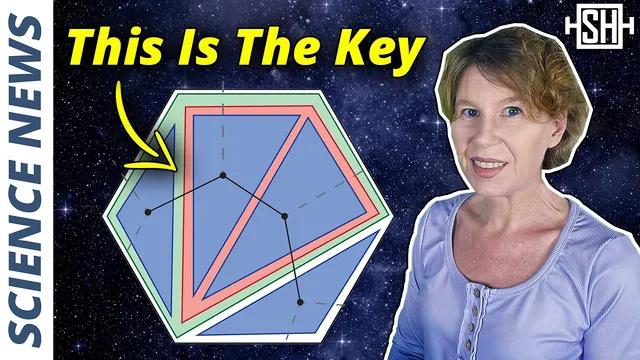
The technical bottleneck is that the standard way to compute quantum interactions—Feynman diagrams—generates infinitely many contributions. Even with computers, summing the most important diagrams first and then adding more is slow and cumbersome. The Cosmohedron approach, built on earlier “Amplituhedron” ideas from particle physics, swaps diagrams for polygons. In this picture, each polygon represents a contribution to the wave function, and each polygon’s edges correspond to particle momenta. Because momentum is conserved at interactions, the momenta of particles entering and leaving an interaction must add up to zero, which geometrically forces them to form a closed shape—a polygon.
Further interactions among the particles correspond to additional structure inside the polygon. Crucially, any polygon can be decomposed into triangles via triangulation. That decomposition creates a nested, systematic way to build up complicated contributions from simpler ones, turning a hard-to-enumerate diagram sum into a more tractable polygon/triangle summation.
The work is described as a step toward making the universe’s wave function computable, but it stops short of producing directly measurable predictions. Still, it matters because the early universe also involves quantum behavior of space and time—an area where quantum gravity is expected to play a role. The formalism is said to already include elements relevant to quantum gravity, suggesting a potential bridge between quantum field theory methods and the physics of spacetime itself.
The broader context is a recurring hope in theoretical physics: that the right mathematical structure could replace brute-force computation. Here, the proposed structure is geometric—polygons and triangulations—offering a new route to the quantum origin story of the cosmos, even if the final, observationally testable calculations remain ahead.
Cornell Notes
The Cosmohedron is a proposed geometric method for calculating the universe’s wave function, aiming to replace the standard Feynman-diagram expansion that becomes infinite and computationally heavy. In quantum physics, the wave function determines probabilities, and in cosmology it matters because early-universe quantum fluctuations seeded later structure. The approach represents contributions using polygons whose edges correspond to conserved particle momenta; momentum conservation forces the momenta to form closed shapes. Triangulation lets any polygon be decomposed into triangles, giving a systematic nested construction for larger contributions. While the framework is not yet tied to new measurable predictions, it could help connect quantum field theory to quantum gravity, since the early universe involves quantum aspects of space and time.
Why does the “wave function of the universe” matter for cosmology rather than staying purely formal?
What makes the usual quantum-calculation method with Feynman diagrams so difficult?
How does the polygon-based Cosmohedron idea mirror the role of Feynman diagrams?
What does triangulation buy the calculation?
Why is this framework interesting for quantum gravity?
Review Questions
- How does momentum conservation determine the geometry of polygons in the Cosmohedron framework?
- What specific observational features of the universe are linked to primordial quantum fluctuations?
- Why does triangulation make the polygon method more computationally manageable than summing Feynman diagrams?
Key Points
- 1
The Cosmohedron proposes a geometric way to compute the universe’s wave function using polygons rather than summing infinitely many Feynman diagrams.
- 2
Early-universe quantum fluctuations are treated as the seeds of later cosmic structure, connecting the wave function to measurable signatures like CMB temperature variations and galaxy filaments.
- 3
In the polygon approach, polygon edges represent particle momenta, and momentum conservation forces those momenta to form closed shapes.
- 4
Triangulation decomposes any polygon into triangles, enabling a systematic nested construction for larger contributions.
- 5
The method is positioned as more tractable for summation than the traditional diagram expansion, though it has not yet produced new directly testable predictions.
- 6
Because the early universe involves quantum aspects of space and time, the framework is viewed as a potential bridge toward quantum gravity.