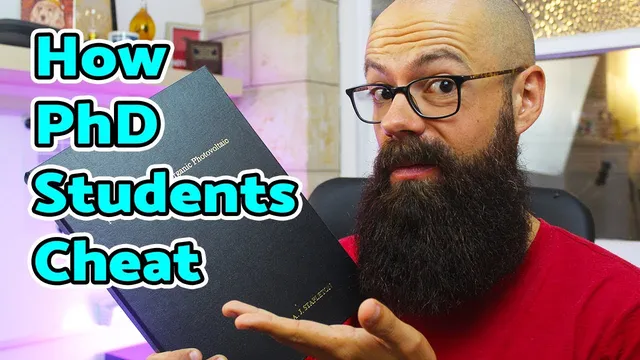
The ways PhD students cheat on their thesis. Avoid doing this...
Based on Andy Stapleton's video on YouTube. If you like this content, support the original creators by watching, liking and subscribing to their content.
PhD theses can be discovered long after graduation because they’re archived and often searchable online, so plagiarism and fabrication risks don’t end at submission.
Briefing
PhD cheating often starts in “gray areas” where improving a thesis slides into misrepresenting what was actually done—and the long tail of consequences can surface years later. Because theses are archived and increasingly searchable online, plagiarism or fabrication can be rediscovered long after graduation. Oral defenses (vivas) add another risk: if someone can’t convincingly explain methods and results, even small inconsistencies can trigger scrutiny and expose who did what.
A high-profile example underscores how serious the stakes can be. In 2011, Germany’s defense minister resigned after major portions of his PhD were found to be plagiarized. The core lesson: a thesis isn’t a private document. Once it’s publicly accessible—through libraries, online repositories, and searchable databases—copied text and questionable claims can be traced.
One common failure mode involves copying from unpublished prior work. A story from within a department describes a person who took large chunks from a related master’s or honors thesis and pasted them into their own work. The transcript stresses that continuing a project is legitimate, but word-for-word copying is not—especially when the earlier thesis is typically not indexed like journal articles. The advantage for cheaters is that external examiners may not have read internal documents, making plagiarism harder to detect. Still, the remedy is straightforward: write in one’s own words, and if text is truly reused, provide robust, direct referencing rather than swapping a few terms.
Another major category is manipulating or selectively presenting results. In experimental science, repeatability can be difficult; the transcript gives an example of a solar cell made only once, with analysis that couldn’t be reproduced. Presenting that honestly—clearly stating what was done, what was observed, and what couldn’t be repeated—can be acceptable in a thesis because theses often allow more flexibility than peer-reviewed papers. The risk appears when “only once” or “not reproducible” details are omitted or softened, turning a limited observation into an implied breakthrough.
Collaboration is also a frequent gray zone. Sharing expertise and even having others perform early-stage experiments can be legitimate, but the thesis must accurately attribute who collected which results. The transcript describes keeping chronological clarity while clearly distinguishing contributions, including explicitly noting when results were collected by someone else using the student’s materials.
Finally, the transcript warns about outsourcing writing. Editing by supervisors is normal, but hiring services—or having someone else write large sections—can erode ownership. Translation can be a legitimate support for non-native English writers, yet the line is crossed when the work handed back is effectively someone else’s phrasing and interpretation rather than the student’s own meaning. The practical test offered is ownership: improvements should preserve underlying intent and evidence, not replace it.
Across all these scenarios, the message is consistent: cheating may delay detection, but it tends to surface—during a viva, through later scrutiny, or when supervisors recognize work that wasn’t primarily authored by the candidate. The transcript frames the alternative as better: earn the rewards from the struggle of doing the work oneself.
Cornell Notes
PhD misconduct often begins as “improvement” but becomes misrepresentation when credit, authorship, or evidence is handled dishonestly. Major risks include plagiarism from prior theses, fabrication or selective presentation of results, unclear attribution of collaborative work, and outsourcing writing so the candidate loses ownership of the meaning. Because theses are archived and increasingly searchable—and because vivas require candidates to defend methods and claims—problems can be uncovered years later. The transcript emphasizes that limited or non-reproducible findings can be acceptable if fully disclosed, and that collaboration is fine if contributions are clearly attributed.
Why does plagiarism from unpublished theses still carry high risk for a PhD student?
What’s the difference between honest reporting of limited results and cheating with results?
How can collaboration become a “gray zone” in a thesis?
When does editing or translation drift into writing-for-hire territory?
What role do vivas play in detecting misconduct?
Review Questions
- What specific practices help distinguish legitimate collaboration from misattributed work in a thesis?
- How should a student present a result that is not reproducible, and what omission would turn it into a cheating risk?
- What indicators during a viva could suggest that a candidate did not have primary authorship of key parts of the thesis?
Key Points
- 1
PhD theses can be discovered long after graduation because they’re archived and often searchable online, so plagiarism and fabrication risks don’t end at submission.
- 2
Copying word-for-word from prior theses is a clear red line, even if the earlier work is unpublished and not easily indexed.
- 3
Limited or non-reproducible results can be acceptable in a thesis when fully disclosed, but implying stronger evidence than what was actually achieved crosses into misconduct.
- 4
Collaboration is fine when contributions are accurately attributed; unclear authorship of experiments and results is a common gray-zone failure.
- 5
Outsourcing writing or translation can become cheating when it replaces the candidate’s ownership of meaning rather than improving what the candidate already wrote.
- 6
Vivas increase detection risk because candidates must defend methods and claims; weak or inconsistent explanations can trigger deeper investigation.
- 7
A practical self-check is discomfort: if a thesis process feels “awkward” or like ownership is slipping, it’s a warning sign to stop and correct course.