The White House Won't Stop Posting Nazi Propaganda. Here's Why.
Based on Second Thought's video on YouTube. If you like this content, support the original creators by watching, liking and subscribing to their content.
Official messaging is described as borrowing from white nationalist and Nazi-era themes, including slogans, victimhood narratives, and appeals to white supremacy.
Briefing
The White House’s use of Nazi-leaning propaganda isn’t treated as an accident or a one-off controversy—it’s framed as a deliberate political project built to fuel escalation, distract from economic failure, and keep a far-right base in a loop of anxiety and revenge.
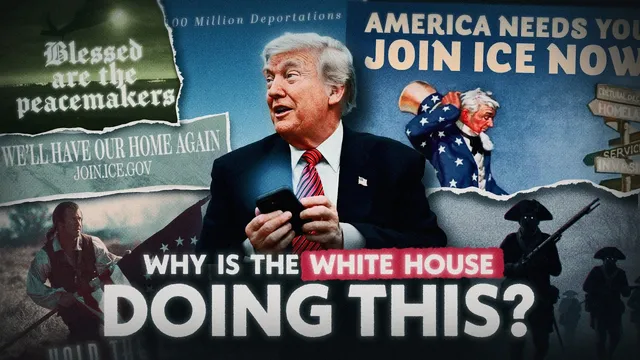
In recent months, government-linked accounts and officials have posted imagery and slogans drawn from right-wing and white nationalist circles, including content that resembles Nazi-era messaging. Examples cited include banners and promotional posts on DHS and other official channels using white nationalist lyrics and neo-Nazi slogans, along with rhetoric that casts immigration as an “invasion,” labels opponents “wicked and evil,” and frames supporters as heirs to a Roman imperial legacy while urging defense of a “declining” (less white) nation. A speech by White House deputy chief of staff Steven Miller at a Charlie Kirk memorial is described as strongly resembling a Nazi propaganda minister’s work, with matching metaphors, imagery, victimhood framing, and appeals to white supremacy and revenge.
The argument then shifts from symbolism to consequences: the same administration that circulates this rhetoric also denies or distorts reality around state violence. After ICE-related killings of people such as Renee Good, Keith Porter, and Alex Prey, the White House is described as contradicting video evidence and blaming journalists or protesters rather than ICE. The central question becomes why lie when the cruelty is visible. The answer offered is that far-right politics can’t deliver solutions—only adrenaline and revenge—so propaganda becomes a substitute for governance.
A broader historical pattern is used to explain how this mechanism sustains itself. Drawing on Richard Seymour’s Disaster Nationalism, the account describes a recurring arc across fascist and far-right regimes: leaders hijack the language of mainstream politics (including promises aimed at working people), then govern through radical violence rather than structural change. When wages, inequality, and living standards fail to improve, the political system turns to escalation. Propaganda dehumanizes outsiders, saturates public messaging with threats, and normalizes violence as heroism. As supporters radicalize, violence spreads beyond official policy—through hate crimes, lone-wolf attacks, and eventually lethal actions by police—creating a feedback loop.
That loop also serves a strategic purpose: killings and repression become a way to redirect attention from economic failure and to present violence as proof the regime is under attack by outsiders. The account compares this to Nazi dynamics, where anti-Semitic rhetoric and persecution intensified before it became formal law, and where repression increased as Germany’s war prospects collapsed. The claim is that mass violence never runs out of enemies because it never produces lasting results; it only deepens fear and the demand for more brutality.
In the end, the White House’s propaganda is portrayed as spectacle without substance: not building policy wins like labor protections or healthcare, but staging conflict—because for a movement driven by anxiety and collective hate, the momentary relief of “someone is doing something” eventually returns as a need for the next round of violence.
Cornell Notes
The account argues that the White House’s Nazi-leaning propaganda is part of a broader far-right strategy rather than isolated “bad optics.” It points to official posts and speeches using white nationalist and neo-Nazi imagery, slogans, and rhetoric about immigration, enemies, and national decline. It connects that messaging to state violence and denial of evidence around ICE killings, arguing that lies and propaganda are tools to sustain adrenaline and revenge when real solutions fail. A historical pattern—promise, failure, mutual radicalization, and escalating repression—is used to explain why violence becomes self-reinforcing. The stakes are political: spectacle replaces governance, and violence keeps expanding because it never resolves the underlying anxiety.
What concrete examples are cited to show Nazi-leaning messaging coming from official channels?
Why does the account claim the administration would lie about state violence if the cruelty is visible?
How does the account explain the far-right pattern of escalation after economic or policy failure?
What role does violence play in distracting from governance failures?
How does the account use Nazi history to argue that mass violence becomes self-perpetuating?
What does the account say far-right regimes avoid doing when it comes to policy?
Review Questions
- Which types of official messaging are presented as evidence of Nazi-leaning influence, and what themes do they share (e.g., immigration framing, enemy language, national identity)?
- How does the account connect propaganda, denial of evidence, and escalating violence into a single feedback loop?
- What historical parallels are used to argue that violence becomes self-perpetuating even when it fails to solve underlying problems?
Key Points
- 1
Official messaging is described as borrowing from white nationalist and Nazi-era themes, including slogans, victimhood narratives, and appeals to white supremacy.
- 2
DHS and other government-linked social media posts are cited for using white nationalist lyrics and neo-Nazi slogans.
- 3
A speech by White House deputy chief of staff Steven Miller is described as resembling Nazi propaganda messaging in metaphors, imagery, and framing.
- 4
The account links propaganda to denial and distortion of evidence surrounding ICE-related killings, arguing that lies help sustain a revenge-driven political project.
- 5
Far-right politics is portrayed as relying on adrenaline and collective hate rather than policy solutions, especially when economic outcomes disappoint.
- 6
A recurring historical cycle is described: hijack mainstream rhetoric, fail to deliver, dehumanize outsiders, escalate violence, and then use violence to distract from governance failures.
- 7
Nazi history is used to argue that mass violence expands because it never resolves fear, so the demand for more enemies and more brutality persists.