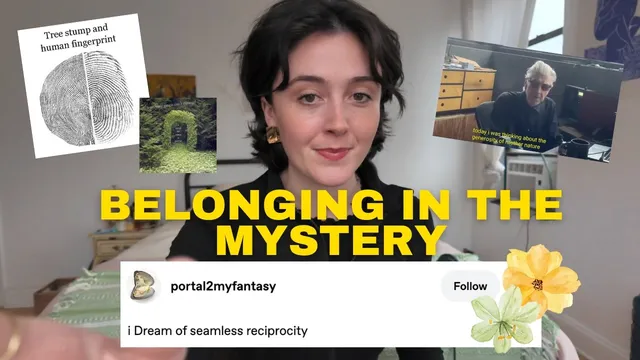
The World Is Re-Enchanted When We Pay Attention To Trees
Based on Anna Howard's video on YouTube. If you like this content, support the original creators by watching, liking and subscribing to their content.
Childhood animism is presented as a natural human tendency that can build empathy, but it can also bias scientific interpretation toward human-like minds.
Briefing
The central thread running through this episode is a call to “re-enchant” everyday life by paying attention to trees and other nonhuman beings—while also taking seriously what science can and can’t currently prove about plant intelligence and consciousness. The episode links childhood animism, ecological reciprocity, and a growing scientific debate over whether plants “see,” “hear,” “remember,” or otherwise exhibit intelligence-like capacities. That matters, the host argues, because how people interpret nature shapes both personal hope and public messaging—especially at a time when many feel alienated by human systems.
Early on, the episode grounds the discussion in human psychology: children naturally attribute life and intention to the world around them. It cites anthropological and developmental claims that young kids treat grasshoppers, pavement, and flowers as if they might feel or respond, and it connects that instinct to the way children’s stories often animate forests and objects. The episode also frames anthropomorphism as a double-edged tool: it can deepen empathy and meaning-making, but it can also mislead when scientific claims get flattened into human-like assumptions.
From there, the episode pivots to a specific contemporary debate in botany. It draws on Zoe Schlinger’s The Lighter Eater, a climate journalist’s deep dive into plant intelligence controversies. The book’s premise is that plant behavior is increasingly studied through questions once reserved for animals and cognition—such as whether plants can perceive, recognize relatives, feel pain, or even “count” time. The episode highlights several striking examples from the research literature as summarized by Schlinger: flowers may function as a kind of hearing organ; strawberries can reproduce using their own pollen; and certain plants can appear to “learn” visitation schedules and adjust their responses accordingly. It also discusses the “chameleon vine” (bokeila), which changes appearance based on neighboring plants, and notes an active dispute over whether the mechanism is true perception or microbial transfer.
A key tension is linguistic. Scientists and researchers often resist terms like “intelligence” or “behavior” for plants, arguing that measuring plants against human cognition distorts what’s actually happening. The episode adds that public understanding is further complicated by scientific hedging language, and it turns to metaphor as a bridge—invoking Theophrastus, often called the father of botany, who used human-centered metaphors to make plant structures intelligible. That leads into a broader conversation about consciousness itself: there is no single scientific definition widely agreed upon, and subjective experience is hard to infer in other beings.
The episode then broadens beyond botany into artificial intelligence and storytelling. It criticizes the marketing habit of lumping many different technologies under “AI,” arguing that this misnomer encourages people to treat systems as intelligent in ways that can displace human judgment. The episode contrasts narratives of domination—nature as inferior resource—with narratives of relationship, drawing on animism as a practice that recognizes power and agency in places, animals, and plants.
Finally, the episode ties the philosophy back to action and hope. It includes a message from a viewer struggling with the unnaturalness of modern life and suggests that despair can be countered by choosing specific advocacy and watching for real-world change. It closes with “crown shyness” as an ecological metaphor: some trees avoid overlapping canopies to maximize shared access to resources, and the episode treats that as a model for mutual care. The takeaway is not a definitive answer to whether plants are conscious, but a shift in attention—toward reciprocity, humility about definitions, and a more relationship-centered way of living.
Cornell Notes
The episode argues that paying close attention to trees and other nonhuman life can “re-enchant” daily existence while also forcing a serious look at what science can currently support about plant intelligence and consciousness. It traces how humans naturally project life onto the world in childhood, then asks when that instinct helps (empathy, meaning) versus when it misleads (human-centered assumptions). Using Zoe Schlinger’s The Lighter Eater as a backbone, it highlights research claims such as plants responding to time schedules, flowers potentially acting like hearing structures, and vines changing appearance in response to neighbors—along with ongoing controversies over wording like “intelligence.” It then connects these debates to AI marketing language and to animism as a relationship practice, concluding that hope can be sustained through concrete advocacy and ecological reciprocity.
Why does childhood animism matter to the plant-intelligence debate?
What kinds of plant “intelligence” examples are highlighted, and why are they controversial?
How does the episode handle the problem of defining consciousness?
What does the episode say about language—especially metaphor—in science communication?
How does AI fit into the episode’s broader argument about intelligence and storytelling?
What practical hope does the episode offer when people feel overwhelmed by “unnatural” systems?
Review Questions
- Which plant examples in the episode are used to suggest intelligence-like capacities, and what mechanism disputes are mentioned?
- How does the episode connect childhood animism to both empathy and scientific caution?
- What distinction does the episode draw between “intelligence” as a human comparison and intelligence-like processing in nonhuman systems?
Key Points
- 1
Childhood animism is presented as a natural human tendency that can build empathy, but it can also bias scientific interpretation toward human-like minds.
- 2
Plant intelligence debates hinge on both evidence and terminology, with researchers often resisting words like “intelligence” or “behavior” as oversimplifications.
- 3
Reported plant findings include time-schedule learning (via a study using a plant called Nasa Poanana), potential “hearing” via flowers, and neighbor-driven shape changes in the bokeila vine.
- 4
Consciousness remains hard to define scientifically; subjective experience (“what it is like to be”) can’t be directly inferred from behavior alone.
- 5
The episode argues that metaphor can help science communication, using Theophrastus as an example of accessible framing without necessarily claiming human-like minds.
- 6
A critique of AI marketing emphasizes that “AI” lumps together different automation technologies, encouraging people to treat them as intelligent when they lack consciousness.
- 7
Hope is framed as actionable: pick a specific advocacy focus, track change, and use ecological reciprocity (like crown shyness) as a model for mutual care.