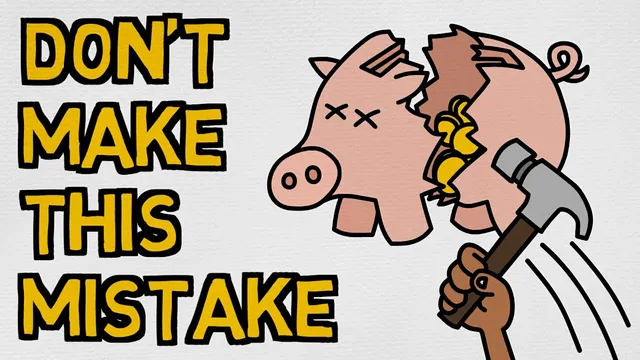
The Worst Financial Mistake You Can Make
Based on Better Than Yesterday's video on YouTube. If you like this content, support the original creators by watching, liking and subscribing to their content.
Lifestyle inflation is the automatic upgrade of spending when income rises, often leaving savings near zero.
Briefing
The most common financial trap isn’t overspending on a single purchase—it’s lifestyle inflation, the habit of automatically upgrading spending when income rises. The result is that people can earn more and still end up with the same (or worse) financial outcome: little to no savings, paycheck-to-paycheck living, and vulnerability when emergencies hit. Lifestyle inflation can keep someone poor “forever,” and it can also break wealthy people who assume higher income equals lasting security.
A concrete example shows how the cycle works. “Mike” earns $30,000 a year and spends about $25,000 on essentials—food, housing, car and gas, insurance—leaving roughly $5,000 for non-essential luxuries like vacations, gifts, and new clothes. After a promotion, his income jumps to $45,000. Instead of saving or investing the extra $15,000, his spending rises with his new status: a fancier car, a bigger apartment with higher housing costs, more exotic vacations, and frequent dining out or food delivery. By year’s end, he “breaks even” again—no meaningful savings, just a higher-cost lifestyle that consumes the raise.
That pattern matters because emergencies don’t care about income growth. If Mike gets injured in a car accident, medical bills can add to his costs; if he loses his job, his fixed living expenses remain while his income disappears. With minimal savings, either scenario can quickly turn a stable life into financial stress.
The transcript also argues that lifestyle inflation isn’t limited to average earners. Former athletes—NFL and NBA players in particular—can file for bankruptcy shortly after retirement even after earning millions, because they maintained luxurious spending after income stopped. Lottery winners face a similar fate: large payouts often don’t translate into long-term wealth when spending isn’t controlled.
A key takeaway is that “being rich” isn’t just about earning; it’s about keeping money. The message warns against a “society’s illusion of wealth,” where people appear affluent because they spend heavily on visible brands—like expensive clothes or sports cars—while still struggling financially. Social media, friends, and culture can normalize extravagant lifestyles, making paycheck-to-paycheck living feel “normal.”
Avoiding the trap comes down to two steps: recognize lifestyle inflation early and practice self-discipline. Before buying, the advice is to pause—sleep on the decision—and ask whether the purchase truly improves life long-term. Impulse spending is singled out, including the idea of replacing devices or accessories simply because newer versions exist. Finally, the transcript recommends a rule of thumb: when income increases, increase savings and investing instead of upgrading the lifestyle. People can still spend on what they enjoy, but they should stay within their means, avoid debt used to impress others, and remember that money-making is harder than money-spending. The closing line frames the choice as whether to fall into the cycle of “We buy things we don’t need… To impress people we don’t like.”
Cornell Notes
Lifestyle inflation is the habit of raising spending whenever income rises, so the extra money disappears into a more expensive lifestyle. The transcript uses “Mike” to show how a raise from $30,000 to $45,000 leads to higher costs for a car, housing, vacations, and dining out—ending with little or no savings again. This matters because emergencies (medical bills or job loss) keep living expenses in place while income can drop, making people financially fragile. Higher income can make saving easier, but it doesn’t guarantee security if spending expands to match. Avoiding the problem requires recognizing the pattern early and practicing self-discipline—pausing before purchases and directing income increases toward saving and investing rather than lifestyle upgrades.
How does lifestyle inflation keep someone from building wealth even after a raise?
Why does lifestyle inflation become dangerous when something goes wrong?
What evidence is used to argue that lifestyle inflation affects wealthy people too?
What does “being rich” mean in this framework?
What practical steps are recommended to avoid lifestyle inflation?
Review Questions
- What specific changes to Mike’s spending after his raise illustrate lifestyle inflation, and how do they lead to “breaking even” again?
- Why can lifestyle inflation be financially riskier than simply having a low income? Give two emergency scenarios mentioned in the transcript.
- What decision rule does the transcript suggest for purchases, and how does it connect to increasing savings when income rises?
Key Points
- 1
Lifestyle inflation is the automatic upgrade of spending when income rises, often leaving savings near zero.
- 2
Raising expenses to match a raise can make people “break even” again, even though their pay increased.
- 3
Minimal savings makes emergencies—like medical bills or job loss—far more financially damaging.
- 4
Higher income does not guarantee security; athletes and lottery winners are cited as examples of spending outpacing lasting wealth.
- 5
Visible consumption can create an illusion of wealth while people remain financially fragile.
- 6
Avoid lifestyle inflation by recognizing it early and practicing self-discipline, including pausing before purchases.
- 7
When income increases, increase saving and investing rather than expanding the lifestyle to consume the extra money.