These are the asteroids to worry about
Based on Veritasium's video on YouTube. If you like this content, support the original creators by watching, liking and subscribing to their content.
Chelyabinsk’s high-altitude explosion delayed human response, turning a bright event into a late-arriving shockwave that shattered windows and injured about 1,500 people.
Briefing
A major asteroid impact can arrive with little warning because detection is biased by where asteroids appear in the sky—and even strong predictions can miss the one object that matters. The Chelyabinsk meteor over Russia in 2013, about 20 meters across, exploded roughly 30 kilometers above the ground. The blast was brighter than the sun, but the event was so high that it was effectively silent for about 90 seconds, delaying the moment people realized what was happening. When the shockwave finally hit, it shattered windows and injured around 1,500 people, with damage to thousands of buildings.
That failure of timing was especially striking because the same day astronomers had correctly predicted a different near-Earth asteroid flyby. Sixteen hours after Chelyabinsk, the asteroid Duende passed within 27,000 kilometers of Earth’s surface—closer than geosynchronous satellites. The contrast underscored a recurring problem: asteroid detection is not comprehensive, and the system can be “right” about one object while missing another that is unrelated.
The gap comes from how asteroids are found and how their orbits behave. Most discoveries rely on ground-based telescopes that look for moving points against a background of stars. But asteroids are small, dark, and often only visible when fully illuminated by the sun. That creates a major blind spot: more than 85% of detected near-Earth asteroids were found in the 45-degree patch of sky opposite the sun, a viewing geometry known as the opposition effect. Objects approaching from the sun’s direction can be essentially invisible until they are too close.
Even after an asteroid is detected, predicting an impact is limited. With only a short observation arc—days rather than years—calculations can’t reliably project where the body will be. And even with extensive data, gravitational tugs from planets introduce dynamical chaos, making long-term forecasting unreliable. In practice, accurate predictions beyond about 100 years aren’t feasible.
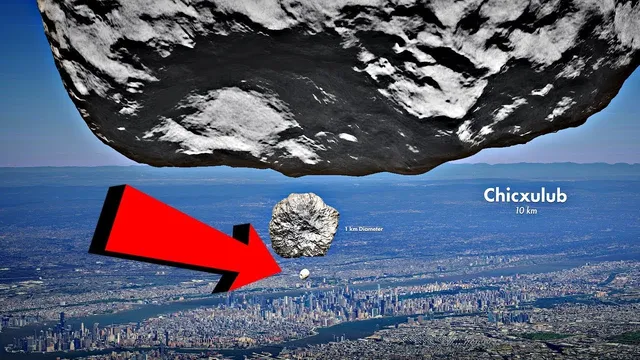
The stakes are real, but not evenly distributed by size. A 10-kilometer asteroid is associated with global extinction-level effects, with a rough expectation of one such impact every ~100 million years; for the next century, known trajectories imply the chance of a 10-kilometer hit is effectively zero. Smaller objects are more common: about a thousand times more one-kilometer asteroids exist for every 10-kilometer body, and impacts of 1–2 kilometers can devastate regions comparable to entire countries. The biggest remaining threat may be a few hundred meters across—large enough to obliterate a city, yet still undercounted.
Deflection technology also lags behind the threat. Attempts to “bomb” an asteroid are uncertain because fragmenting a rubble pile may not change the outcome. Rocket nudges require sustained, precise contact that current missions can’t provide, and concepts like surface ablation with lasers or wrapping an asteroid in reflective foil face power and deployment limits. The most actionable near-term strategy is therefore detection: expand surveys, build telescopes (including in space), and then concentrate resources on the rare objects that appear especially dangerous. Evacuating a city is considered a last resort and is often impractical, since mass movement can jam the limited road network instantly.
The takeaway is blunt: the world doesn’t need panic about dinosaur-scale impacts in the near term, but it does need better sky coverage and earlier detection—because the next “Chelyabinsk” could still arrive before warning systems catch up.
Cornell Notes
Chelyabinsk showed how a dangerous asteroid can explode with little warning because telescopes struggle to see objects near the sun’s direction and because short observation arcs limit orbit predictions. Even when scientists correctly forecast one close approach (like Duende), they can miss another unrelated impactor. Detection is further constrained by dynamical chaos: planetary gravity makes accurate impact forecasts reliable for only about a century. The risk is size-dependent—10-kilometer impacts are rare and effectively ruled out for the next hundred years, but 1–2 kilometer bodies can still cause massive regional destruction, and a few-hundred-meter objects may be the most underdetected threat. Current deflection ideas (bombing, rockets, lasers, foil) don’t yet work for kilometer-scale asteroids, so expanding surveys and focusing on newly identified hazards is the best available plan.
Why did Chelyabinsk cause injuries even though it was a bright event?
How could scientists predict Duende’s close flyby yet miss the Chelyabinsk impactor?
What is the opposition effect, and how does it create a detection bias?
Why can’t astronomers reliably predict asteroid impacts far into the future?
How does asteroid size translate into different kinds of catastrophe?
What are the main reasons deflection efforts are considered impractical today?
Review Questions
- What observational geometry makes near-Earth asteroids hardest to detect, and how does the opposition effect change where surveys concentrate?
- Explain how dynamical chaos limits impact predictions even when an asteroid’s orbit is measured precisely.
- Compare the expected hazard levels for 10-kilometer, 1–2 kilometer, and few-hundred-meter asteroids, and identify which size range is most underdetected.
Key Points
- 1
Chelyabinsk’s high-altitude explosion delayed human response, turning a bright event into a late-arriving shockwave that shattered windows and injured about 1,500 people.
- 2
Correct predictions for one asteroid (Duende) don’t guarantee detection of others because surveys have sky-direction blind spots, especially near the sun.
- 3
Most near-Earth asteroid discoveries come from the opposition effect—about 85% were found in the 45-degree region opposite the sun—leaving objects near the sun harder to see.
- 4
Impact forecasting is limited by both short observation arcs and dynamical chaos from planetary gravity, making accurate predictions beyond roughly 100 years unrealistic.
- 5
A 10-kilometer impact is extremely rare and effectively ruled out for the next century based on known trajectories, but 1–2 kilometer objects can still cause catastrophic regional damage.
- 6
The most concerning gap may be a few-hundred-meter asteroids: large enough to destroy a city yet still missing from catalogs.
- 7
Deflection methods (bombing, rockets, lasers, foil) are not yet reliable for kilometer-scale threats, so expanding detection and rapid follow-up is the most practical mitigation strategy.