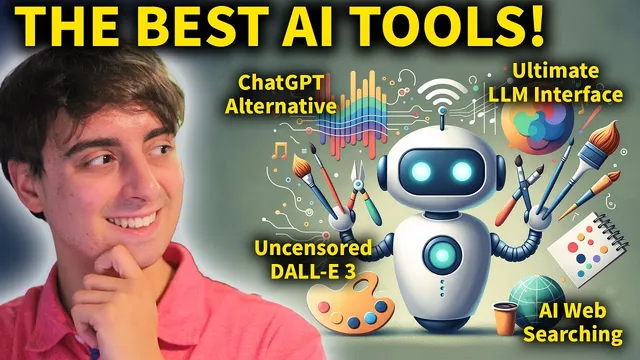
These are the BEST Free AI Tools You Haven't Heard of!
Based on MattVidPro's video on YouTube. If you like this content, support the original creators by watching, liking and subscribing to their content.
Claude 2 is presented as a free LLM option with very large context (up to 100,000 tokens), enabling chapter-scale summarization and large-file workflows.
Briefing
Several lesser-known AI tools stand out for doing real work—especially when they can ingest large files, generate uncensored images, or automate browser tasks—without forcing users into the usual paid tiers. The biggest “why it matters” theme is capacity and control: some of these services handle far more text than mainstream chatbots, while others let power users swap models, tune generation settings, or even delegate tasks to an autonomous agent.
Claude 2 (Anthropic) is positioned as a free alternative to ChatGPT with a major practical advantage: it can take in up to 100,000 tokens at once (about 75,000 words). That’s roughly an order of magnitude more than ChatGPT Plus with GPT-4, which the transcript pegs at about 7,500 words per input. The payoff is straightforward—students can upload entire textbook chapters or large datasets (including PDFs, text files, and CSVs) and get summaries, bullet points, and coding help. It’s also described as strong at summarization and understanding, with performance said to land between GPT-3.5 and GPT-4 at times. The workflow includes uploading up to five files (10 MB each) and running multiple chats in parallel, with the option to upgrade for more daily chats and faster access.
For image generation, Idiogram AI is highlighted as a free, relatively uncensored text-to-image tool that can produce on-screen text—something the transcript contrasts with the censorship-heavy experience described for Dolly 3 inside Bing Chat and ChatGPT. Idiogram is also framed as more social than typical generators: users can share posts to a community, like and follow creators, and generate without worrying about bans as much as other platforms.
For power users who want maximum flexibility, “open playground” (nat. deev / Open Playground) is presented as an interface that connects to many model APIs in one place. It includes access to GPT-3.5 variants (including a 16k token model), an “instruct” model that behaves differently from chat models and is described as less censored, and a GPT-4 32k option. A key workflow feature is cross-model continuation: generate with GPT-3.5 turbo, then take the output into Claude 2 to continue the generation with a different model. The platform also offers adjustable parameters like temperature plus frequency and presence penalties, a “compare mode” for side-by-side testing with the same prompt, and the ability to save multiple chats. Paid models use a pay-as-you-go credit system rather than subscriptions.
Search and document workflows get their own picks. Perplexity AI is described as a fast, Google-replacement style search engine that returns AI-generated answers with citations and follow-up questions, plus a Pro mode that can use Claude 2 or GPT-4. It also supports file uploads, including PDFs. For deep PDF Q&A, Ask Your PDF is recommended for uploading very large documents (entire textbooks) and retrieving accurate answers based on the content, with a Chrome extension and a ChatGPT plugin.
Finally, Hyper’s personal assistant (HyperRight) is framed as the most “cool” and most underrated: a fully autonomous browser-controlling agent that can execute tasks like searching eBay, sorting results, and returning direct product links. It comes with a limited free trial and then credits that the transcript calls expensive, but it’s presented as a glimpse of where AI is heading—agents that can research, write, and even book or buy on a user’s behalf.
Cornell Notes
Claude 2 is singled out for free access plus unusually large context: up to 100,000 tokens (about 75,000 words), enabling users to upload entire textbook chapters or large CSVs and get summaries, bullet points, and coding help. Idiogram AI offers a free, relatively uncensored text-to-image generator that can render text on screen and includes a social sharing/community layer. Open Playground targets power users by letting them switch among many models, tune generation parameters, compare outputs side-by-side, and even continue a generation across models (e.g., GPT-3.5 output continued in Claude 2). Perplexity AI provides search-style answers with citations and follow-up questions, while Ask Your PDF focuses on accurate Q&A over very large uploaded documents. HyperRight is presented as a browser-controlling autonomous agent that can complete tasks end-to-end, though it uses a credit-based trial model.
Why does Claude 2’s input size matter for everyday productivity?
What makes Idiogram AI different from other text-to-image tools mentioned in the transcript?
How does Open Playground enable “model collaboration” in a way standard chatbots don’t?
What is the practical value of Perplexity AI’s search-style answers with citations?
What makes HyperRight’s “autonomous agent” approach stand out from chat-based tools?
Review Questions
- Which tool’s advantage is primarily about ingesting far more text at once, and what token/word figures are given?
- How does Open Playground’s “compare mode” and adjustable parameters help users evaluate model quality objectively?
- What distinguishes HyperRight’s autonomous agent behavior from Claude 2 or ChatGPT-style chat responses?
Key Points
- 1
Claude 2 is presented as a free LLM option with very large context (up to 100,000 tokens), enabling chapter-scale summarization and large-file workflows.
- 2
Idiogram AI is highlighted as a free, relatively uncensored text-to-image generator that can render text on screen and includes community sharing features.
- 3
Open Playground targets power users by offering many model choices, tunable generation settings (temperature, frequency/presence penalties), and side-by-side comparisons using the same prompt.
- 4
Open Playground supports cross-model workflows, including generating with GPT-3.5 and continuing with Claude 2 to combine strengths.
- 5
Perplexity AI is positioned as a search engine that produces cited answers quickly and can generate follow-up questions, with optional Pro access to Claude 2 or GPT-4.
- 6
Ask Your PDF focuses on accurate Q&A over very large uploaded documents (including entire textbooks) using retrieval rather than open-ended chat-style reasoning.
- 7
HyperRight is framed as a browser-controlling autonomous agent that can complete tasks like searching and sorting listings, though it relies on a limited trial and credit-based usage.