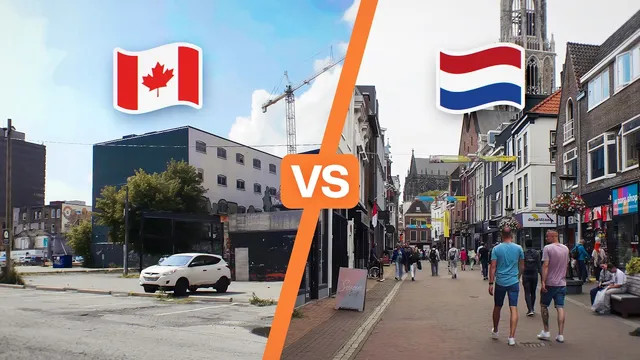
These Two Cities Used to be the Same
Based on Not Just Bikes's video on YouTube. If you like this content, support the original creators by watching, liking and subscribing to their content.
Utrecht and London, Ontario shared a similar early urban structure before both adopted car-first redesigns, including major road expansions and downtown disruption.
Briefing
Two cities that once looked like near-twins—London, Ontario and Utrecht—diverged sharply after car-first planning took over, and Utrecht’s turnaround shows what’s possible when streets are redesigned for people rather than vehicles. A century ago, both places were compact, walkable, mixed-neighborhood cities connected by streetcars. Over the 20th century, both embraced automobiles: wide roads expanded, highways cut through the core, canals were filled or neighborhoods bulldozed, and even early suburban-style shopping malls arrived as part of the same car-centric wave.
The key shift came around the 1990s, when Utrecht reversed course. Growing concern about the harms of car-dependent development pushed the city to make a fundamental decision: prioritize walking and cycling, reduce car traffic, and reclaim space for greener public areas. The highway ring around the center was turned back into a canal, and the former downtown shopping area was reconnected to a new train station through pedestrianized space—integrating it tightly with the rest of the city center. The arrival experience by train becomes the proof point: Utrecht’s station handles more than 200,000 passengers per day with over a thousand daily departures to national and international destinations, while London, Ontario’s “fake London” station has only about 10 departures per day.
Utrecht’s people-first infrastructure extends beyond transit. The city’s bicycle culture is supported by a major facility described as the world’s largest bicycle parking garage, with space for over 12,000 bikes. With a transit card, riders can access rental bicycles and cycle quickly and safely across the city, aided by low car volumes and low speed limits near the station. The street network around the station is restricted to walking, cycling, and public transit, and the cycling corridor is described as among the busiest in the world—so busy that the narrator claims seeing more cyclists in minutes than in their entire time in London, Ontario.
Walking in Utrecht is also framed as practical rather than nostalgic: shops and restaurants line the streets, surface parking lots are largely gone, and residential areas are described as notably quiet. The broader logic is blunt—cities aren’t loud because of people; cars are loud, and when viable alternatives exist, fewer people feel forced to drive. Access for deliveries, emergency vehicles, and people with disabilities remains, but the argument is that “designing for cars” is often a justification for car dependency, not a true mobility requirement.
The comparison then turns into a caution for North America. Replicating Dutch protests or “before-and-after” images without context can mislead; some campaigns were not peaceful, and timing mattered—especially the 1970s oil crisis, which helped drive policy changes like mandatory car-free days. Utrecht’s success also rests on different starting conditions: North American downtowns were often bulldozed, exclusionary zoning and sprawl shaped decades of development, public transit declined, and car ownership became entrenched.
For Canadians and Americans seeking change, the prescription is local: join advocacy groups, attend community engagement meetings, and avoid outsourcing strategy to distant social-media advice. The ultimate takeaway is that car-dependent suburban patterns can be challenged, but the path depends on local damage, local politics, and local organizing—Utrecht’s story is a template for direction, not a plug-and-play blueprint.
Cornell Notes
Utrecht and London, Ontario started from similar early-20th-century urban forms—compact, mixed neighborhoods connected by streetcars—then both embraced car-first redesigns, including highways and downtown demolition. Utrecht’s major pivot began in the 1990s, when the city prioritized walking and cycling, reduced car traffic, and reclaimed central space (including turning a highway back into a canal). The results are visible in transit and street design: a high-capacity train station, a pedestrianized connection to downtown, and major cycling infrastructure like a bicycle parking garage for over 12,000 bikes. The lesson for North America is that cities can change, but copying Dutch tactics without local context—especially different starting conditions and policy drivers—won’t work; local advocacy and engagement are central.
What makes Utrecht’s turnaround more than a “nice bike city” story?
How do transit and cycling infrastructure reinforce each other in Utrecht?
Why does the comparison argue that “design for cars” is often a cover for car dependency?
What’s the warning about using Dutch history as a simple marketing “before-and-after”?
Why does the transcript say North America can’t just “replicate the Dutch” in a straightforward way?
What practical steps does the transcript recommend for people trying to improve their own city?
Review Questions
- What planning changes in Utrecht are described as the turning point, and how do they alter daily movement patterns?
- How do the transcript’s transit statistics and bicycle infrastructure details support the argument that car dependency can be reduced?
- Why does the transcript argue that protest history and “before-and-after” images can mislead people trying to advocate in North America?
Key Points
- 1
Utrecht and London, Ontario shared a similar early urban structure before both adopted car-first redesigns, including major road expansions and downtown disruption.
- 2
Utrecht’s decisive pivot in the 1990s prioritized walking and cycling, reduced car traffic, and reclaimed central space for greener public areas.
- 3
Turning a highway back into a canal and pedestrianizing connections between downtown and a new train station helped make transit arrival the city’s organizing principle.
- 4
Utrecht’s cycling safety and convenience are supported by low speeds and low car volumes near key destinations, plus large-scale bicycle parking and rental access.
- 5
“Design for cars” is framed as a justification for car dependency rather than a universal mobility requirement, since deliveries, emergency access, and disability access remain available.
- 6
Copying Dutch tactics without local context is discouraged because North American starting conditions—downtown demolition, sprawl, weak transit, and entrenched car ownership—differ substantially.
- 7
Effective change is presented as local: advocacy groups and community engagement meetings are positioned as the most reliable routes to city repair.