These Ugly Big Box Stores are Literally Bankrupting Cities
Based on Not Just Bikes's video on YouTube. If you like this content, support the original creators by watching, liking and subscribing to their content.
Big box stores are portrayed as financially harmful because their low per-acre property tax returns don’t match the per-acre infrastructure and maintenance costs they create.
Briefing
Big box retail is portrayed as a fiscal trap for cities: the sprawling, car-dependent stores and their parking lots generate too little property tax per acre to cover the infrastructure and public-service costs they trigger, while also hollowing out local downtown businesses that would otherwise pay more and require less maintenance.
The case starts with what “big boxes” look like and how they function in North American suburbs—single-story, windowless buildings on tens of thousands of square feet, surrounded by even larger parking lots. That land-hungry footprint pushes development outward, reinforces sprawl, and makes walking, cycling, and transit access harder. The result is a built environment that depends on driving for everyday errands, then shifts the bill to municipalities through widened roads, new utilities, traffic control, signage, and flood-prevention infrastructure.
The financial mechanism is framed around taxes and per-acre costs. As residential property taxes were constrained—most notably through California’s Prop 13—the argument goes that cities leaned more heavily on sales tax and commercial property tax. To boost those revenue streams, municipalities offered incentives to large retailers. Yet even when a big box store pays a large-looking annual tax bill, it can still pay far less per acre than older, mixed-use downtown buildings. A cited Urban 3 study of Asheville, North Carolina, found downtown per-acre property tax revenue nearly 100 times higher than a suburban Walmart. Because infrastructure obligations scale with land area—roads, pipes, electrical systems, and traffic infrastructure—low per-acre tax returns can leave cities effectively subsidizing big box retailers from other sources, often including taxes generated by traditional small businesses.
Parking requirements and zoning rules deepen the problem. Minimum parking mandates tied to building size mean big boxes must be paired with massive lots, further increasing land consumption and car trips. Those trips then create downstream costs that arrive later: traffic expansion and ongoing maintenance for the infrastructure built to serve the development.
The transcript also links big box dominance to competitive displacement. Walmart’s corporate goal is described as achieving a 30% market share in new markets, a strategy that relies on running smaller shops out of business. When local competitors close, the city loses not just storefront activity but also the property tax base those businesses supported. The argument extends to tax avoidance tactics, including “dark store theory of value,” where big box properties are assessed as if vacant or functionally worthless rather than as operating businesses. A specific example is Lowe’s taking a property-tax dispute to court in Marquette, Michigan, arguing that freestanding big box stores should be taxed less because they are not built to be resold or leased in the marketplace.
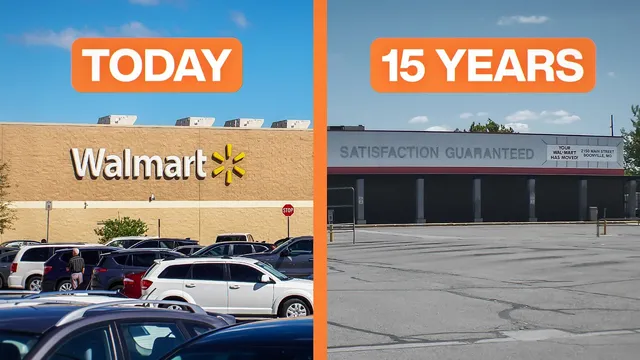
Finally, the transcript argues that the long-term cleanup costs are often worse than the short-term tax gains. Big box buildings are described as having a planned obsolescence cycle of roughly 15 years, leaving municipalities with vacant or hard-to-repurpose structures. Even when cities retrofit them into public uses like libraries, the costs can be millions and the locations remain car-dependent, limiting who benefits. In small towns, the stakes are framed as existential: when a big box grocery replaces a local store and later leaves, the community may lose access to basic goods like food and pharmacy services.
The proposed alternative is less about individual consumer guilt and more about policy: stop subsidizing big box development, redirect incentives toward locally rooted businesses, protect downtown and walkable areas, and adjust tax and pricing rules that let mega retailers undercut local stores through economies of scale. The transcript points to European hypermarkets as a partial contrast—regulated to reduce loss-leader tactics and bulk-discount advantages—while concluding that cities need “import replacement” strategies to keep money circulating locally rather than exporting it through corporate supply chains and tax structures.
Cornell Notes
The transcript argues that big box retail undermines city finances and community life by combining low per-acre property tax returns with high infrastructure and maintenance costs. Sprawling stores and their required parking lots push development outward, increase car dependence, and create long-term public expenses for roads, utilities, traffic control, and flood prevention. Even when big boxes pay substantial taxes annually, the per-acre comparison—highlighted via an Urban 3 study of Asheville—shows downtown buildings can generate dramatically more revenue per unit of land. Competitive displacement compounds the damage: discount strategies can drive local shops out of business, shrinking the tax base further. The piece concludes that cities should stop subsidizing big box expansion and instead incentivize locally rooted businesses and protect walkable downtown areas.
Why does the transcript focus on “per acre” rather than total annual property tax paid by big box stores?
How do zoning and parking rules make big box development more expensive for cities?
What is “dark store theory of value,” and why is it presented as a tax avoidance tactic?
What does the transcript claim happens to cities when big box stores close or relocate?
How does the transcript connect big box retail to job loss and government support programs like SNAP?
What policy alternatives does the transcript propose instead of subsidizing big box stores?
Review Questions
- How does the transcript use the per-acre property tax comparison to argue that big box stores can be net losses for cities?
- What role do zoning-driven parking minimums play in the car dependence and infrastructure costs described?
- Which tax assessment approach (“dark store theory of value”) is cited, and what valuation change does it attempt to achieve?
Key Points
- 1
Big box stores are portrayed as financially harmful because their low per-acre property tax returns don’t match the per-acre infrastructure and maintenance costs they create.
- 2
Constrained residential property tax regimes (including California’s Prop 13) are linked to cities relying more on commercial revenue, which increases incentives for big box development.
- 3
Zoning parking minimums tied to large building footprints force massive parking lots, increasing land consumption and car-dependent traffic burdens.
- 4
Discount retail strategies are described as competitive displacement: big boxes can drive local shops out of business, shrinking the local tax base further.
- 5
Tax avoidance tactics such as “dark store theory of value” are presented as a way big box properties are assessed as if they were vacant or functionally worthless.
- 6
Big box closures are framed as costly for municipalities due to planned obsolescence, vacancy, deed restrictions, and expensive retrofits that still leave sites car-dependent.
- 7
The transcript argues cities should stop subsidizing big box expansion and instead incentivize locally rooted businesses, protect downtown areas, and adjust pricing/tax rules that enable extreme discounting.