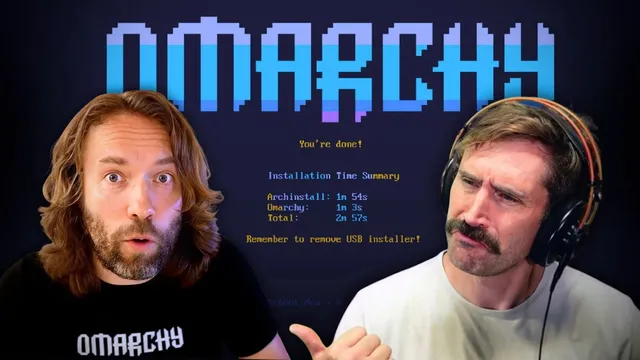
TheStandup - DHH Talks Omarchy
Based on The PrimeTime's video on YouTube. If you like this content, support the original creators by watching, liking and subscribing to their content.
DHH links his move away from Apple to App Store revenue disputes and later PWA-related conflicts, then traces the path to Omachi through Ubuntu experimentation and eventual Arch + Hyperland adoption.
Briefing
Omarchy’s creator, DHH, traces the rise of Omachi to a personal break with Apple—then turns that detour into a broader thesis about what makes Linux finally stick on the desktop: fast, low-friction onboarding plus the freedom to customize once someone actually cares. After 22 years as a Mac user, DHH says Apple’s business decisions (notably the App Store revenue cut) and later disputes around PWA pushed him out of the “walled garden.” The switch wasn’t immediate; he first tried Windows via WSL 2, but the decisive moment came when he bought a Framework laptop, tested Ubuntu on it, and noticed the same hardware felt noticeably snappier—an experience he attributes to Linux’s efficiency and the absence of system-level “bloat” like ads.
From there, DHH describes a gradual but intense migration: Ubuntu led to heavy tinkering, then a remix called “coupop,” and eventually a deep dive into Arch and the Hyperland tiling window manager ecosystem. He credits Hyperland’s out-of-the-box look and smoother animations for making tiling feel less like a chore and more like a finished product. He also highlights a key design difference versus older tiling setups: i3-style workflows often assume a separate desktop environment and require significant effort to make things look good, while Hyperland’s defaults aim to make the system aesthetically pleasing without extensive configuration.
DHH frames Omachi as a “chef’s choice” distribution built on Arch + Hyperland, designed to capture Linux’s core strengths—openness, modifiability, and community patching—without forcing newcomers to spend weeks assembling a system from scratch. He argues that selling Linux primarily on philosophy fails developers who just want a better machine that works. Instead, Omachi’s pitch is practical: tens of thousands of users have tried it since its release around July 1, and the community can iterate quickly because Arch sits “lower in the stack,” meaning changes can be swapped in rather than locked behind high-level defaults.
A major emphasis is the “ease curve” from zero effort to real learning. DHH says Omachi targets an install time of minutes—citing a reported record install around 1 minute 46 seconds—and treats customization as an optional next step, not a prerequisite. He rejects the “don’t learn” trend common in modern tooling and argues that developers and people who genuinely like computers should be willing to invest a short, painful ramp (like learning Neovim keybindings) for long-term payoff. The system is meant to be frictionless to try, but not frictionless to master.
The conversation also ties aesthetics to productivity and enjoyment. DHH and others contrast “calm, professional” visuals with flashy “ricing” that can feel like a mechanic’s shop with smoke machines. Omachi is positioned as a middle path: crisp fonts, smooth animations, and minimal distraction—while still allowing enthusiasts to push further if they want. Underneath it all is a cultural claim: Linux on the desktop is finally reaching the “momentum” where the right hardware, window manager tech, and community energy align—making it plausible that the next wave arrives not gradually, but suddenly.
Cornell Notes
DHH’s Omachi story starts with leaving Apple after years of frustration, then finding that Linux—especially Arch plus Hyperland—can feel faster and more “alive” on the same hardware. Omachi is built to solve Linux’s biggest adoption barrier: newcomers shouldn’t need weeks of setup before they can tell whether they like the experience. The distribution aims for extremely quick installation (reported record around 1 minute 46 seconds) and a low-friction on-ramp, while still encouraging learning through real configuration and keybindings. DHH argues that Linux’s open, low-level foundation lets a community patch and iterate rapidly—something closed ecosystems can’t match—so users can gradually widen control without losing the initial ease.
What pushed DHH away from Apple after 22 years, and how did that lead to Omachi?
Why does Hyperland matter in DHH’s account of making tiling usable?
What is Omachi’s core onboarding philosophy—especially the “ease curve”?
How does Omachi’s Arch + Hyperland foundation change what the community can do?
How do aesthetics and minimalism fit into the Omachi pitch?
What does DHH say about the “don’t learn” mindset in developer tools?
Review Questions
- What specific factors made DHH decide he could no longer stay with Apple, and how did those factors shape the eventual Linux direction?
- How does DHH distinguish between being easy to try and being easy to master, and what mechanisms in Omachi enforce that distinction?
- Why does DHH believe Arch’s “lower in the stack” position matters for community-driven improvements compared with higher-level distributions or closed ecosystems?
Key Points
- 1
DHH links his move away from Apple to App Store revenue disputes and later PWA-related conflicts, then traces the path to Omachi through Ubuntu experimentation and eventual Arch + Hyperland adoption.
- 2
Hyperland’s polished defaults—smooth animations and a more finished look—are presented as a key reason tiling becomes practical for everyday use.
- 3
Omachi targets a low-friction on-ramp: install quickly (with a cited record around 1 minute 46 seconds) so users can judge the system before investing heavily in customization.
- 4
The distribution is designed to encourage learning over time, including pushing users toward Neovim when editing configuration files rather than keeping everything abstract and “no learning required.”
- 5
DHH argues Linux adoption stalls when it’s sold as philosophy instead of as a better, working system that developers actually want to use.
- 6
Omachi’s community momentum is tied to Arch’s flexibility and the ability to swap or patch components quickly, unlike closed platforms where users can’t influence the next release.
- 7
Aesthetics are treated as productivity and enjoyment: calm, crisp defaults are prioritized, while flashy “ricing” is framed as optional rather than the professional default.