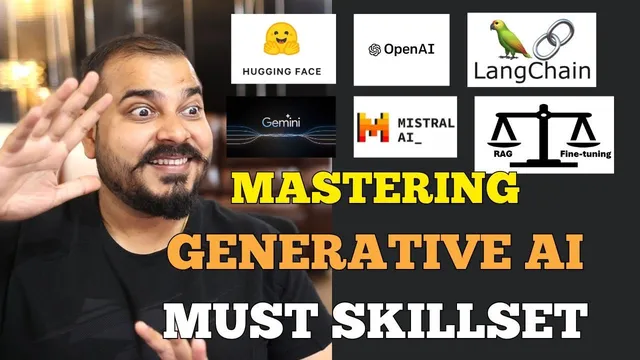
Things Required To Master Generative AI- A Must Skill In 2024
Based on Krish Naik's video on YouTube. If you like this content, support the original creators by watching, liking and subscribing to their content.
Treat Python and statistics as prerequisites before attempting generative AI projects, because interview questions often test foundational reasoning and implementation readiness.
Briefing
Mastering generative AI in 2024 hinges on building a strong technical base first—especially Python, statistics, and the core machine-learning foundations behind NLP or computer vision—then stacking practical skills around LLM application development, model selection, fine-tuning, and LLM-focused MLOps. Skipping prerequisites may still allow someone to “start,” but it tends to break performance in interviews where basic concepts like embeddings and how models are used come up immediately.
The roadmap starts with prerequisites. Python is treated as non-negotiable because most current frameworks and libraries for LLMs and multimodal systems are built around it. Statistics is the second pillar, framed as interview insurance: many common questions in data science and related roles require statistical reasoning and the ability to apply it to real scenarios. From there, the path splits based on interest. For text-focused work, NLP must be solid, including machine-learning concepts like word embeddings and text embeddings, plus classic representations such as one-hot encoding, bag-of-words, and TF-IDF. For deep learning in NLP, the essentials include recurrent neural networks and variants—LSTM, GRU, encoder-decoder setups—followed by attention mechanisms and Transformers, since modern LLMs largely rely on Transformer-based architectures.
If the goal is image generation or other vision-heavy use cases, computer vision becomes the prerequisite track. The guidance points to CNNs, CNN variants like R-CNN, and object detection techniques as the core knowledge expected in interviews. The underlying idea is simple: multimodal systems exist, but the strongest interview answers come from knowing the fundamentals of the modality being targeted.
Once prerequisites are in place, generative AI mastery is organized into three practical skill areas. First is frameworks for building LLM applications—examples named include LangChain, LlamaIndex, and Chainlit, alongside Hugging Face—because these tools help connect applications to different LLMs. Second is understanding LLMs and multimodel systems in terms of how they work, how to evaluate performance using metrics, and how to consume them via APIs. The roadmap highlights both open-source model research and managed model access such as AWS Bedrock, with examples of using APIs to build chatbot-style applications.
Third is fine-tuning, with an emphasis on parameter-efficient techniques like LoRA and QLoRA. Fine-tuning is positioned as a likely requirement for companies that want models adapted to specific data, especially when open-source models can be tuned and then deployed commercially. If deployment complexity is a concern, managed services like AWS Bedrock can handle parts of the workflow.
To stand out, the roadmap adds LLM Ops—adapting CI/CD ideas (including GitHub Actions and pipelines) to the full lifecycle of generative projects. That includes automating fine-tuning and updates so models improve over time, plus modern inference approaches such as Gro for fast responses using open-source models. Platforms like Vortex AI from Google are mentioned as examples of systems aimed at managing the end-to-end generative AI lifecycle.
The final instruction is to implement multiple end-to-end projects—RAG Q&A, fine-tuning on custom data, and deployment—because practical, deployed work is presented as the most direct route to job readiness.
Cornell Notes
Generative AI mastery in 2024 requires two layers: strong prerequisites and practical engineering skills. The prerequisites start with Python and statistics, then branch into NLP (embeddings, word representations, RNN/LSTM/GRU, encoder-decoder, attention, Transformers) or computer vision (CNNs, R-CNN, object detection). After that foundation, build real systems using LLM frameworks such as LangChain, LlamaIndex, Chainlit, and Hugging Face. Then learn how to choose and evaluate LLMs (including multimodal models) and how to consume them via APIs like AWS Bedrock. Finally, fine-tune models using techniques such as LoRA/QLoRA and apply LLM Ops to automate the lifecycle, culminating in end-to-end projects like RAG Q&A and deployed chatbots.
Why does Python and statistics come before “jumping into” generative AI?
What NLP fundamentals are positioned as prerequisites for LLM work?
How does the roadmap decide between an NLP track and a computer vision track?
What are the three practical skill areas for building generative AI systems?
What does “LLM Ops” add beyond basic model building?
Review Questions
- If an interviewer asks how word embeddings work and how they’re used in an LLM pipeline, which prerequisite topics from the roadmap should you be able to answer?
- Map the roadmap’s three practical skill areas (frameworks, LLMs/multimodels, fine-tuning) to a single project idea like a RAG Q&A chatbot—what would you implement in each area?
- What role does LLM Ops play in keeping a generative AI system up to date, and how is it different from just training or fine-tuning once?
Key Points
- 1
Treat Python and statistics as prerequisites before attempting generative AI projects, because interview questions often test foundational reasoning and implementation readiness.
- 2
Build an NLP foundation for text-focused work: embeddings (word/text), one-hot/bag-of-words/TF-IDF, then RNN variants (LSTM/GRU, encoder-decoder) and Transformers with attention.
- 3
If vision-heavy use cases are the goal, prioritize CNNs, R-CNN, and object detection so multimodal or image generation work doesn’t rely on gaps in core vision knowledge.
- 4
Develop generative AI applications using LLM frameworks such as LangChain, LlamaIndex, Chainlit, and Hugging Face to connect apps to different LLMs.
- 5
Evaluate and compare LLMs and multimodal models using performance metrics, and learn to consume them via APIs such as AWS Bedrock.
- 6
Master fine-tuning with parameter-efficient methods like LoRA and QLoRA, and understand the tradeoff between deploying open-source models yourself versus using managed services.
- 7
Differentiate with LLM Ops: automate the generative AI lifecycle (fine-tuning, updates, inference workflows) and finish with multiple end-to-end deployed projects like RAG Q&A and custom-data fine-tuning.