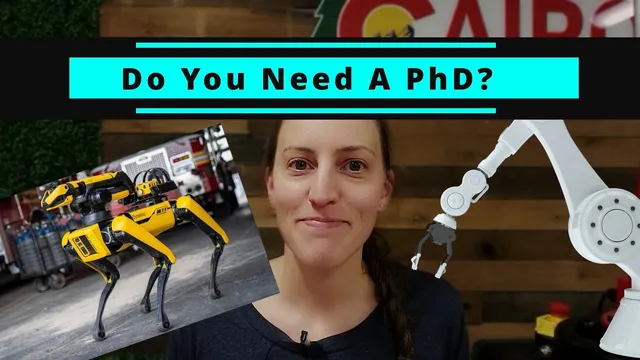
Thinking About A Career in Robotics? (PhD vs Master's vs Bachelor's)
Based on Code Mechanics: My PhD Life in AI & Robotics's video on YouTube. If you like this content, support the original creators by watching, liking and subscribing to their content.
A robotics PhD is most appropriate for research-oriented goals, not as a blanket requirement for all robotics careers.
Briefing
Whether a robotics career “needs” a PhD depends less on the field’s prestige and more on the kind of work someone wants to do—research-heavy and ambiguity-driven, or more deliverable- and application-focused. A PhD tends to fit best when the goal is a specialized, research-oriented path such as academic faculty or an industry research scientist role. That choice matters because the day-to-day reality of a PhD is not building a product with a clear spec; it’s reading the newest robotics-related research, identifying gaps, proposing novel methods, and running experiments that may fail or produce inconclusive results.
In a typical PhD workflow, students spend substantial time surveying recent papers—often AI or machine learning, but sometimes other disciplines that still connect to robotics. From that reading, they develop hypotheses and design experiments to test them. The process then moves through experimentation, result analysis, and—when outcomes are meaningful—writing up findings for submission to conferences or journals. The tradeoff is that robotics research frequently involves undefined problems and shifting directions. For people who find that uncertainty frustrating, a PhD can feel misaligned with their preferences; for others, the open-ended challenge is the point.
After graduation, the most common outcomes split into two lanes. One is a traditional faculty track: becoming a professor, potentially running a lab, and mentoring PhD students. The other is industry: applied science or research scientist roles where problems are still less well-scoped than typical engineering tasks, but the work aligns with business needs and aims to produce valuable outputs. Landing industry research roles without a PhD is possible, but it’s described as harder because competition often includes candidates with PhDs, stronger research portfolios, more publications, and deeper experience in a specific area.
For those who don’t want a research trajectory, the transcript lays out alternative robotics paths. Many companies hire robotics technicians or field robot technicians with only a bachelor’s degree. These roles are hands-on—fixing robots in the field, working on manufacturing floors, or supporting warehouse and facility operations. The picture becomes more complex when moving into software and hardware roles. Software engineering positions in robotics can be competitive even for strong general software backgrounds, especially when applicants lack robotics-specific experience.
A key practical takeaway is that employers often favor evidence of working with real robot hardware because it’s difficult and comes with messy, real-world constraints. The transcript suggests that if someone is aiming for robotics software roles without a graduate degree, they should build a portfolio through robotics projects—ideally hands-on—and be prepared to complete additional robotics coursework to become competitive (for example, specializing in computer vision or control theory). The overall message is a decision framework: choose a PhD if the work’s ambiguity and research reading match personal motivation; choose industry or technician routes if the preference is for clearer scope, tangible deliverables, and application-driven outcomes.
Cornell Notes
A robotics PhD is best viewed as a research training path, not a universal requirement for robotics jobs. PhD work centers on reading current robotics research, forming hypotheses, running experiments, and publishing results—often under ambiguous conditions where outcomes may be inconclusive. Graduates typically pursue either academic faculty roles or industry research scientist/applied science roles; industry research jobs are harder to enter without a PhD because many applicants have publications and research portfolios. If someone prefers clear scope and tangible deliverables, the transcript recommends leaning toward industry tracks such as technician roles or software roles supported by hands-on robotics projects and targeted coursework (e.g., computer vision or control theory).
What does a robotics PhD actually involve day to day?
Why does the transcript say a PhD can be frustrating for some people?
What career outcomes are most typical after a PhD in robotics?
How does the transcript describe the difficulty of getting industry research roles without a PhD?
If someone doesn’t want a research PhD, what robotics paths are suggested?
What hiring bias does the transcript mention for robotics software roles?
Review Questions
- What elements of a robotics PhD workflow (reading, hypothesis building, experimentation, publishing) make it fundamentally different from a deliverable-driven engineering track?
- Compare the two post-PhD career avenues described and explain how industry research roles differ from traditional engineering roles.
- What strategies does the transcript recommend for someone targeting robotics software roles without a PhD, and why do those strategies matter to employers?
Key Points
- 1
A robotics PhD is most appropriate for research-oriented goals, not as a blanket requirement for all robotics careers.
- 2
PhD training centers on reading current research, proposing novel methods, running experiments, and publishing—often under ambiguity.
- 3
Unstructured, undefined problems and inconclusive experiments are a common part of PhD work and can be a poor fit for people who want clear scope and predictable outputs.
- 4
Industry research scientist roles are possible without a PhD but are typically more competitive because many applicants have publications and deeper research portfolios.
- 5
Hands-on robotics technician roles are often accessible with a bachelor’s degree and focus on fixing robots in the field or supporting facilities.
- 6
Robotics software roles can be difficult without robotics-specific experience; building a portfolio through hands-on robotics projects and taking targeted coursework (e.g., computer vision or control theory) improves competitiveness.
- 7
Real robot hardware experience is strongly valued by employers because it reflects the practical difficulty of robotics systems.