Thinking outside the 10-dimensional box
Based on 3Blue1Brown's video on YouTube. If you like this content, support the original creators by watching, liking and subscribing to their content.
Treat a unit n-dimensional sphere constraint as a fixed “real estate” budget: the sum of squared coordinates equals 1.
Briefing
Higher-dimensional geometry stops behaving like “bigger 2D/3D,” and one of the clearest ways to see why is to track how the unit constraint on a sphere is shared across many coordinates. Instead of trying to picture a 4D or 10D sphere directly, the approach treats each coordinate as a slider and interprets the condition “on the unit sphere” as a fixed budget: the sum of the squares of all coordinates must equal 1. That budget can be thought of as “real estate,” cheap near 0 and expensive farther out, so moving one slider forces compensating motion in the others. This makes the rules of motion on a high-dimensional sphere feel concrete—even when global geometric intuition fails.
The method starts in 2D, where a circle is the set of pairs (x,y) with x²+y²=1. The “real estate” picture explains why the circle looks steep near (1,0): a small change in x near 1 can free up a lot of budget, allowing y to change substantially, because x² is expensive to move away from 1 while y² is cheap near 0. Adding tick marks for fixed increments of real estate turns the motion into a “piston dance”: sliders move slowly when their coordinates are far from 0 (budget is costly) and faster when near 0 (budget is cheap). In 3D, the same budget is shared among x, y, and z; fixing x slices the sphere into a circle in the remaining coordinates, and the slice shrinks as less budget remains.
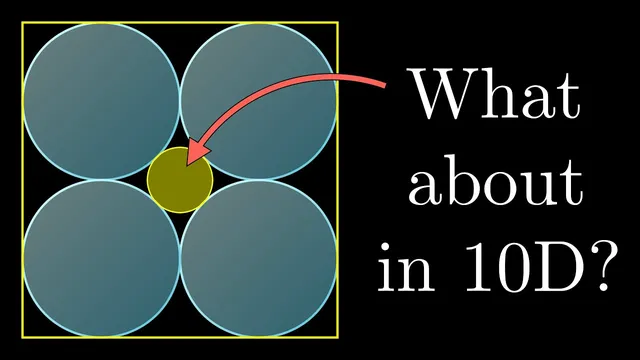
The real payoff comes from a classic “box of tangent spheres” puzzle that looks straightforward in 2D and 3D but becomes counterintuitive in higher dimensions. In 2D, four unit circles sit at the corners of a 2×2 square centered at the origin, and the largest circle centered at the origin tangent to all four has radius √2−1 ≈ 0.414. In 3D, eight unit spheres at the corners of a 2×2×2 cube lead to an inner sphere radius √3−1 ≈ 0.73—still comfortably smaller than the corner spheres.
In 4D, the same construction uses 16 unit spheres centered at all sign combinations of (±1,±1,±1,±1). The largest inner 4D sphere tangent to them turns out to have radius exactly 1, the same size as the corner spheres. That equality is not a computational accident; it reflects how the “real estate” budget is split across four coordinates. Push the idea further: in 5D the inner radius grows to about 1.24, and by 10D it reaches about 2.16. The inner sphere’s diameter can even exceed the diameter of the outer bounding box that would be drawn in lower dimensions, and the fraction of the inner sphere lying inside that box shrinks toward zero as dimension increases.
The central insight is that high-dimensional spheres allocate a fixed budget across many coordinates, and that allocation changes distances in ways that cannot be compressed into 2D or 3D intuition. The slider-and-budget framework doesn’t replace analytic reasoning; it redesigns the “instruments” so analytic constraints become visually graspable, making the strange geometry of high dimensions feel less mystical and more inevitable.
Cornell Notes
A unit sphere in n dimensions is the set of points whose coordinates satisfy x1²+x2²+…+xn²=1. The transcript turns that constraint into a “real estate” budget: each coordinate’s squared value is the amount of budget it occupies, and moving away from 0 is costly while near 0 is cheap. Using this slider model, the largest sphere centered at the origin tangent to unit spheres at the corners of a 2×2×…×2 box grows much faster than lower-dimensional intuition predicts. In 2D the inner radius is √2−1≈0.414; in 3D it’s √3−1≈0.73; in 4D it becomes exactly 1; and in 10D it’s about 2.16. The takeaway is that distance and “space-filling” behavior change qualitatively as the number of coordinates increases.
How does the “real estate” idea make the unit circle feel less mysterious?
Why does slicing a 3D sphere into a 2D circle match the slider picture?
What changes in the tangent-spheres “box” puzzle when moving from 3D to 4D?
Why does the inner radius keep growing in higher dimensions (e.g., 5D and 10D)?
What does it mean that the inner sphere’s portion inside the box shrinks toward zero?
Review Questions
- Using the budget model x1²+…+xn²=1, how would you predict whether a small change in one coordinate near 0 or near 1 produces a larger change in the others?
- Compute the inner radius for the 2D and 3D box-of-tangent-spheres cases using the distance-from-origin minus 1 rule, and compare the results to the 4D equality claim.
- In the 10D case, why does the box’s face distance from the origin remain constant while the inner sphere radius increases so dramatically?
Key Points
- 1
Treat a unit n-dimensional sphere constraint as a fixed “real estate” budget: the sum of squared coordinates equals 1.
- 2
Near 0, squared-coordinate budget is cheap; farther from 0 it becomes expensive, producing the “piston dance” behavior of slider motion.
- 3
Fixing one coordinate turns an n-dimensional sphere slice into an (n−1)-dimensional sphere/circle whose size is determined by the remaining budget.
- 4
In the tangent-spheres box puzzle, the inner sphere radius grows much faster with dimension than √n−1 intuition from 2D/3D suggests.
- 5
The 4D case is special: the inner sphere radius becomes exactly 1, matching the corner spheres due to how the budget splits across four coordinates.
- 6
In 10D, the inner radius is about 2.16, and the inner sphere can extend beyond the lower-dimensional bounding box scale.
- 7
As dimension increases, the fraction of the inner sphere lying inside the box shrinks toward zero even though the inner sphere grows without bound.