This AI Shows You EXACTLY Why Your Paper Will Get Rejected (Before You Submit)
Based on Andy Stapleton's video on YouTube. If you like this content, support the original creators by watching, liking and subscribing to their content.
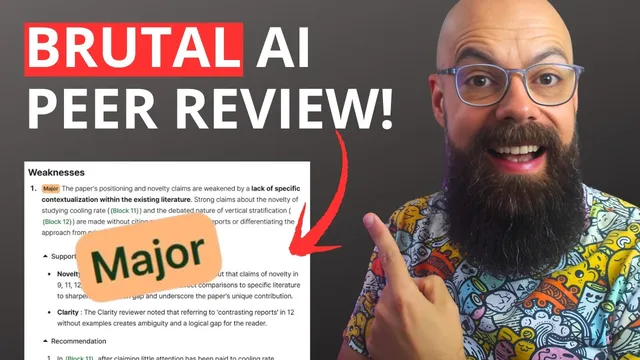
Liner Pro’s strongest feature is a peer reviewer module that delivers a structured meta-review across novelty, rigor, clarity/impact, and limitations.
Briefing
An academic AI suite called Liner Pro is positioning itself as more than a writing assistant by adding a “peer reviewer” workflow that produces targeted, role-based critiques—novelty, rigor, clarity/impact, and limitations—so researchers can fix weaknesses before submission. The standout value is that the feedback comes as a structured meta-review with multiple reviewer perspectives, and it can point to specific areas to strengthen, offering a practical way to avoid the all-too-common experience of rewriting after rejection.
Beyond peer review, Liner Pro bundles several research-support tools under one interface. It includes an essay/drafter-style generator where users can upload three samples of their writing style, choose a citation style, and generate a short draft with references attached for verification. It also offers a hypothesis generator that turns a research question into a mind-map of promising hypotheses, then lets users refine a chosen hypothesis by adding perspectives and running deeper reflective reasoning. A hypothesis evaluator provides a “sense check” using criteria such as clarity, novelty, and feasibility, returning an overall evaluation rather than leaving researchers to judge quality alone.
For citation work, Liner Pro can recommend sources from a sentence or paragraph and returns multiple citation options. The workflow still requires human checking: at least one recommended citation was tied to a paper’s introduction rather than the specific result the user needed, highlighting the risk of cherry-picking or misattribution even when the citation looks relevant.
Literature review features are more mixed. The literature review output is described as “okay” but not strong—too short, not organized into themes, and lacking the depth and structure that general large language models like Gemini and Chat GPT can deliver. Still, it does generate research gaps and future directions, which the user found useful for identifying where to push a new line of work.
Other modules include research workspace tools such as source collection and search filters (including publication-date filtering with a histogram), plus research tracer that attempts to map relationships from a paper. That tracer visualization is criticized for poor contrast and unclear labeling, making it close to unusable in its current form. The suite also includes survey generator and survey simulator, letting users draft surveys and preview results with AI respondents; the idea is treated with skepticism, especially for fields outside the user’s experience.
Overall, Liner Pro earns its strongest recommendation for the peer review section, where targeted advice can help researchers address likely reviewer objections early. Other components are seen as helpful but uneven—useful when they match a specific need, yet sometimes less polished than dedicated alternatives or general-purpose AI tools.
Cornell Notes
Liner Pro bundles multiple academic AI tools, but its most compelling feature is a peer reviewer workflow that generates a structured meta-review from different reviewer angles. It assigns critiques across novelty, rigor, clarity/impact, and limitations, giving targeted guidance on what to improve before submission. The suite also supports writing-style drafting with citation references, hypothesis generation via mind maps, and hypothesis evaluation using criteria like clarity, novelty, and feasibility. Citation recommendations can speed up sourcing, though users must verify that cited papers support the claimed results. Literature review and some visualization tools are less reliable, while survey simulation is optional and may not fit every researcher’s practice.
What makes Liner Pro’s peer reviewer workflow different from generic writing feedback?
How does the hypothesis generator help someone who has ideas but not a research plan?
What does hypothesis evaluation measure, and why does it matter?
How does Liner Pro assist with citations, and what risk remains?
Why is the literature review tool described as only moderately useful?
Which features are treated as less reliable or potentially mismatched to some researchers?
Review Questions
- Which peer-review categories does Liner Pro use, and how could that change how a researcher revises a manuscript?
- What steps connect hypothesis generation to hypothesis refinement and evaluation in Liner Pro?
- What verification step is still necessary when using AI citation recommendations?
Key Points
- 1
Liner Pro’s strongest feature is a peer reviewer module that delivers a structured meta-review across novelty, rigor, clarity/impact, and limitations.
- 2
The peer reviewer output is designed for targeted revision by pointing to specific areas to strengthen before submission.
- 3
Writing-style drafting lets users upload writing samples, select a citation style, and generate a short draft with references that can be checked.
- 4
Hypothesis generation turns questions into a mind-map of promising hypotheses, then supports refinement via added perspectives and deeper reasoning.
- 5
Hypothesis evaluation provides an overall quality sense check using criteria such as clarity, novelty, and feasibility.
- 6
Citation recommendations can speed up sourcing from sentences or paragraphs, but researchers must verify that citations support the claimed results.
- 7
Some modules—like literature review depth and research tracer visualization—are uneven, and survey simulation may not fit every research context.