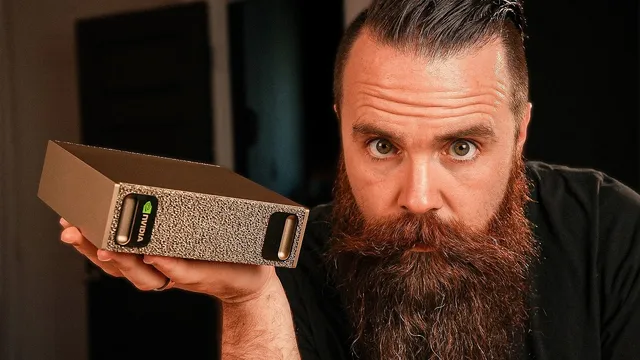
This AI Supercomputer can fit on your desk...
Based on NetworkChuck's video on YouTube. If you like this content, support the original creators by watching, liking and subscribing to their content.
Nvidia’s DGX Spark is built around GB10 Grace Blackwell hardware plus 128 GB unified memory, targeting memory-heavy local AI workflows rather than maximum inference throughput.
Briefing
Nvidia’s DGX Spark is a palm-sized AI “server” built around a GB10 Grace Blackwell superchip and 128 GB of unified memory, aiming to make serious local AI workloads affordable and practical. Early benchmarks against a custom dual 4090 setup (“Terry”) show a clear tradeoff: the Spark doesn’t beat a high-end consumer-GPU rig on raw inference speed, but it can run more models and larger memory-hungry workflows—especially multi-agent systems and fine-tuning—because the GPU can directly access a large shared memory pool.
The Spark’s core specs include a 20-core ARM processor, a Blackwell GPU rated for “one pedlop” of AI compute, 128 GB of LP DDR5X unified memory, and a 10 gig Ethernet port. Nvidia positions it as capable of running up to 200B-parameter models, with a price around $4,000 for a Founders Edition (and rumored lower-cost OEM variants). In practice, when tested with Comfy UI and local LLMs, Terry leads on speed for single-model inference: a smaller Quinn 38B run hits about 132 tokens per second on Terry versus roughly 36 tokens per second on the Spark. With a larger Llama 3.3 70B test, the Spark still doesn’t catch up, reinforcing that this device isn’t designed to be a drop-in replacement for a top-tier inference workstation.
Where the Spark changes the equation is capacity and concurrency. Terry’s two 4090s provide 48 GB of VRAM total, but their GPUs can’t efficiently use system RAM over the slower bus. The Spark’s unified memory lets the GPU draw from the full 128 GB pool, enabling multi-model setups that would be awkward or impossible on a typical consumer-GPU box. In a live multi-agent demo, the Spark ran multiple components—GBT OSS 12B, DeepSeek Coder 6.7B, and a Quinn 3 embedding 4B—using far more memory than Terry could comfortably support in the same way.
Image generation tests in Comfy UI further highlight the mismatch: Terry’s configured single-GPU behavior and the Spark’s different architecture make direct comparisons imperfect, but the Spark still produced results at a slower iteration rate (about 1 iteration per second versus 11 on Terry). Training and fine-tuning tell a more nuanced story. Nvidia’s unified-memory approach helps the Spark load and train models that require more memory, and the device is built for training workflows. In a smaller training run, Terry was roughly three times faster per iteration, yet the Spark’s advantage becomes clearer for developers who want to fine-tune without renting cloud GPUs.
The Spark’s standout technical differentiator is FP4 support via hardware acceleration. Nvidia claims the device can run FP4 with quality close to FP8 for models optimized for it, using NVMP4 quantization techniques that target minimal accuracy loss. That hardware focus enables speculative decoding: a smaller fast model drafts tokens ahead while a larger model verifies them, reducing latency by shifting work across two models. The Spark can run this approach using more VRAM than consumer GPUs typically allow, with speculative decoding demonstrated on a 70B setup using about 77 GB of VRAM.
Beyond performance, Nvidia emphasizes usability. The Spark ships with Ubuntu-based DGXO OS and includes Nvidia Sync, which simplifies remote access by handling SSH setup and integrating with tools like Cursor and VS Code. For always-on access, the transcript also promotes Twin Gate, a zero-trust remote access layer that avoids opening inbound ports.
Bottom line: the DGX Spark looks less like a faster replacement for a dual-4090 inference rig and more like a compact, developer-focused machine for memory-heavy tasks—fine-tuning, multi-model orchestration, and FP4-accelerated workflows—where cloud GPU rental costs and setup friction are the real bottlenecks. The next question raised is whether unified-memory Macs (like a maxed-out Mac Studio M3 with 512 GB) can match the Spark’s practical capabilities.
Cornell Notes
Nvidia’s DGX Spark is a compact AI system built for memory-heavy local workloads, not for beating a dual-4090 rig on raw inference speed. It pairs a GB10 Grace Blackwell superchip with 128 GB of unified memory, letting the GPU access a large shared memory pool—useful for multi-model and multi-agent setups. In tests, Terry (dual 4090s) delivers much higher tokens-per-second on single-model inference, while the Spark’s strength shows up in running more things at once and supporting training/fine-tuning workflows locally. Hardware FP4 support and speculative decoding are key differentiators, enabling faster generation strategies that consumer GPUs may struggle to run efficiently. For developers, the Spark’s value centers on fine-tuning without cloud GPU rental and on easier deployment via Nvidia Sync.
Why does unified memory matter more for the Spark than for a typical dual-4090 workstation?
What do the early LLM speed tests imply about where the Spark fits?
How does the Spark’s multi-model demo illustrate its practical advantage?
What role does FP4 hardware acceleration play, and why is it different from consumer GPUs?
How does speculative decoding help, and what does it require?
Review Questions
- When would unified memory make the Spark a better choice than a dual-4090 system?
- What evidence from the transcript suggests the Spark is not a direct replacement for Terry on inference speed?
- How do FP4 hardware support and speculative decoding combine to change generation latency tradeoffs?
Key Points
- 1
Nvidia’s DGX Spark is built around GB10 Grace Blackwell hardware plus 128 GB unified memory, targeting memory-heavy local AI workflows rather than maximum inference throughput.
- 2
In single-model LLM inference tests, Terry (dual 4090s) delivers far higher tokens-per-second than the Spark, indicating a speed gap for raw chat workloads.
- 3
The Spark’s unified memory enables multi-model and multi-agent setups that would be constrained by consumer-GPU VRAM limits and slow system-RAM access.
- 4
For developers, local fine-tuning can become more practical because the Spark can load and train models that require more memory than typical consumer GPU setups can handle.
- 5
Hardware FP4 support is a major differentiator: the Spark runs FP4 efficiently in hardware, while consumer GPUs typically convert FP4 in software.
- 6
Speculative decoding is enabled by the ability to run a small drafting model and a larger verification model together, reducing latency at the cost of higher concurrent memory usage.
- 7
Nvidia Sync and DGXO OS aim to reduce setup friction, making remote access and tool integration simpler than DIY home-lab approaches.