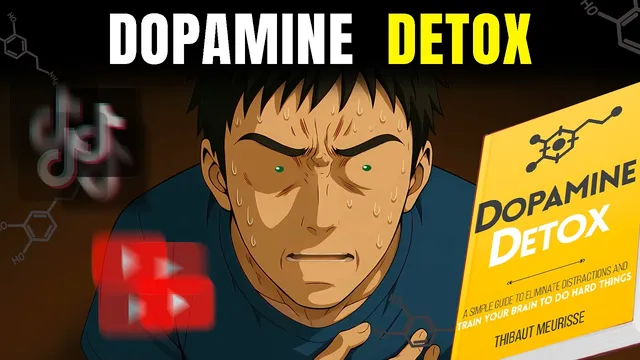
this book CURED my procrastination / doom scrolling addiction - Dopamine Detox
Based on Alex Dekora's video on YouTube. If you like this content, support the original creators by watching, liking and subscribing to their content.
Dopamine is framed as an anticipation signal, so repeated checking can trigger dopamine spikes even when outcomes are trivial.
Briefing
Dopamine detoxing is presented as a practical way to break a self-reinforcing cycle of overstimulation—one that makes important work feel harder the longer a person keeps feeding quick, frequent reward cues. The core claim is that modern apps and notifications don’t merely distract; they hijack dopamine’s role in anticipation, pushing daily life into a constant state of craving. When stimulation drops back to normal, focus becomes uncomfortable, and procrastination becomes the brain’s “escape route.” That matters because the routine doesn’t just steal time—it also shrinks the motivation to do the very tasks that would improve career, health, or a side business.
The transcript’s explanation starts with a dopamine misconception: dopamine isn’t treated as a “pleasure chemical.” Instead, dopamine is framed as a neurotransmitter that spikes when rewards are anticipated—often right before the reward arrives. That timing is crucial. If someone repeatedly checks email, stock prices, social feeds, or news, the brain gets dopamine hits from the expectation alone, even when nothing meaningful happens. Over time, the baseline level of stimulation gets “thrown out of whack,” so sitting down to do deep work triggers restlessness and rationalizations for “productive” detours like reorganizing files or cleaning an office.
A second mechanism reinforces the loop: once the brain learns to expect frequent stimulation, it becomes uncomfortable when stimulation returns to normal. The result is a craving-response-reward pattern that resembles addiction. The transcript adds a set of thought experiments to expose common self-deceptions: breaks don’t make returning to work easier; they often make it harder by raising baseline stimulation. “Excitement” from monitoring metrics (like refreshing sales figures) is contrasted with “fulfillment” from doing the work that actually grows the business. And FOMO—fear of missing something—drives constant checking of messages and headlines, even when the long-term payoff comes from staying on a single priority.
To detox, the book’s approach is organized into three options based on willingness and intensity. A 48-hour complete detox cuts out nearly all stimulation sources—phones, internet, social media, movies, sugar, processed food, video games, and even drugs or alcohol—replacing them with lower-stimulation activities like walking, journaling, reading, meditating, and stretching. A 24-hour detox uses the same structure but for one day. For those who can’t manage that, a partial detox targets one major trigger (for example, TikTok, Instagram, or anime) and removes it for a set period.
The transcript then turns to behavioral design: add “friction” to bad habits and “lube” to good ones. Examples include using app limits, turning off phone Wi‑Fi at work, and placing the phone across the room to make checking harder. On the flip side, it recommends preparing the environment so starting the right task is effortless—cleaning and organizing the workspace, and having Microsoft Word open so writing is the first visible action. Finally, it emphasizes starting the highest-priority task immediately after waking, since continuing an existing action is easier than initiating a new one. Consistent rituals—like athletes repeating pre-serve routines—are offered as a way to make deep work automatic, while removing interruptions (phones, TVs, and easy access to distractions) helps protect an uninterrupted focus window.
Cornell Notes
The transcript frames procrastination and doom scrolling as a dopamine-driven overstimulation problem rather than a simple lack of discipline. Dopamine is described as spiking when rewards are anticipated, so repeated checking of email, stocks, social stats, and news can trigger dopamine hits even without meaningful outcomes. When stimulation later drops to normal levels, focus feels uncomfortable, and the brain seeks the next “hit,” often through rationalized distractions. The book’s solution comes in three detox formats: a 48-hour complete cut, a 24-hour version, or a partial detox removing one major trigger. Long-term success is supported by adding friction to bad habits, adding ease to good habits, and starting the day with the highest-priority task in a distraction-minimized environment.
Why does frequent checking (email, stocks, social media) create a focus problem even when nothing “good” happens?
How does the “break” from work often make procrastination worse?
What’s the difference between excitement and fulfillment in this framework?
What are the three detox options, and what does each remove?
How do “friction” and “lube” work as tactics to change behavior?
Why does the transcript emphasize starting with the highest-priority task in the morning?
Review Questions
- How does anticipation-based dopamine release change the way someone should think about checking email or social media?
- Which detox option would fit a person whose biggest trigger is one app, and what would “partial detox” look like in practice?
- What environmental changes could reduce interruptions during a planned hour of deep, focused work?
Key Points
- 1
Dopamine is framed as an anticipation signal, so repeated checking can trigger dopamine spikes even when outcomes are trivial.
- 2
Overstimulation raises baseline discomfort when stimulation drops, making deep work feel harder and increasing procrastination.
- 3
“Productive distractions” (like organizing) can function as dopamine substitutes that delay meaningful progress.
- 4
Detox can be structured as a 48-hour complete cut, a 24-hour version, or a partial detox removing one major trigger such as TikTok or Instagram.
- 5
Adding friction—like app limits and disabling phone Wi‑Fi—reduces the ease of giving in to cravings.
- 6
Adding lube—like preparing a clean workspace and opening Microsoft Word in advance—reduces the effort needed to start the right task.
- 7
Starting the highest-priority work immediately after waking is emphasized because initiating new actions is harder than continuing an existing one.