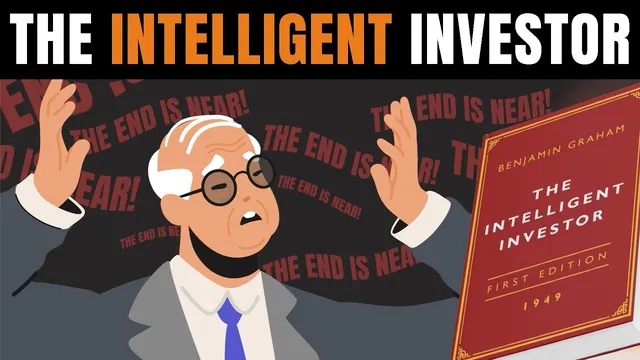
This book earned me $192,000 last year - The Intelligent Investor (Detailed Summary)
Based on Alex Dekora's video on YouTube. If you like this content, support the original creators by watching, liking and subscribing to their content.
Treat market prices as emotional signals; estimate intrinsic value using business fundamentals before deciding to buy or sell.
Briefing
The core lesson from Benjamin Graham’s investing playbook is to treat market prices as unreliable signals and make decisions based on a company’s real underlying value—then protect yourself with a “margin of safety.” The stock market is likened to “Mr. Market,” a neighbor who offers wildly different prices for the same business day to day. Some days the offer is eupiringly high; other days it’s absurdly low. The point isn’t to guess what Mr. Market “really thinks,” but to calculate what the business is worth from fundamentals—profit power, growth, and other operating realities—and only trade when the quoted price is meaningfully favorable.
That framework matters because it turns panic-driven price swings into opportunity. During the 2008 financial crisis, American Express shares fell about 75% in under a year. The business—an entrenched global payments network—didn’t suddenly become worthless, so investors who viewed the collapse as irrational pricing could buy at depressed levels and later benefit as markets stabilized. The transcript cites outcomes like a roughly 500% gain for those who simply held through the recovery, and a much larger payoff for investors who added shares near the lows. A similar pattern appears in 2020: Marriott stock dropped about 60% in six weeks during the early COVID-19 crash. With travel uncertainty driving fear, the price fell far faster than the company’s long-term business footprint, and investors who bought after the plunge are described as earning about a 330% return over the next four years.
Graham’s second pillar is risk control through a margin of safety. Even when a fair value estimate is reasonable, uncertainty remains—so the strategy is to buy only when the market price is below intrinsic value by a buffer. The transcript uses a bridge example: engineers don’t design for the maximum load; they build in slack so unknowns don’t cause failure. In investing, that slack can mean buying stocks at a discount to calculated worth, or for bonds, demanding enough financial cushion that the issuer can survive a slowdown without default.
The book also divides investors into two types: defensive and enterprising. Defensive investors—most people—should diversify, favor large, established companies, and use dollar-cost averaging to reduce the emotional damage of trying to time markets. The transcript ties this to behavioral finance research and the idea that “time in the market beats timing the market.” Enterprising investors may take more active bets, but the transcript emphasizes that risk isn’t identical for everyone.
A key illustration compares two families buying identical houses. One family expects to stay long-term and can ride out market cycles; the other may be forced to sell early due to job changes and life circumstances. The same mortgage can be a good deal for one household and a bad one for the other because timing risk hits differently. That personal-risk lens extends to portfolio construction, including how “familiarity” can backfire.
Finally, the transcript highlights a philosophical tension between Graham and Warren Buffett. Buffett favors investing within a “circle of competence,” buying what investors understand. Graham warns that familiarity can create complacency—“home bias”—where people overconcentrate in their employer’s stock. The transcript points to 401(k) behavior (often 25–30% in company stock) and the fallout from collapses such as Enron and Signature Bank, where workers saw both jobs and savings deteriorate at once. The proposed middle ground: invest in what you understand, but still diversify and keep doing the homework.
Cornell Notes
Graham’s approach treats stock prices as unreliable and insists investors anchor decisions to intrinsic business value. “Mr. Market” symbolizes the market’s emotional swings—sometimes offering far too much, other times far too little—so investors should calculate value from fundamentals and trade only when the price is favorable. A “margin of safety” reduces uncertainty by requiring a discount to estimated worth, whether buying stocks or bonds. Graham also distinguishes defensive investors (diversify, use large companies, dollar-cost average) from enterprising investors (more active, specialized skill). Risk varies by personal circumstances, and overconfidence from “buy what you know” can become dangerous “home bias,” especially when workers concentrate retirement savings in employer stock.
Why does the “Mr. Market” analogy push investors to ignore day-to-day prices?
How does “margin of safety” work in practice?
What strategies does the transcript attribute to defensive investors?
Why can the same investment be good for one person and bad for another?
What disagreement is described between Graham and Buffett about “buy what you know”?
How do the transcript’s examples connect market crashes to opportunity?
Review Questions
- How would an investor apply intrinsic value analysis to decide whether to accept or reject Mr. Market’s offer?
- What does a “margin of safety” protect against, and how might it change a stock purchase decision?
- In what ways can personal circumstances (like job stability or required relocation) alter the risk of an otherwise similar investment?
Key Points
- 1
Treat market prices as emotional signals; estimate intrinsic value using business fundamentals before deciding to buy or sell.
- 2
Only act when the market price offers a meaningful discount to intrinsic value, using a margin of safety to reduce the impact of uncertainty.
- 3
Use defensive investing habits—diversification, large established companies, and dollar-cost averaging—to counter common behavioral mistakes.
- 4
Recognize that risk is personal: the same asset can be safe for one investor and dangerous for another depending on time horizon and likelihood of forced selling.
- 5
Avoid complacency from familiarity; “buy what you know” can become “home bias” when investors overconcentrate in employer stock.
- 6
Large market selloffs can create opportunity when fear drives prices below what the underlying business is worth.
- 7
Keep doing homework even when a company seems familiar or widely popular; familiarity can mask weaknesses.