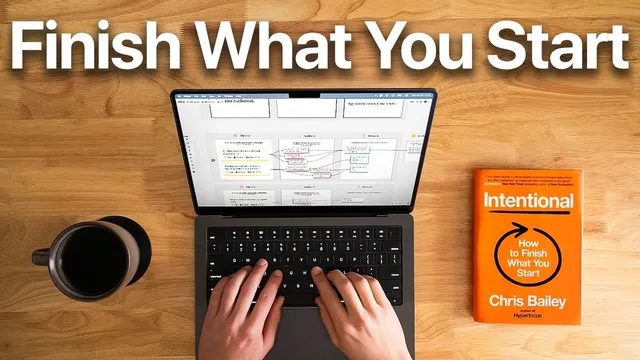
This Book Will Help You Finish What You Start (Intentional by Chris Bailey)
Based on Linking Your Thinking with Nick Milo's video on YouTube. If you like this content, support the original creators by watching, liking and subscribing to their content.
Treat values, priorities, goals, plans, and next actions as layers of the same intention system rather than separate items.
Briefing
Finishing what you start comes down to one fix: stop treating goals as isolated “middle-layer” wishes and instead build a connected intention stack that runs from core values to today’s next action. Chris Bailey’s framework treats every goal-related item—values, priorities, goals, plans, and day-to-day actions—as different lengths of the same thing: intentions. When a goal is aligned across those layers, progress becomes both tangible and meaningful; when it isn’t, goals drift into a “goal graveyard” where abandoned gym memberships, stalled creative projects, and unused productivity apps pile up.
The intention stack is the organizing model. At the bottom sits present intention: what someone is trying to do right now (for example, tying shoelaces). Above that are plans for daily and weekly actions, such as going to the gym three times this week or writing for 90 minutes each morning. Higher still are goals—intentions aimed at over weeks or months, like losing 10 lbs by summer or launching a product by quarter 3. Above goals come priorities: what matters most this year, such as rebuilding health, finishing a dissertation, or starting a business. At the top are values, the longest-term guiding principles like integrity or making a meaningful contribution.
Most people set goals in the middle of this stack and never connect them all the way up to values or all the way down to present actions. The result is a floating objective with no anchored pathway: the intention never becomes a full system that can drive consistent follow-through. The practical question becomes how to keep the entire stack connected from the top down.
That’s where the “command center” comes in—a single, holistic workspace designed to mirror the intention stack. The top section is the theme, which functions like values but focused on the next 12 months. A theme provides coherence for the year; for example, “making inroads” can reflect a priority to create more bandwidth for relationships. Next come yearly objectives (about three), which correspond to priorities and answer “What do I want to achieve?” These objectives should be directional rather than task-like—bigger containers that can hold multiple goals.
Each objective then gets key results: specific, measurable outcomes that confirm whether the objective is achieved. For instance, writing a complete manuscript by July 1st can serve as a key result for the objective of writing a book to help more people. Strategies sit below key results as the “how”—a set of brainstormed approaches, but only the ones that directly support the key result should be chosen. Finally, next actions map to present intention: the very next step someone will do, defined with clarity such as opening a Google Doc and starting edits from chapter 1 onward. Next actions are treated as optional in the command center because they change frequently, so they may live elsewhere.
To make the system stick, the framework recommends limiting yearly objectives to three to prevent dilution, holding goals loosely because goals are ultimately predictions that sometimes need adjustment, and ensuring everything flows from theme to objectives to key results to strategies to weekly actions. The core promise is simple: alignment across the intention stack creates a clear line from who someone wants to be this year to what they do this week—turning intentions into follow-through rather than wishful thinking.
Cornell Notes
Finishing what you start requires connecting goals to a full chain of intentions rather than leaving them stranded in the middle. Chris Bailey’s intention stack treats values, priorities, goals, plans, and next actions as layers of the same mental plan. A goal succeeds when it aligns downward to daily/weekly actions and upward to the strongest values that motivate it. The “command center” operationalizes this by organizing a year into a theme, three yearly objectives, measurable key results, supporting strategies, and optional next actions. The payoff is follow-through: when the stack is connected, progress becomes concrete and meaningful; when it isn’t, goals accumulate in a “goal graveyard.”
What is the intention stack, and why does it matter for follow-through?
How does the “command center” translate the intention stack into a usable planning system?
What makes a key result different from a goal or a task?
Why are strategies treated as selective rather than exhaustive?
What counts as a “next action,” and how specific should it be?
What practical rules help prevent goals from drifting into a “goal graveyard”?
Review Questions
- How would you redesign a goal you’ve been stuck on by connecting it to values (top of the stack) and to a concrete next action (bottom of the stack)?
- What would be a strong key result for an objective you care about, and what would make it measurable rather than activity-based?
- Why does limiting yearly objectives to three increase the chance of follow-through in this system?
Key Points
- 1
Treat values, priorities, goals, plans, and next actions as layers of the same intention system rather than separate items.
- 2
Use the intention stack to diagnose why goals fail—most drift when they’re set in the middle without connecting to both ends.
- 3
Build a command center with a year theme, about three yearly objectives, measurable key results, supporting strategies, and optional next actions.
- 4
Define key results as specific outcomes that answer “How will I know I got there?” rather than vague progress markers.
- 5
Choose strategies selectively so each one directly supports a key result, even if that means dropping tempting ideas.
- 6
Make next actions concrete and immediate (when/where/how), such as opening a specific document and starting a specific task.
- 7
Keep goals adaptable by holding them loosely and revising when predictions don’t match reality, without treating changes as failure.