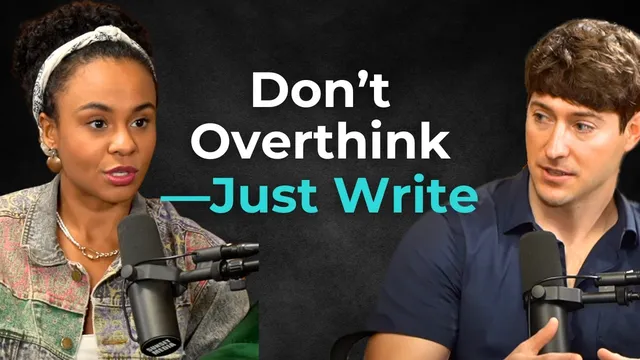
This Changes Everything for Human Connection with Jo Franco @jofranco
Based on Linking Your Thinking with Nick Milo's video on YouTube. If you like this content, support the original creators by watching, liking and subscribing to their content.
Language learning becomes a pathway to deeper connection when it trains people to interpret context and communicate feelings and thoughts.
Briefing
Language learning becomes a blueprint for human connection—and for self-direction—when it’s treated as more than vocabulary. Joe Franco describes learning English after moving from Brazil to a small town in the U.S. as a destabilizing experience that forced constant observation: reading body language, tracking social cues, and scanning the physical environment for meaning. Once English arrived, that same observational skill turned inward through journaling, letting him process what he’d noticed and translate it into a clearer sense of self.
The core claim is that journaling and language learning are linked by a shared mechanism: both demand discomfort, attention, and pattern recognition. Franco frames the early “floundering” of learning a new language as a return to being “child again,” where mistakes are unavoidable and communication depends on learning how to interpret the world. Over time, that discomfort becomes fuel rather than failure. He connects this to a broader life pattern—building an “American dream on steroids” from being undocumented as a kid to hosting a Netflix show and founding a journaling company—arguing that growth came from staying with tension long enough for insight to emerge.
Franco’s personal story also turns into a practical productivity model. He rejects the idea that action and reflection are separate. Instead, he argues that people should start by identifying patterns of thinking and values, then “cross reference” whether daily actions match that truth. If they don’t, the fix isn’t vague motivation—it’s scheduling aligned actions on the calendar. Journaling functions as the “canvas” for decision-making: it helps people notice what they’re actually drawn to, what they keep avoiding, and what they’re repeatedly trying to prove.
A major emphasis lands on journaling as a process, not a one-time emotional dump. Franco highlights rereading as the turning point: stepping back to view one’s own writing “as if you’re somebody else” creates compassion and reveals patterns. He describes how rereading can initially feel painful or disappointing—“wasted ink”—until the practice shifts toward what he wants future self to remember. That change, he says, creates a feedback loop: focusing on positive memories increases awareness in real time, which then produces more of the experiences worth recording.
The conversation then connects introspection to creative output and entrepreneurship. Franco describes imposter syndrome while editing a docu-series pilot shot years earlier, and the relief that came from realizing the doubt only appeared because he cared deeply about making it good. He also explains how a long-held passion didn’t disappear: a film-school teacher dismissed his early pitch about telling a story in five languages, but the idea resurfaced over the next decade through travel-show experiments and eventually a YouTube pivot when executives said no.
Finally, journaling becomes communal. After the world shut down in 2020, Franco shared journal photos publicly and launched a 90-day free journaling challenge with daily prompts. Strangers joined, then the demand for real-time connection led to “Joe club,” his online community and company. The model scales into workshops, art/photo/music journaling options, and retreats designed to change environment—because new surroundings, he argues, make new thinking possible. The takeaway: discomfort is not a detour from growth; it’s often the signal. Journaling helps translate that signal into aligned action and deeper connection.
Cornell Notes
Joe Franco links language learning, journaling, and human connection through one shared skill: learning to observe patterns under discomfort. Moving from Brazil to the U.S. made communication difficult, so he relied on reading body language and the environment; later, once English arrived, journaling helped him process those observations. He treats journaling as an ongoing practice—especially rereading—to spot what’s misaligned, build compassion, and create a feedback loop that increases awareness of what he truly values. He also argues that reflection and productivity are connected: values discovered in journaling should be cross-referenced with actions scheduled on the calendar. Over time, those insights fueled creative work and led to a journaling community and retreats.
Why does Franco frame language learning as more than an academic skill?
What role does discomfort play in Franco’s growth?
How does journaling function as a decision-making tool, not just self-expression?
Why is rereading emphasized so strongly?
How did Franco’s journaling practice evolve into a community and company?
What’s the practical “quick start” approach he recommends for beginners?
Review Questions
- What specific observational skills does Franco say helped him survive the language barrier before he could communicate verbally?
- How does rereading change the purpose of journaling in Franco’s framework?
- In Franco’s “cross reference” model, what should someone do when their actions don’t match their values?
Key Points
- 1
Language learning becomes a pathway to deeper connection when it trains people to interpret context and communicate feelings and thoughts.
- 2
Early communication barriers can force strong observational habits (body language and environment) that later become introspection through journaling.
- 3
Discomfort is treated as a growth signal; staying with tension helps the brain adapt and can lead to major life and creative breakthroughs.
- 4
Journaling and productivity are not separate: values discovered through reflection should be cross-referenced with scheduled actions.
- 5
Rereading is the practice’s leverage point—viewing one’s writing as an outsider reveals patterns and builds compassion.
- 6
Journaling works best as an ongoing system (with prompts, visuals, photos, or music) rather than a one-time diary entry.
- 7
Community and environment matter: sharing prompts publicly and using retreats can turn private reflection into sustained, aligned action.