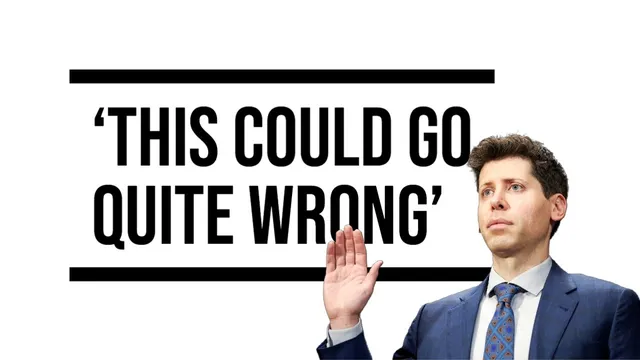
'This Could Go Quite Wrong' - Altman Testimony, GPT 5 Timeline, Self-Awareness, Drones and more
Based on AI Explained's video on YouTube. If you like this content, support the original creators by watching, liking and subscribing to their content.
Altman urged a licensing system for AI efforts above defined capability thresholds, with the ability to revoke permission for noncompliance.
Briefing
Samuel Altman’s testimony to Congress put a blunt warning at the center of the AI debate: if advanced AI “goes wrong,” the damage could be world-scale. The stakes were framed not only as a jobs issue, but as a threat to human survival—an interpretation reinforced by the hearing’s repeated linkage between superhuman machine intelligence and existential risk. While some lawmakers and industry representatives tried to steer the conversation toward a “balance” narrative—old roles fading while new ones emerge—Altman’s remarks were treated as less reassuring, especially given his broader track record of predicting severe labor disruption and power shifting from workers to capital.
A major thread of the hearing focused on what should count as a capability threshold for regulation and licensing. Altman argued for a system that licenses efforts above a certain scale and can revoke permission if safety standards aren’t met. He also pushed for safety standards built around “dangerous capability evaluations,” including tests for behaviors that could enable harmful outcomes—such as whether a model can self-replicate or self-exfiltrate into the wild. Finally, he called for independent audits, not just internal checks, with measurable performance criteria tied to specific dangerous capabilities.
The discussion sharpened when military use cases entered the room. Lawmakers asked whether large language models could enable drones to select targets autonomously. Examples cited during the hearing pointed to existing demonstrations: surveillance drones ordered through chat interfaces, with real-time responses that generate attack recommendations, route planning, and target assignment—built on a fine-tuned model with a stated 20 billion parameters. That raised the question of how quickly “capability” becomes “deployment,” and whether licensing regimes can keep pace with rapid iteration.
Altman also addressed international enforcement, arguing that regulation is harder to coordinate when major competitors won’t follow the same rules. He warned that relying on global restraint could “handicap” the U.S. if China does not reciprocate. At the same time, he urged lawmakers not to treat GPT-like systems as creatures, emphasizing that today’s models should be treated as tools rather than entities with intentions or identity.
A separate but related safety controversy centered on “self-awareness” and “self-learning.” Lawmakers referenced work by Anthropic on whether models can recognize they are AI during training, while Google DeepMind researchers discussed the possibility that an AGI system could develop a coherent understanding of its place in the world—running on hardware and being shaped by human designers. The hearing’s risk logic leaned toward a practical constraint: even if alignment techniques can work in principle, the timeline for capability growth may outstrip the time available to make them reliable.
The testimony also highlighted a governance gap. Several remarks converged on the idea that voluntary trust in major labs is not an enforcement strategy, and that there is no mechanism to pause deployment if safety standards lag behind. Altman’s comments about deployment timing—waiting more than six months after training GPT-4 and having no near-term plans for GPT-5—were contrasted with the broader sense that “nobody’s pausing this thing,” making oversight and licensing frameworks urgent rather than optional.
Cornell Notes
Samuel Altman’s Congress testimony centered on a licensing-and-auditing approach to advanced AI: restrict deployments above defined capability thresholds, require compliance checks, and allow licenses to be revoked. He argued for safety standards tied to dangerous capability evaluations—such as tests for self-replication or self-exfiltration—rather than vague assurances. The hearing connected these ideas to real-world risks, including the possibility of AI-enabled autonomous targeting in drones. It also raised concerns that alignment work may not keep up with how quickly capabilities improve, making enforcement mechanisms and measurable thresholds more important than trust. The discussion further stressed that international coordination is difficult if major competitors do not adopt similar constraints.
What capability-threshold framework did Altman propose for regulating advanced AI?
How did the hearing connect large language models to military and drone risks?
Why did the hearing treat “self-awareness” and “self-learning” as safety-relevant rather than purely philosophical?
What did Altman say about jobs, and why did that clash with a more optimistic “transition” narrative?
How did the testimony address international enforcement, especially regarding China?
What role did model “constitutions” play in the discussion of self-improvement and self-preservation?
Review Questions
- What are the three components of Altman’s proposed licensing and safety regime, and how do they differ from compute-based regulation?
- Which dangerous capability evaluations were discussed as examples of what should trigger licensing and audits?
- How did the hearing connect alignment timelines to the likelihood of safety failures as AI capabilities accelerate?
Key Points
- 1
Altman urged a licensing system for AI efforts above defined capability thresholds, with the ability to revoke permission for noncompliance.
- 2
Safety standards should be tied to measurable “dangerous capability evaluations,” including tests for self-replication or self-exfiltration into the wild.
- 3
Independent audits—performed by external experts—were presented as essential to verify compliance beyond internal company checks.
- 4
The hearing linked language models to drone and military workflows, citing chat-driven demonstrations that produce targeting and routing recommendations in real time.
- 5
International coordination was treated as a major obstacle, with Altman arguing that China’s likely noncompliance could undermine restraint-based strategies.
- 6
Concerns about self-awareness were framed as behavioral and safety-relevant, not just philosophical, especially as alignment work may not keep pace with capability growth.
- 7
Multiple remarks converged on the absence of a credible pause mechanism, making oversight and enforcement frameworks more urgent than voluntary trust.