This Experiment Just Ruled Out The Many Worlds Theory, Physicists Claim
Based on Sabine Hossenfelder's video on YouTube. If you like this content, support the original creators by watching, liking and subscribing to their content.
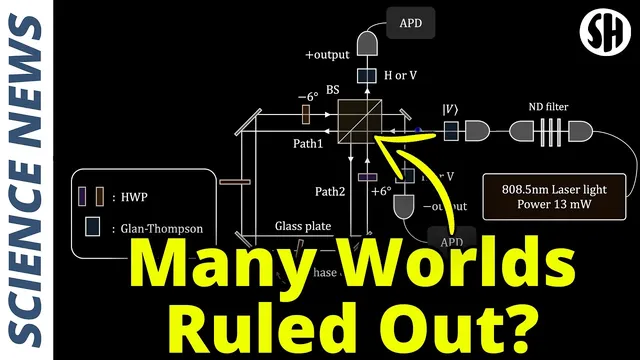
The experiment uses a Mach–Zehnder interferometer tuned so one output port is bright and the other is dark via constructive/destructive interference.
Briefing
A Hiroshima experiment using a Mach–Zehnder interferometer with “weak measurements” has been promoted as evidence against the many-worlds interpretation of quantum mechanics—so strongly that some coverage framed it as potentially “destroying the multiverse.” The core claim is that the experiment lets researchers infer which path a photon took in a way that makes the particle’s “past” depend on which polarization measurement is performed later. That’s a provocative idea, because many-worlds is often portrayed as requiring multiple universes to coexist when outcomes are possible.
The experimental setup starts with a standard interferometer: an incoming photon is split into two paths and then recombined. The path lengths are tuned so that one output port is bright (constructive interference) and the other is dark (destructive interference). Crucially, this interference pattern persists even when photons are sent one at a time, which already demonstrates that the photon’s behavior must be coherent across both arms.
To go further, the researchers insert a polarization-twisting plate in each arm. The twist is tiny—small enough to preserve the interference—so the polarization measurement becomes a “weak measurement” of which path information is being imprinted without fully destroying the interference. After recombination, the team measures both where the photon exits (bright vs dark port) and the polarization state. They report that in the normally bright port, the polarization effects can cancel in a way they interpret as evidence the photon traversed both paths. They also observe photons in the dark port and attribute this to an unusual accounting described as a “negative fraction of a photon” in one arm.
The dispute centers on interpretation rather than instrumentation. The strong “past depends on future measurements” framing comes from looking at only one output port at a time: if one detector is used, the photon is said to have gone both paths; if the other detector is used, the photon is said to have followed the alternative story involving the negative fraction. A more conservative reading is that each output port simply corresponds to different physical outcomes—one port collects photons consistent with one effective behavior, while the other port collects photons consistent with another—without requiring that the photon’s earlier history was rewritten by later choices.
The many-worlds interpretation itself treats the key event as what happens at measurement: when outcomes become definite, branches form. In that framework, a photon can still take multiple paths in the same universe until a measurement forces an outcome. From that perspective, the experiment’s interference results are not a contradiction but a demonstration of how coherence and measurement interact. The experiment may be technically sound, but the leap from “weak measurement plus interferometer statistics” to “many-worlds is ruled out” is presented as an overreach driven by misunderstanding of what many-worlds is actually claiming at the moment of measurement.
Cornell Notes
An experiment in a Mach–Zehnder interferometer uses tiny polarization twists in each arm (a “weak measurement”) while keeping the interference between paths intact. Researchers then measure both the output port (bright vs dark) and the polarization to argue that the photon’s effective “past” depends on which future measurement is performed. The reported cancellation in the bright port is treated as evidence the photon went through both paths, while counts in the dark port are explained via a “negative fraction of a photon.” A critical counterpoint is that output ports correspond to different outcome classes, and that inferring “past dependence” from which detector is considered misreads how interpretations like many-worlds handle measurement and branching.
What does the Mach–Zehnder interferometer do in this experiment, and why does it matter that it works with single photons?
How do the “weak measurements” work here, and what role do the polarization-twisting plates play?
Why do the researchers interpret polarization cancellation in the bright port as evidence the photon went through both paths?
What is meant by “negative fraction of a photon,” and how is it used to explain detections at the dark port?
Why does the “past depends on future measurements” claim hinge on looking at only one output port?
How does the many-worlds interpretation fit with a photon producing both-path interference in this setup?
Review Questions
- What experimental feature makes it possible to infer that a single photon must interfere across both interferometer arms?
- How does adding tiny polarization twists enable “weak measurement” without fully destroying interference?
- What interpretive step turns detector-conditioned statistics into a claim that the photon’s past depends on future measurement choices?
Key Points
- 1
The experiment uses a Mach–Zehnder interferometer tuned so one output port is bright and the other is dark via constructive/destructive interference.
- 2
Single-photon interference already implies coherent behavior across both arms, not a purely classical single-path trajectory.
- 3
Tiny, opposite polarization twists in each arm act as a weak measurement that preserves interference while adding partial path information.
- 4
Observed polarization cancellation in the bright port is used as evidence for contributions from both paths.
- 5
Some detections in the normally dark port are explained using a “negative fraction of a photon,” a modeling choice that is central to the interpretation.
- 6
The strongest “past depends on future measurements” claim relies on conditioning on which output port is used in the reasoning, which can be challenged as an overreach.
- 7
A critique argues that many-worlds concerns what happens at measurement (branching into outcomes), so the interference results do not automatically rule it out.