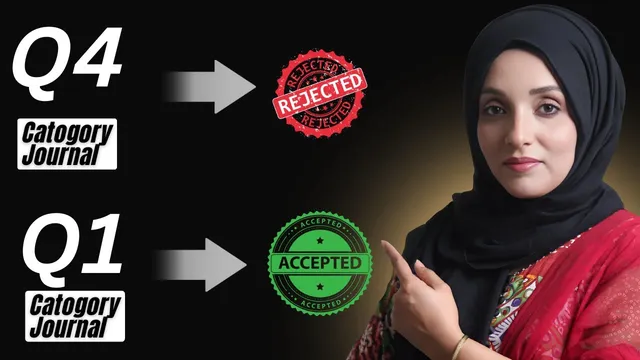
This FREE AI Tool Help me to write a Paper for Q1 Category Journal
Based on Dr Rizwana Mustafa's video on YouTube. If you like this content, support the original creators by watching, liking and subscribing to their content.
Use free AI tools to audit every major manuscript section—title, abstract, introduction, problem statement, research questions, literature review, methodology, results/discussion, and conclusions.
Briefing
Getting a paper rejected from Q3/Q4 journals repeatedly often comes down to weak structure, generic framing, and limited critical analysis—not just the underlying topic. The workflow presented here uses free AI tools to audit every major section of a manuscript (title, abstract, introduction, problem statement, research questions, literature review, methodology, results/discussion, and conclusions) and then generates targeted revision instructions aimed at meeting Q1 expectations.
The process starts by uploading a previously rejected manuscript to a free AI tool (the transcript mentions ChatGPT and Google Gemini as two options). The same instruction is fed to each tool: identify what prevents Q1 acceptance and recommend concrete changes for each section, including what information to add. Example feedback from ChatGPT highlights common Q1-level gaps: a title that is “clear but generic,” an abstract that is missing from the file, and section-level improvements needed to make writing sharper and more specific. The tool also suggests how to restructure the abstract and how to revise the introduction and problem statement—shifting from broad justification toward a clearer summary of the problem. It further calls for strengthening research questions, upgrading literature review quality, and replacing low-quality citations with higher-tier Q1/Q2 journal references.
Gemini’s audit is described as providing section-by-section strengths and weaknesses, along with improvement guidance and even links to relevant pages. The transcript characterizes Gemini’s suggestions as more generic, but still useful for identifying where the manuscript falls short—such as needing clearer focus, stronger structure, and better alignment between the research questions and the review’s purpose.
The most emphasized tool is Google AI Studio, used in a different way because the free model may not support direct file upload. Instead, the entire paper is pasted into the prompt, allowing the model to process unlimited prompt text. The resulting critique is more blunt and higher-level: the manuscript reads like an undergraduate literature review, lacking depth critical analysis and a strong focus. Specific issues include a descriptive rather than analytical tone, repetitive or unclear writing, and research questions that are too broad. The guidance then turns into actionable direction: narrow the scope, move beyond merely reviewing “state techniques,” and critically evaluate techniques in the context of a specific scientific application (the transcript gives examples such as AI-driven text generation in format analysis and clinical trials, including opportunities and challenges).
Google AI Studio also recommends rewriting the paper’s conceptual backbone: prioritize new insights, synthesize existing knowledge in a novel way, identify gaps, compare and contrast prior work, and connect those gaps to sharper research questions. It flags additional quality requirements such as improved writing flow, deeper methodological coverage, and explicit attention to ethical implications—covering bias, transparency, accountability, authorship, and intellectual property. The transcript frames the outcome as a practical path to upgrade a manuscript from Q4 toward Q2/Q3, and potentially Q1 for experienced writers, by iterating through these targeted revisions.
Beyond journal acceptance, the transcript extends the same AI-driven approach to thesis-to-paper conversion and publication planning—using AI to brainstorm multiple publication angles and to restructure work into several papers. It also promotes a longer course and a playlist of AI tools for research, positioning AI as a support system for writing, brainstorming, and overcoming being stuck at different stages.
Cornell Notes
The transcript lays out a section-by-section AI workflow for upgrading a rejected manuscript toward Q1 journal standards. Free tools like ChatGPT and Google Gemini can audit titles, abstracts, introductions, problem statements, research questions, literature reviews, and citation quality, producing concrete revision instructions (e.g., make the title less generic, add or restructure the abstract, sharpen research questions, and swap low-quality citations for Q1/Q2 sources). Google AI Studio is presented as the most comprehensive option because it can deliver deeper critique when the full paper is pasted into a prompt. Its feedback emphasizes moving from descriptive summaries to critical analysis, narrowing scope to a specific application area, and strengthening methodology and ethical considerations (bias, transparency, accountability, authorship, and intellectual property).
What does the transcript identify as the most common reasons a paper fails to reach Q1-level acceptance?
How does the suggested AI workflow work from start to finish?
What specific Q1-oriented changes are suggested for the title, abstract, and introduction?
How does the transcript define the difference between a descriptive review and a Q1-style critical review?
Why does narrowing scope matter, and what examples are given?
What additional requirements beyond writing quality does Google AI Studio emphasize?
Review Questions
- If your title is “clear but generic,” what kinds of changes should you make to better align it with Q1 expectations?
- How would you revise research questions that are currently too broad, using the gap-and-synthesis approach described in the transcript?
- What ethical elements (bias, transparency, accountability, authorship, intellectual property) should be explicitly addressed when upgrading a manuscript for higher-tier journals?
Key Points
- 1
Use free AI tools to audit every major manuscript section—title, abstract, introduction, problem statement, research questions, literature review, methodology, results/discussion, and conclusions.
- 2
Treat Q1 feedback as actionable: rewrite generic titles, add or restructure missing abstracts, and tighten the problem statement into a clear summary rather than broad justification.
- 3
Upgrade research questions by narrowing scope and tying them directly to identified gaps in the literature, not by keeping them broad.
- 4
Move literature reviews from descriptive summaries to critical analysis: compare and contrast techniques, synthesize novel insights, and explicitly state gaps.
- 5
Replace low-quality citations with Q1/Q2 journal sources to improve scholarly credibility.
- 6
When using Google AI Studio, paste the full paper into the prompt if free upload isn’t supported, then iterate on the detailed section-by-section critique.
- 7
Add methodological depth and address ethical implications explicitly, including bias, transparency, accountability, authorship, and intellectual property.