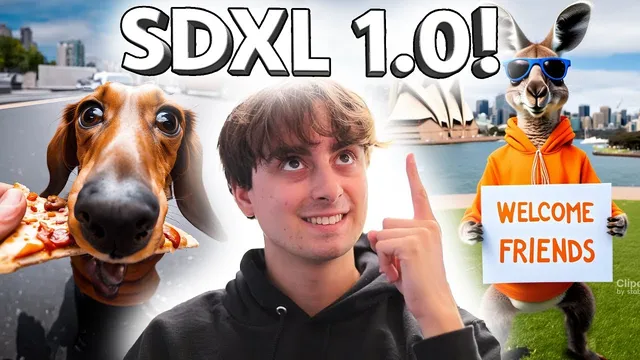
This is a MAJOR Win! Open Source & Uncensored: SDXL 1.0 is OUT!
Based on MattVidPro's video on YouTube. If you like this content, support the original creators by watching, liking and subscribing to their content.
Stable Diffusion XL 1.0’s open-source release enables local image generation for free when users have sufficient GPU VRAM.
Briefing
Stability AI’s release of Stable Diffusion XL 1.0 as fully open source is being framed as a major turning point for AI image generation—because it combines high-end image quality with the ability for anyone to run, modify, and fine-tune the model. The practical impact is straightforward: with sufficient GPU VRAM, users can generate images locally for free, while developers can retrain or extend the base model with add-ons already built for SDXL-style workflows. That openness also keeps the ecosystem moving quickly, with community modifications and new derivatives expected to proliferate.
Early sample outputs emphasized photorealism and fine-grained rendering. Examples highlighted accurate depth-of-field effects (bokeh blur), convincing lighting, and detailed scenes such as a leaping dog on a beach, a close-up of a wiener dog eating pizza in New York streets, and a high-resolution anime-style dog-walking scene. Hands were repeatedly called out as a key quality area: not always perfect, but generally strong enough to compete with top commercial systems. Beyond realism, the model also demonstrated more stylized and fantastical imagery—glowing blue lighting, luminous backgrounds, and creative objects—suggesting SDXL 1.0 is not limited to “photography mode.”
Text generation emerged as one of the most consequential differentiators. Multiple demonstrations showed coherent, readable words on signs, notepads, and even in stylized “coffee art” and cityscape lettering. The transcript contrasts this with Midjourney’s perceived weakness in prompt following and text rendering, claiming Midjourney often captures only a handful of prompt words while the rest drifts, whereas SDXL 1.0 more reliably follows instructions. Community tests reinforced that pattern: “Welcome Friends” appeared clearly in several variations, “police” showed up correctly on a cyber-vest, and longer phrases like “AI for Success” were rendered with strong legibility.
The release also comes with concrete technical and usage details. SDXL 1.0 is described as having a large parameter base—3.5 billion for the base model and 6.6 billion for a larger model—plus a refiner pipeline designed to improve color accuracy, contrast, and fine detail. Generation is presented as faster and capable of 1024×1024 outputs with multiple aspect ratios. For access, the transcript points to several paths: Stability AI’s API (described as low cost per image), Clipdrop (free usage with a queue), DreamStudio (paid, with higher throughput), and Playground AI (free daily generation with tools like image-to-image, inpainting, and canvas-style editing).
Finally, the open-source angle is treated as an industry-level pressure test. Commercial image generators are expected to respond by upgrading their own models, but the transcript argues open access changes the competitive baseline—making top-tier generation cheaper and more customizable. It also notes SDXL 1.0 is “largely uncensored,” with prompt tweaking sometimes producing more extreme outputs, and predicts that within a year the model will remain central as new community modifications and derivatives build on it.
Cornell Notes
Stable Diffusion XL 1.0’s release as fully open source is positioned as a major shift because it lets people run high-quality image generation locally for free (with enough GPU VRAM) and lets developers train or extend the model with add-ons. Sample results emphasized photorealism, strong lighting, and improved detail, with hands described as generally good though not flawless. A standout theme was text rendering: multiple examples showed readable words and phrases on signs, notepads, and stylized surfaces, with the transcript contrasting this with weaker text performance and prompt-following in Midjourney. SDXL 1.0 also includes a refiner pipeline and supports 1024×1024 generation, with access options ranging from Stability AI’s API to Clipdrop, DreamStudio, and Playground AI.
Why does open source matter for Stable Diffusion XL 1.0 beyond cost?
What quality areas did the transcript highlight in SDXL 1.0’s sample images?
How did the transcript evaluate SDXL 1.0’s text generation compared with Midjourney?
What technical details were given about SDXL 1.0’s model size and pipeline?
What are the main ways mentioned to use SDXL 1.0 right now?
What limitations or trade-offs were mentioned when generating 1024×1024 images?
Review Questions
- Which specific SDXL 1.0 capabilities were linked to better text output, and what examples were used to support that claim?
- How does open-source access change what users can do compared with closed image generators (think training, add-ons, and local execution)?
- What role does the refiner pipeline play in the SDXL 1.0 workflow, according to the transcript?
Key Points
- 1
Stable Diffusion XL 1.0’s open-source release enables local image generation for free when users have sufficient GPU VRAM.
- 2
Open-source access also allows training custom models and adding extensions such as DreamBooth-style workflows.
- 3
SDXL 1.0 sample outputs emphasized photorealism, depth-of-field effects, and strong lighting, with hands generally improved but not always perfect.
- 4
Text rendering was presented as a standout strength, with multiple readable sign/phrase examples and a contrast against Midjourney’s perceived text and prompt-following issues.
- 5
The model is described as large-scale (3.5B base and 6.6B with a refiner pipeline) to improve color, contrast, and fine detail.
- 6
Practical usage options include Stability AI’s API, Clipdrop, DreamStudio, and Playground AI, each with different costs, queues, and feature sets.
- 7
Generation speed for 1024×1024 images can be slow on some platforms, even if quality is high.