This is Pathetic.
Based on Second Thought's video on YouTube. If you like this content, support the original creators by watching, liking and subscribing to their content.
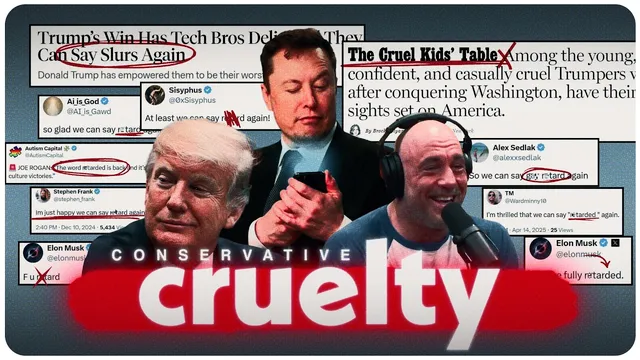
Slurs and dehumanizing rhetoric are framed as in-group signaling that reinforces who belongs and who is excluded, aligning with broader political goals.
Briefing
Conservatives’ sharper, more public cruelty toward marginalized groups is portrayed as more than a cultural mood or “edgy” rhetoric—it’s framed as a coordinated political strategy tied to backlash politics, racial capitalism, and the shrinking of social guarantees for working people. The core claim is that slurs and dehumanizing talk function as in-group signaling while policy actions—especially those targeting DEI and transgender people—work to defund and dismantle public institutions that keep society safer.
A central thread links rhetoric to concrete measures. After Trump’s return to office, multiple actions are described as focusing on transgender people and on groups lumped under the DEI label, including women, Black people, the broader queer community, and people with disabilities. One example given is an internal effort at NSF: employees reportedly received a list of words to watch for in grants, with flagged language potentially leading to termination. The argument is that this kind of gatekeeping at the policy level supports a larger agenda—defunding, deregulating, and gutting agencies—leaving a state that is more focused on policing and protecting wealth than on public welfare.
The transcript then places today’s DEI backlash inside a long American pattern. “Backlash,” often discussed as white backlash, is described as the violent or coercive reversal of progressive gains. Historical examples include Reconstruction-era efforts to exclude Black voters through poll taxes, literacy tests, and all-white primaries; later backlash against the civil rights movement, the women’s movement, and gay rights. The mechanism changes—gerrymandering, voter ID laws, judge appointments, the war on drugs, and the dismantling of affirmative action—but the purpose remains: block material equality and preserve hierarchy.
A key analytical move is that backlash rarely follows real loss of privilege. Instead, it’s driven by fear that equality will invert the hierarchy. The transcript argues that this fear is rooted in racial capitalism: capitalism uses racial categories to sort people into “deserving” and “undeserving” groups, with the “deserving” receiving better jobs, status, and safety nets. As direct discrimination against some groups becomes less socially acceptable, the target shifts—immigrants are described as a more permissible outlet. The claim is that both Democratic and Republican administrations have pursued harsh immigration enforcement, including asylum restrictions and detention, while also expanding border policing.
DEI is treated as a symbol that threatens the psychological safety of the in-group. Even if DEI doesn’t restructure wealth or power at scale, it signals that status protections may be slipping. That perceived slippage, combined with broader economic precarity—gig work, weak healthcare, and debt-heavy higher education—is said to fuel anger that conservatives redirect away from billionaires and toward racialized outsiders. Within that frame, slurs are not just “fun” or “lame”—they are a way to define who belongs, who is out, and who is “one of the good ones,” reinforcing a movement identity built on cruelty.
The transcript closes by arguing that neoliberalism leaves everyone vulnerable, including conservatives, and that believing the fantasy of being spared can be enough to justify cruelty in the short term—until the chopping block expands again.
Cornell Notes
The transcript argues that today’s conservative cruelty—especially slurs and attacks on DEI—is part of a long backlash tradition rather than a spontaneous cultural reaction. It links rhetoric to policy actions that target transgender people and other groups labeled under DEI, including an NSF-related effort to flag grant language for possible termination. Historically, backlash has used changing legal and political tools (poll taxes, literacy tests, gerrymandering, voter ID laws, judge appointments, and dismantling affirmative action) to block equality gains. The deeper driver is framed as fear produced by racial capitalism: people are sorted into “deserving” and “undeserving” groups, and when social status protections feel threatened, anger is redirected toward outsiders like immigrants. Slurs then function as in-group signaling—proof of who is “good” and who is “out.”
How does the transcript connect casual slurs to actual political power?
What examples are used to show DEI backlash operating through policy, not just culture?
Why does the transcript say backlash is historically recurring rather than triggered by “left went too far” claims?
How does the transcript explain why immigrants become a frequent target?
What role does economic precarity play in the backlash story?
What is the transcript’s view of DEI’s real-world impact?
Review Questions
- What mechanisms does the transcript claim connect backlash rhetoric (slurs, “edgy” cruelty) to institutional policy changes?
- How does the transcript use historical voter suppression and civil-rights-era backlash to challenge the idea that conservatives react only to “overreach” by progressives?
- According to the transcript, why does DEI become a symbolic trigger even when it doesn’t meaningfully change wealth distribution?
Key Points
- 1
Slurs and dehumanizing rhetoric are framed as in-group signaling that reinforces who belongs and who is excluded, aligning with broader political goals.
- 2
Recent actions targeting transgender people and groups labeled under DEI are presented as part of a wider effort to defund and dismantle public agencies.
- 3
An NSF example is cited: employees reportedly received a list of words to flag in grants, with potential termination tied to the flagged language.
- 4
Backlash is described as a recurring American pattern used to block equality gains, using evolving tools like poll taxes, literacy tests, gerrymandering, voter ID laws, and judge appointments.
- 5
The transcript argues backlash is driven more by fear of losing hierarchy than by any actual loss of privilege.
- 6
Racial capitalism is presented as the underlying system that sorts people into “deserving” and “undeserving” categories, with immigrants portrayed as a politically convenient target.
- 7
Economic precarity and shrinking social guarantees are described as feeding anger that conservatives redirect toward marginalized outsiders rather than wealthy decision-makers.