This is the natural disaster to worry about
Based on Veritasium's video on YouTube. If you like this content, support the original creators by watching, liking and subscribing to their content.
Rubber’s “heat shrink” behavior comes from polymer-chain dynamics: warming increases the tendency of stretched chains to kink back into a contracted state.
Briefing
Heating a rubber band should, in principle, weaken most materials—but rubber does the opposite: it contracts and pulls harder when warmed. That counterintuitive behavior comes from rubber’s molecular structure and its “elastic memory.” Rubber is made of long polymer chains that are normally coiled and jostled by heat and small molecules like trapped water and air. Stretching straightens those chains, but when the stress is released, constant molecular bombardment and chain “kinks” restore the original shape. Add heat and the chains vibrate faster, increasing the tendency to kink back—so the rubber snaps tighter.
Rubber’s elasticity also depends on how its monomers are arranged. In natural rubber, monomers attach in a “cis” configuration that favors a folded, ribbon-like wiggle. When pulled, polymer chains align first, then each chain unfolds, making rubber unusually stretchable. When the force stops, the system returns from an improbable, highly aligned state to a more probable, wiggly one. This same hydrophobic carbon-and-hydrogen backbone helps explain why rubber is naturally waterproof, while its tendency to lose shape under temperature extremes explains why raw rubber alone isn’t enough for modern life.
The breakthrough that made rubber industrially reliable was vulcanization—cross-linking polymer chains so they resist heat, cold, and permanent deformation. In the 1830s, Charles Goodyear experimented after repeated failures with sticky, unstable rubber. His key discovery came when a sulfur-treated piece of rubber accidentally hit a hot stove: instead of melting, it charred and hardened into a flexible material that stayed workable in cold and hot conditions. Chemically, sulfur rings break under heat and form bridges between rubber chains by bonding to carbon atoms on different chains. Those cross-links prevent melting in summer, reduce brittleness in winter, and make rubber stronger and more elastic. The degree and length of cross-links can be tuned: more cross-linking yields stiffer rubber for tires and shoe soles; different link structures improve weather resistance or allow greater stretch for medical uses.
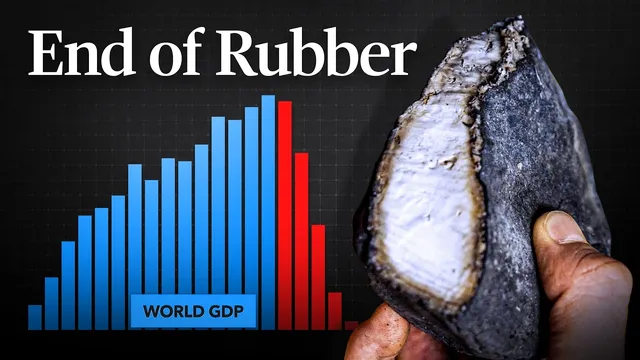
Industrial demand then turned vulcanized rubber into a global dependency—especially for tires, which consume most natural rubber. That dependence carries a strategic risk because natural rubber is concentrated in a few regions and vulnerable to disease. The South American leaf blight (SAL) devastated rubber plantations in Brazil, including Henry Ford’s Fordlândia project, where tightly packed monocultures spread infection like a “plague.” With Southeast Asia relying heavily on cloned rubber trees descended from seeds smuggled to England, a single outbreak there could sharply cut supply. The stakes extend beyond consumer products: without rubber, transportation systems falter, military mobility suffers, and even urban food logistics could be disrupted.
The transcript also traces how synthetic rubber partly reduced risk—especially during World War II when Japan cut off access to natural rubber—but synthetic substitutes don’t fully replicate natural rubber’s performance in demanding conditions like airplane tires. Newer alternatives, including nitrile gloves and alternative natural rubber crops such as guayule, address specific weaknesses like latex allergies and supply fragility. The central warning is clear: rubber’s molecular advantages and industrial importance are inseparable from supply-chain and biosecurity realities, and the world has repeatedly underestimated how quickly a “single point of failure” can cascade into societal disruption.
Cornell Notes
Rubber’s unusual behavior—getting stronger and shrinking when heated—comes from how its polymer chains respond to heat and stretching. When rubber is warmed, molecular motion increases the tendency of chains to kink back into a contracted state, and the cis structure of natural rubber supports a folded “wiggle” that drives elasticity. Raw rubber is too temperature-sensitive and sticky, so vulcanization was developed to cross-link chains using sulfur and heat, creating a network that resists melting and brittleness. That chemistry underpins modern tires, seals, and medical materials, but it also creates a strategic vulnerability because natural rubber supply is concentrated and disease-prone. A major outbreak such as South American leaf blight in Southeast Asia could trigger large-scale production shortfalls with cascading effects on transport and daily life.
Why does heating a rubber band make it contract instead of weaken?
What molecular feature gives natural rubber its extra stretch?
How does vulcanization change rubber’s temperature stability and strength?
Why is natural rubber supply considered a national-security risk?
How do synthetic rubbers differ from natural rubber in performance?
What’s the role of crystallization in natural rubber’s toughness?
Review Questions
- What physical and molecular mechanisms explain why rubber contracts when heated?
- Describe how sulfur cross-linking during vulcanization changes rubber’s behavior in both hot and cold conditions.
- Why does reliance on cloned rubber trees increase the risk of large-scale supply disruptions from a fungal outbreak?
Key Points
- 1
Rubber’s “heat shrink” behavior comes from polymer-chain dynamics: warming increases the tendency of stretched chains to kink back into a contracted state.
- 2
Natural rubber’s cis monomer attachment favors a folded chain wiggle, enabling large stretch and reliable snap-back after release.
- 3
Raw natural rubber fails industrial needs because it is highly temperature-sensitive and can become sticky or brittle; vulcanization fixes this by cross-linking chains with sulfur and heat.
- 4
Cross-link density and structure determine rubber properties: more cross-links generally mean stiffer, more durable rubber; different link lengths can improve weather resistance or stretchability.
- 5
Natural rubber supply is concentrated and disease-prone; a major outbreak like South American leaf blight in Southeast Asia could trigger global transportation and food-distribution shocks.
- 6
Synthetic rubber reduces dependence but doesn’t fully replace natural rubber in every high-demand application, such as airplane tires where crystallization-driven toughness matters.
- 7
Alternative materials and crops (like nitrile gloves and guayule rubber) address specific weaknesses—latex allergies and supply fragility—while adding resilience to the overall system.