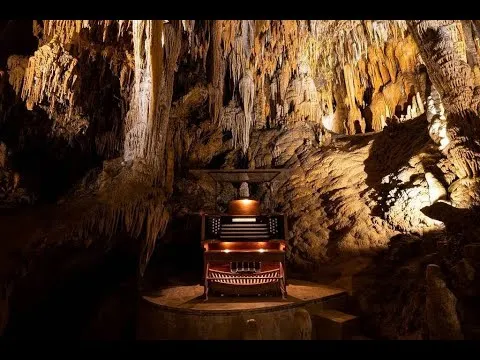
This Is the Oldest, Weirdest Instrument On Earth
Based on Veritasium's video on YouTube. If you like this content, support the original creators by watching, liking and subscribing to their content.
The Great Stalacpipe Organ is a lithophone that uses tuned stalactites as the sound source inside Luray Caverns.
Briefing
A limestone cave in Luray, Virginia houses the Great Stalacpipe Organ—an unusual “organ” that turns naturally formed stalactites into musical notes using electromechanical mallets, steel bolts, and electric guitar pickups. The instrument spans about three and a half acres of cave space, with notes distributed across the chamber so that players and listeners effectively stand inside the instrument rather than in front of it. It matters because it demonstrates how physics, geology, and mid-20th-century engineering can be fused into a playable system without replacing the cave’s natural material.
The project began in the 1950s after Leland Sprinkle, a mathematician who worked at the Pentagon, noticed a guide tapping stalactites with a small mallet during a tour. Sprinkle’s three-year effort culminated in the organ’s first performance in 1957, following work that started in 1954. The tuning process was painstaking: stalactites were climbed and tested with mallets and tuning forks, then ground down with a disc grinder until each selected stalactite reached a target pitch such as middle C. The cave’s geology sets the constraints. Stalactites form slowly—about 16 cubic centimeters every 120 years in this cave—driven by slightly acidic water that dissolves limestone underground and redeposits it as droplets reach air. Over thousands of years, stalactites and stalagmites can fuse into columns, meaning the “instrument” is literally still growing.
Once tuned, the organ uses a solenoid-based mechanism: custom brackets hold electrically operated plungers with rubber tips that strike the stalactites to set them vibrating at their resonant frequencies. Because the notes are spread out and their volume varies, Sprinkle amplified the vibrations rather than relying on microphones. In a key engineering twist, he borrowed the principle behind electric guitar pickups—coils of wire wrapped around magnets that detect vibrations in the presence of ferromagnetic material. Each musical stalactite received a steel bolt, allowing the pickup to sense its motion; the resulting signals are amplified, mixed, and routed to speakers.
That design also produced an unexpected side effect: radio interference. One key reportedly picked up a local AM station, turning the cave’s sound system into a kind of accidental sampler—an effect that can happen with electronic instruments, even in underground spaces. Despite the cave’s slow growth and occasional changes in water flow, caretakers say they have never had to retune the organ. The stalactites were chosen to be inactive enough to hold pitch, and while minor growth can come and go, the system has stayed in tune so far.
The result is an instrument with a haunting acoustic character—deep reverb, pure tones, and notes that seem to come from different distances within the chamber. It also reframes the cave itself: a place once used for dances and balls in the ballroom area now functions as a living, resonant map of limestone tuned to music.
Cornell Notes
The Great Stalacpipe Organ in Luray Caverns turns stalactites into musical notes by tuning their resonant frequencies and then striking them with electromechanical plungers. Leland Sprinkle began the project in 1954 after noticing a guide tap stalactites during tours; the organ first played in 1957. Tuning required grinding selected stalactites down to specific pitches, even though they grow extremely slowly (about 16 cubic centimeters per 120 years here). To make the vibrations audible and consistent, Sprinkle added steel bolts and used electric guitar pickups to detect the motion, then amplified and played it through speakers. Radio interference—like picking up an AM station—can occur, but the organ has reportedly never needed retuning because the chosen stalactites were selected to be inactive enough to hold pitch.
How do stalactites become specific musical notes instead of random cave sounds?
What mechanism physically strikes the stalactites during performance?
Why were electric guitar pickups used, and what makes them work here?
What problem did the pickup system create, and what did it sound like?
How does ongoing cave growth threaten tuning, and why hasn’t retuning been required?
Review Questions
- What physical properties of stalactites determine their resonant frequency, and how did tuning change those properties?
- Explain the signal chain from cave vibration to audible sound in the organ, including the role of steel bolts and guitar pickups.
- Why does radio interference happen in electronic instruments like this one, and what evidence of it appears during demonstrations?
Key Points
- 1
The Great Stalacpipe Organ is a lithophone that uses tuned stalactites as the sound source inside Luray Caverns.
- 2
Leland Sprinkle’s project ran from 1954 to 1957, turning a cave tour observation into a full-scale instrument.
- 3
Stalactites were manually tuned by grinding them down to target pitches after testing with mallets and tuning forks.
- 4
Electrically operated plungers strike the stalactites, while steel bolts and electric guitar pickups detect their vibrations for amplification.
- 5
The system can pick up radio stations, with at least one key reportedly sampling an AM broadcast due to interference.
- 6
Despite the cave’s slow but continuous growth, the organ has reportedly never needed retuning because selected stalactites were chosen to be inactive enough to hold pitch.