THIS IS THE REAL VIBE CODING
Based on The PrimeTime's video on YouTube. If you like this content, support the original creators by watching, liking and subscribing to their content.
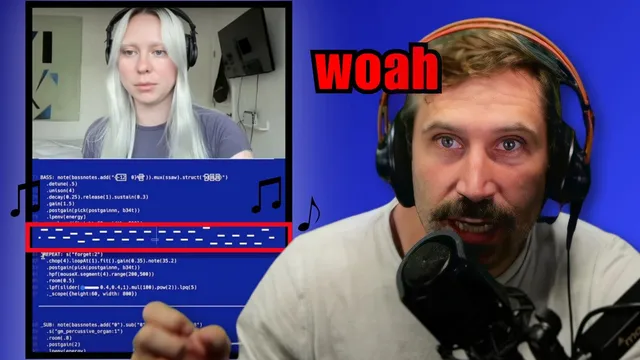
Vibe coding is presented as live music performance driven by code edits that update sound and visuals in real time.
Briefing
Live “vibe coding” is presented as a way to compose and perform music directly in a code-like environment where sound, visuals, and interaction update in real time. The core appeal is immediacy: musical loops, drum patterns, synth layers, and vocal samples can be triggered and reshaped while the performer watches code elements move, edits land instantly, and the result stays tightly connected to performance gestures—especially mouse-driven effects.
A recurring workflow shows up across the examples: projects are organized with similar building blocks (drum section, bass loop, synth loops, vocals, and an effect that responds to mouse movement). Samples can be loaded locally or pulled from GitHub, letting performers swap in new material without leaving the live coding flow. One highlighted environment is Strudel.cc, described as a web-based setup for “long living coding,” and the transcript notes that a specific Strudel repository was archived shortly before the session—an abrupt reminder that these creative tools and repos can change quickly.
The performance itself leans on tight musical control. A visible variable is used to shape the kick drum and simultaneously drive sidechain behavior across other instruments, so bringing in the kick can compress or duck the rest of the mix in sync. Additional processing includes low-pass and high-pass filters, and the performer demonstrates how drops and returns of the kick can create dramatic rhythmic tension. The system also supports live editing: notes and patterns appear to update on a measure boundary, with the transcript speculating about a possible one-measure delay when changes appear to land slightly after the mouse movement.
Beyond the mechanics, the transcript frames vibe coding as a “new arc” for someone who misses playing music—particularly bass guitar. The performer compares thinking in guitar terms (scales, positions, translation into notes) with the demands of note-based coding, suggesting a learning curve but also a strong motivation to return to music through this medium. The excitement extends to tooling and experimentation: there’s talk of using AI to generate code patterns, imagining plugins (including a Neoim plugin), and even testing whether the environment can run Doom—already done in both a “ASI version” and a “real version,” according to the transcript.
The session ends with identification of the live performer as DJ Dave (with the transcript also mentioning “Switch Angel” as a possible name), and a reference to DJ Dave performing at GitHub Universe 2020. The overall takeaway is that vibe coding turns programming into an instrument: it merges coding literacy with DJ-style performance control, making documentation reading feel urgent and life-affirming rather than tedious.
Cornell Notes
Vibe coding is portrayed as a live, interactive way to compose and perform music by editing code-like structures while sound and visuals react immediately. A typical setup includes drum patterns, bass and synth loops, vocal samples, and mouse-controlled effects, with samples sourced locally or via GitHub. One standout technique uses a single variable to control the kick drum and apply sidechain compression across other instruments, creating rhythmic “ducking” in real time. Live edits appear to take effect on a measure boundary, and additional filters (low-pass/high-pass) shape the sound during performance. The approach is also framed as a path back to music for someone who misses playing bass guitar and wants a new way to think musically.
What makes “vibe coding” feel different from traditional music production or coding?
How does the transcript describe controlling sidechain and drums together?
What role do samples and GitHub play in the workflow?
How do live edits appear to take effect—immediately or with timing constraints?
Why does the transcript connect vibe coding to returning to playing music (like bass guitar)?
What additional experiments and capabilities are mentioned beyond music loops?
Review Questions
- What components (drums, bass, synths, vocals, effects) are described as common building blocks in the vibe-coding projects?
- How does the kick drum variable affect sidechain behavior across other instruments, and why does that matter musically?
- What timing behavior is suggested when live edits occur—instant changes or measure-locked updates?
Key Points
- 1
Vibe coding is presented as live music performance driven by code edits that update sound and visuals in real time.
- 2
Common project structure includes drums, bass loops, synth loops, vocals, and mouse-reactive effects for stage control.
- 3
A single variable can simultaneously control the kick drum and apply sidechain compression to other instruments, tightening the groove.
- 4
Live edits appear to take effect around musical boundaries, with at least some changes showing a measure-level timing behavior.
- 5
Samples can be loaded locally or from GitHub, enabling rapid iteration during performance.
- 6
The approach is framed as a motivating route back to music for someone missing bass guitar, despite a learning curve in note-based thinking.
- 7
The transcript links vibe coding to broader experimentation (AI-assisted generation, Neoim plugins, and even running Doom).