This Is Why Electric Vehicles Are Struggling
Based on Sabine Hossenfelder's video on YouTube. If you like this content, support the original creators by watching, liking and subscribing to their content.
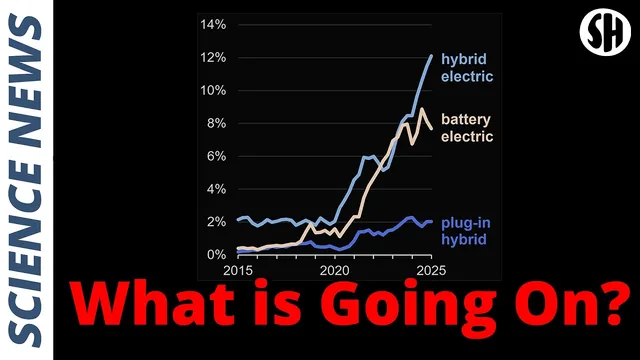
Hybrid and plug-in hybrid sales are rising in the U.S., Germany, and across Europe even as battery-electric and plug-in shares remain relatively flat.
Briefing
Electric vehicles are growing, but the shift has been slower than many forecasts promised—pushing buyers and policymakers toward hybrids as a practical hedge while grid upgrades and pricing catch up. Recent sales headlines across the United States, Germany, and Europe point to hybrids gaining ground even as battery-electric and plug-in shares stay comparatively flat. In Europe, hybrids dominate in most EU markets, with notable exceptions such as Norway and Iceland, where battery-electric adoption has been stronger.
A key reason for the hybrid tilt is that “hybrid” often means something different from battery-electric: conventional hybrids typically use small batteries charged by a gasoline engine, so they don’t always get counted alongside battery-electric vehicles in market statistics. Plug-in hybrids add a larger, externally chargeable battery and can cover meaningful all-electric driving range, and they are also rising in places like Germany, China, and Australia. Together, these categories let consumers reduce fuel use without waiting for the full buildout of charging networks and power-system upgrades.
Battery costs have fallen sharply over the past 15 years, yet electric vehicle prices—at least in the U.S.—haven’t dropped as expected. One speculation cited from a Nature comment is that EVs are still marketed as luxury products, allowing manufacturers to maintain higher prices because affluent buyers are less sensitive to cost. Even so, the economics remain tough: EVs are described as largely loss-making ventures, which complicates the path to broad affordability.
Infrastructure constraints are another major drag. A review article summarized the grid stress that higher EV charging loads can create, including transformer overloads, frequency distortions, voltage instability, grid congestion, and efficiency declines. The international energy agency has warned about these issues for years, and the transcript argues that grid upgrades are not arriving quickly enough. If that gap persists, governments may eventually restrict where and when people can charge—an outcome framed as predictable rather than surprising.
Against that backdrop, hybrids are presented as a consumer strategy for uncertainty: whether energy-transition policies tighten or loosen, and whether the charging-and-power system can scale fast enough, a hybrid can keep working. The broader claim is not that EVs are wrong—combustion engines are still treated as effectively doomed—but that enthusiasts underestimate how long it takes to replace fossil-fuel-centered infrastructure. That timing problem also underpins skepticism toward “net zero” plans that rely on rapid deployment of multiple technologies at once, including heat pumps, carbon capture, and hydrogen.
The transcript’s bottom line is a call for time-buying capacity: nuclear power is argued to be an existing, proven option that could help bridge the gap, despite concerns about safety, non-renewability, and waste. The core message is that transforming energy systems is slower than models assume, and the market is already adjusting to that reality through hybrids while the grid catches up.
Cornell Notes
Electric vehicle adoption is rising, but the transition is moving slower than forecasts predicted. Hybrid and plug-in hybrid sales are increasing in multiple regions, especially across Europe, where hybrids dominate most EU markets except Norway and Iceland. The transcript points to two bottlenecks: EV pricing hasn’t fallen as much as battery costs have, and charging demand risks stressing the power grid unless upgrades arrive quickly. Because grid expansion and policy shifts are uncertain and slow, hybrids are framed as a hedge that can remain viable for years. The discussion also argues that infrastructure change takes longer than “net zero” plans often assume, leading to support for nuclear power as a time-buying measure.
Why are hybrids gaining traction even while EV use grows globally?
What explains the gap between falling battery prices and not-so-falling EV prices?
How does EV charging strain the electricity grid?
What role do grid upgrades and government policy play in the transition timeline?
Why does the transcript treat hybrids as a “hedge” against transition uncertainty?
What is the rationale for supporting nuclear power in this framework?
Review Questions
- What specific grid problems can EV charging create, and why do they imply a need for faster infrastructure upgrades?
- How do conventional hybrids and plug-in hybrids differ in battery size and charging needs, and how does that affect market adoption?
- Why does the transcript claim EV pricing has not tracked battery cost reductions, and what evidence or speculation is offered?
Key Points
- 1
Hybrid and plug-in hybrid sales are rising in the U.S., Germany, and across Europe even as battery-electric and plug-in shares remain relatively flat.
- 2
Conventional hybrids typically rely on small batteries charged by a gasoline engine, which changes how they’re counted versus battery-electric vehicles.
- 3
EV pricing has not fallen as much as battery costs have, with one speculation being luxury-oriented marketing that supports higher margins.
- 4
Grid constraints—transformer overloads, frequency distortions, voltage instability, congestion, and efficiency declines—could force charging limits if upgrades lag.
- 5
Because grid expansion and policy shifts are uncertain and slow, hybrids function as a practical hedge during the energy transition.
- 6
Infrastructure replacement takes longer than many “net zero” roadmaps assume, motivating support for time-buying power sources such as nuclear despite known drawbacks.